
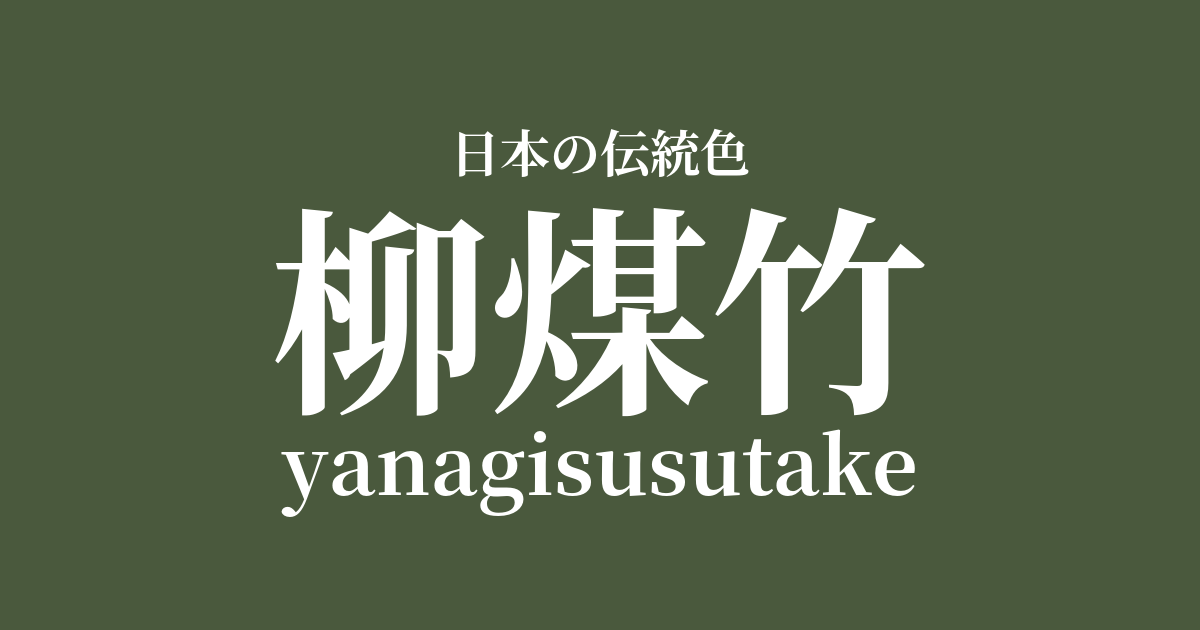
| Japanese color name | willow soot bamboo |
|---|---|
| reading | yanagisusutake |
| HEX | #4A593D |
| RGB | 74, 89, 61 |
What is Yanagi-sutake? Origin and etymology
Yanagisusutake, as its name suggests, is a composite color name combining "yanagi-iro" (willow green) and "susutake-iro" (soot bamboo green). Yanagi-iro refers to a bright yellowish-green like willow leaves, evoking the vitality of spring. Susutake-iro, on the other hand, is the color of bamboo that has been smoked for many years by the smoke from the hearths and stoves of old farmhouses, representing a subdued reddish-brown or dark yellowish-brown. By combining these two colors, the youthfulness of willow is combined with the depth and calmness of soot bamboo, creating a unique, subdued, muted green.
It is said to be one of the colors that originated from the Edo period people's aesthetic sense of appreciating subtle differences in color.
The origin of this color is deeply rooted in the diverse culture of intermediate colors that developed from the mid-Edo period onward, exemplified by the "48 shades of brown and 100 shades of gray." While sumptuary laws restricted flashy colors, common people found countless variations in subdued colors like brown and gray, and enjoyed this as a form of "chic" or "sophistication."
Yanagi-susutake is a color name that symbolizes the Edo aesthetic, expressing a refined, understated elegance and charm by combining two elements: willow, a natural material, and sooty bamboo, which has been transformed through human life.
Historical background of willow bamboo
Willow-colored bamboo is believed to have been popular from the mid to late Edo period. During this time, the shogunate frequently issued sumptuary laws, restricting the colors of clothing worn by commoners to brown, gray, and indigo. However, it was within these constraints that people developed a new aesthetic sense, creating a culture of enjoying even slight differences in color by giving them names. Willow-colored bamboo is one of the fashionable colors that emerged from this background.
In particular, the colors worn by Kabuki actors became objects of admiration for the common people and sparked fashion trends. For example, "Danjuro-cha," a color favored by Ichikawa Danjuro, and "Hanshiro-nezumi," associated with Iwai Hanshiro, are famous. It is said that willow-colored bamboo was also a color favored by Edo townspeople who were sensitive to fashion trends and by connoisseurs who valued sophistication.
This color, possessing both calmness and understated elegance, embodied the spirit of "ura-massari," where a color is used subtly, such as in the lining of a haori jacket, rather than being overtly conspicuous.
Related literature, waka poetry, and seasonal words
It is difficult to find direct examples of the color name "Yanagi-susutake" (willow-soot-bamboo) appearing in specific classical literature or waka poetry. This color name only became common after the mid-Edo period, and is not found in earlier Heian literature such as "The Tale of Genji." However, the "willow" and "bamboo" that make up this color have long been important motifs in Japanese literature and art.
Willows have been frequently featured in waka and haiku poetry as plants that herald the arrival of spring, and for their graceful form. On the other hand, sooty bamboo is sometimes used as a word to symbolize the wabi-sabi aesthetic of things that have aged over many years, and a quiet life. The color willow sooty bamboo can be said to embody the literary imagery of these two words—namely, the vitality of spring and the subtle beauty that deepens with time—both cultural backgrounds.
Color scheme preview
This is to check the readability of the text when this color is used as the background.
Willow and bamboo color scheme proposal
Aphrodisiac tea (#6A5D4A)
The green of the willow-smoked bamboo and the brown of the drab tea are both muted, earthy colors. Reminiscent of the color schemes found in nature, they create a calm, harmonious, and elegant impression. This combination is well-suited for emphasizing a Japanese aesthetic.
Generated color (#FBF9F4)
The depth and subtlety of the willow-colored bamboo enhance the natural, soft whiteness of the off-white color. It gives a clean and sophisticated impression, making it easy to incorporate into modern Japanese-style designs. The contrast is beautiful, and the colors highlight each other.
Suou (#9E3D3F)
The green tones of willow bamboo and the red tones of sappanwood are almost complementary colors that enhance each other. The classic, deep red of sappanwood adds a touch of vibrancy to the understated elegance of willow bamboo. This creates a stylish and striking color combination that is effective for accessories and as an accent color.
Practical Scenes
In the world of traditional Japanese clothing, willow-colored bamboo is considered a color that embodies the refined elegance of Edo, and is used in kimonos, obi sashes, and haori jackets. It is particularly seen in men's kimonos and in women's komon kimonos favored by connoisseurs, creating a calm and mature look. Its deep, understated color is also used in linings and collars, embodying the aesthetic of "ura-masari," where style is enjoyed in unseen areas.
In interior design, incorporating it into fabrics such as wallpaper, curtains, and cushions brings a sense of calm and Japanese aesthetics to a space. It pairs exceptionally well with natural materials such as wood, bamboo, and washi paper, creating a sophisticated atmosphere not only in Japanese-style rooms but also as an accent color in modern living rooms.
In web and graphic design, smoked bamboo is a suitable color for conveying trustworthiness, tradition, and a sense of luxury. Using it on websites of established businesses, pages showcasing traditional crafts, or menus of Japanese restaurants can enhance brand image. As a background color, it is also pleasing to the eye and gives an elegant impression.