
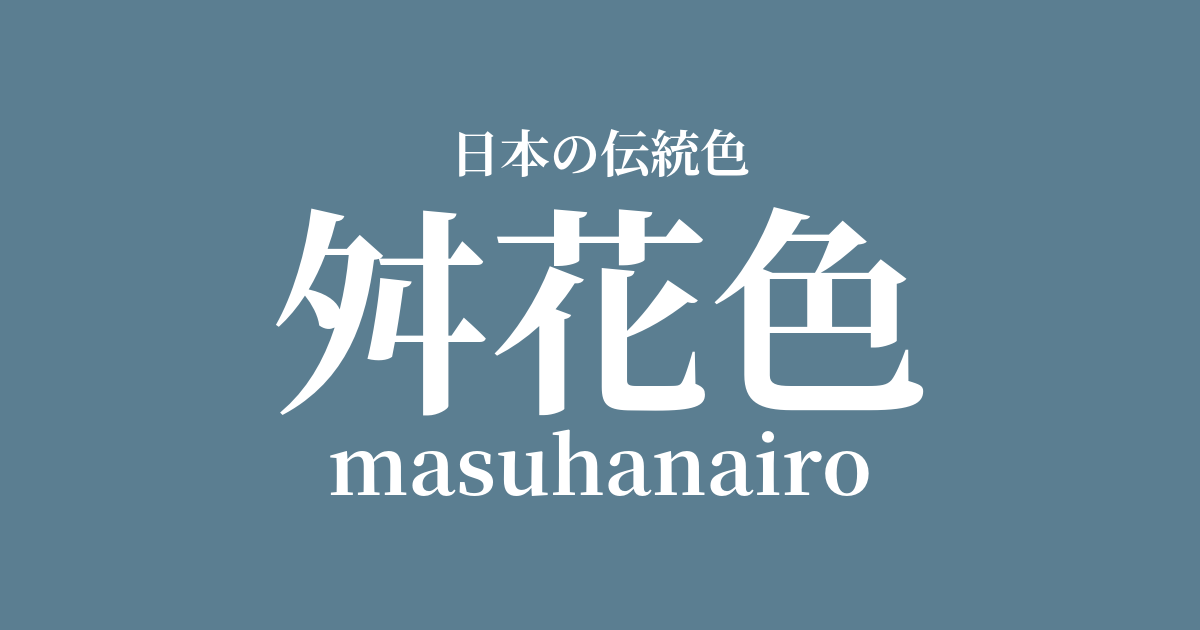
| Japanese color name | Masuhana color |
|---|---|
| reading | masuhanairo |
| HEX | #5b7e91 |
| RGB | 91, 126, 145 |
What is Masuhana-iro? Origin and etymology
Masuhana-iro is known as a color favored by Ichikawa Danjuro V, a popular Kabuki actor of the mid-Edo period. It is said to have been named after his haiku name, "Masuhana." Danjuro favored this greenish-blue color for his stage costumes and in his private life, and it became extremely popular among the common people of Edo as "Masuhana-iro."
This is a prime example of "actor colors," where actors' names are used as color names, illustrating the immense influence of Kabuki actors, who were fashion leaders at the time.
Historical background of Masuhana color
The popularity of the Masuhana color is said to have begun during the An'ei era (1772-1781) in the mid-Edo period. At that time, the immensely popular Ichikawa Danjuro V used this color for the suō (a type of formal robe) in the play "Shibaraku," which sparked its popularity throughout Edo. This color, a calm blue with a slightly greenish tint, set it apart from the indigo dyes of the time and perfectly matched the sophisticated aesthetic sense of the Edo people.
Later, along with other actor-related colors such as "Rokōcha" and "Baikōcha," it became established as a popular color in Edo.
Related literature, waka poetry, and seasonal words
The popularity of Masuhana-iro (a type of reddish-brown color) can be seen in ukiyo-e prints and illustrated books depicting the customs of the Edo period. In particular, costumes in this color frequently appear in actor portraits of Ichikawa Danjuro V. Although no waka or haiku poems that directly mention Masuhana-iro have been identified, it can be said that this color, symbolizing the splendor of Edo townspeople culture and Kabuki, lives on in the background of literary works of the time.
Although it is not designated as a seasonal word, it is thought to have been perceived as a color that evokes a sense of coolness, as it was a popular color for summer kimonos and yukata.
Color scheme preview
This is to check the readability of the text when this color is used as the background.
Masuhana-colored color scheme proposal
Gray (#949495)
This color combination features a shade of gray, one of the "48 shades of brown and 10 shades of gray" that were popular during the Edo period, similar to the Masuhana color. Both are subdued tones, creating a sophisticated color scheme that expresses the "chic" of Edo. It gives a modern and urban impression.
White tea (#b3967d)
The bluish tint of Masuhana green, combined with the warm, bright brown of Shirocha, creates a harmonious interplay of colors. This results in a calm, gentle, and elegant atmosphere, making it ideal for creating a serene and refined space, such as in traditional Japanese clothing or interior design.
Navy blue (#26283c)
By combining it with a darker, deeper iron navy blue than Masuhana color, the overall look becomes more refined, creating a sense of gravitas and dignity. The resulting blue gradient maintains a sense of unity while adding depth to the color scheme. It's well-suited for expressing masculine strength and trustworthiness.
Practical Scenes
Masuhana color, with its calming hue, is still used in a variety of situations today. In traditional Japanese clothing, it remains a popular color for yukata and kimono, and is especially often used for men's kimono and obi. Because it gives a cool and intellectual impression, it is suitable for summer attire.
In interior design, using it as an accent color for wallpaper, curtains, cushions, etc., brings a calm and sophisticated atmosphere to the space. When combined with natural spaces featuring white or wood tones, it easily incorporates a modern and stylish Japanese aesthetic.
In web and graphic design, these colors are often used as corporate colors for companies that want to convey trustworthiness and integrity, or as the main colors for websites. The exquisite shades, neither too flashy nor too plain, offer high visibility and are expected to create a sense of security for users.