
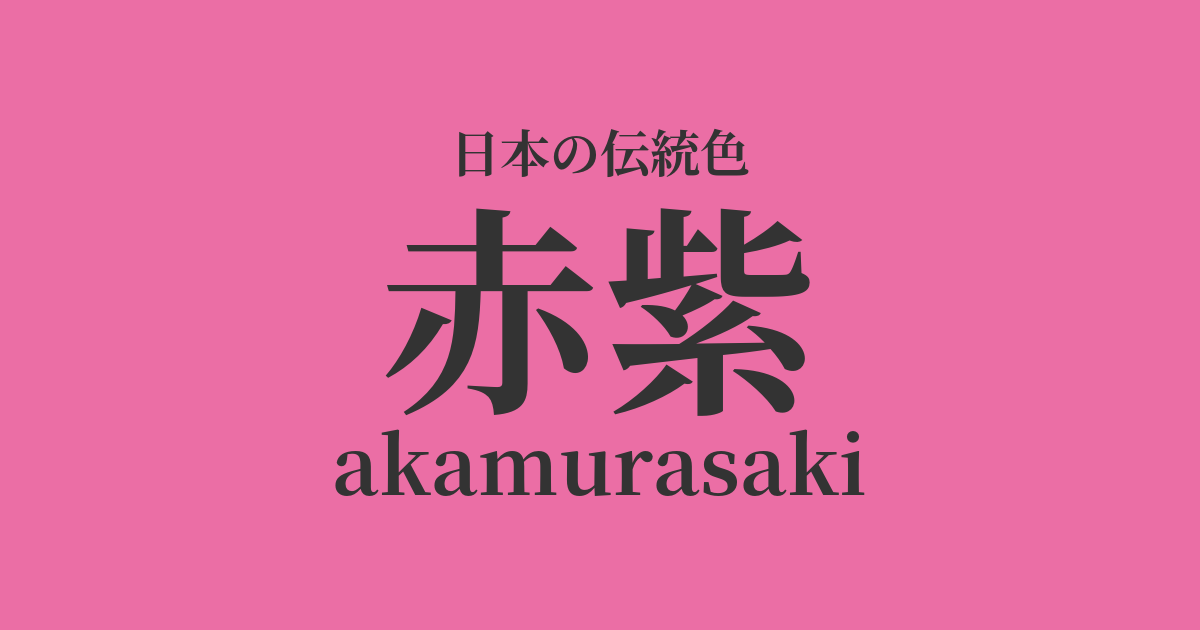
| Japanese color name | reddish-purple |
|---|---|
| reading | akamurasaki |
| HEX | #EB6EA5 |
| RGB | 235, 110, 165 |
What is reddish-purple? Origin and etymology
As the name suggests, reddish-purple is a general term for purple with a reddish tint. The main dye used for this color was shikon, the root of the purple gromwell plant, a member of the Boraginaceae family. The shade of dye produced by shikon changes subtly depending on the type of mordant used and the number of dyeing cycles. It is said that there was a technique to use lye made from camellia ash as a mordant to bring out a stronger reddish tint.
This results in a reddish-purple hue that is different from a bluish-purple, possessing warmth and luster.
There is also a theory that, in order to achieve the reddish-purple hue, the dye was produced by combining not only gromwell root but also safflower. It is believed that by combining the red pigment extracted from safflower with the purple pigment extracted from gromwell root, a more vivid and deep reddish-purple was created. Such ingenuity in dyeing and weaving techniques fostered Japan's rich color culture and became the background for the creation of a wide variety of purple shades.
The historical background of reddish-purple
Purple has long been treated as a noble and special color, as evidenced by its status as the highest-ranking color in the Twelve Levels of Court Rank established by Prince Shōtoku. From the Nara period to the Heian period, dyeing techniques using gromwell root developed, and purple clothing became widely used, especially in the imperial court. In particular, during the Heian period, people's sense of color became more refined, and subtle differences in shades of purple came to be appreciated.
Among the Heian aristocracy, reddish-purple was favored as a color symbolizing love and beauty, known as "purple yuri." Reddish-purple combinations, such as "shion" (aster) and "budou" (grape), can also be seen in the layered color combinations of the uchiki (a type of women's kimono). This color was an important element in the vibrant court culture and is said to have been particularly beloved by women of high social standing.
Related literature, waka poetry, and seasonal words
In "The Tale of Genji," a masterpiece of Heian literature, purple is depicted as a crucial color that forms the core of the story. Fujitsubo no Miya, whom the protagonist Hikaru Genji pursues throughout his life as his ideal woman, and Murasaki no Ue, who embodies her likeness, are both figures symbolized by "purple." While it cannot be definitively stated that the "purple" depicted in the story was specifically reddish-purple, in contexts that evoke passion and sensuality, a reddish-purple is likely to come to mind.
In the world of Japanese poetry, the purple gromwell (Lithospermum erythrorhizon) has often been used as a subject for love poems. For example, because the color of clothing dyed with purple gromwell does not easily fade, it is sometimes used as a symbol of unchanging love. While "reddish-purple" itself is not a seasonal word, "purple gromwell" and the autumn-blooming "aster" (Shion) are seasonal words for autumn, and these words evoke the elegant color of reddish-purple.
On the way to Murasakino, the way to Shimeno, the field guardian does not see you waving your sleeve.
Color scheme preview
This is to check the readability of the text when this color is used as the background.
A proposed reddish-purple color scheme.
Grayish white (#E6E6E6)
This color scheme elegantly enhances the vibrancy of reddish-purple with the refined elegance of grayish-white. The colors harmonize without clashing, creating a sophisticated and modern impression. It's ideal for situations where you want to achieve both calmness and grace.
Light green (#A9D159)
Reddish-purple and light green are close to complementary colors on the color wheel, making each other's colors stand out vividly. The light green, reminiscent of young spring leaves, adds a lively and energetic impression to the lustrous reddish-purple, creating a youthful atmosphere.
Dark color (#634950)
By combining it with a darker, deeper shade of yellow than reddish-purple, a sense of unity and depth is created throughout the color scheme. While maintaining the elegant atmosphere of reddish-purple, it creates a dignified and sophisticated impression, making it a mature color combination for adults.
Practical Scenes
In traditional Japanese clothing, when reddish-purple is used in kimonos such as furisode, houmongi, and iromuji, it has the effect of making the wearer's face appear brighter and more vibrant. By incorporating it as an accent in accessories such as obi, obijime, and han-eri, it can add elegance and sophistication to the entire outfit. It is a color that harmonizes well with a wide range of styles, from classical patterns to modern designs.
In interior design, incorporating reddish-purple into fabrics such as cushion covers, curtains, and rugs brings an elegant and feminine atmosphere to a space. Using it as an accent color on just one wall can tighten up the overall look of the room, creating a dramatic and sophisticated impression.
In web and graphic design, magenta is an effective accent color for areas you want to draw attention to. It's particularly useful on websites targeting women, including beauty and fashion sites, as it conveys a sense of luxury and appeal. It has the power to make a brand image more vibrant and memorable.