
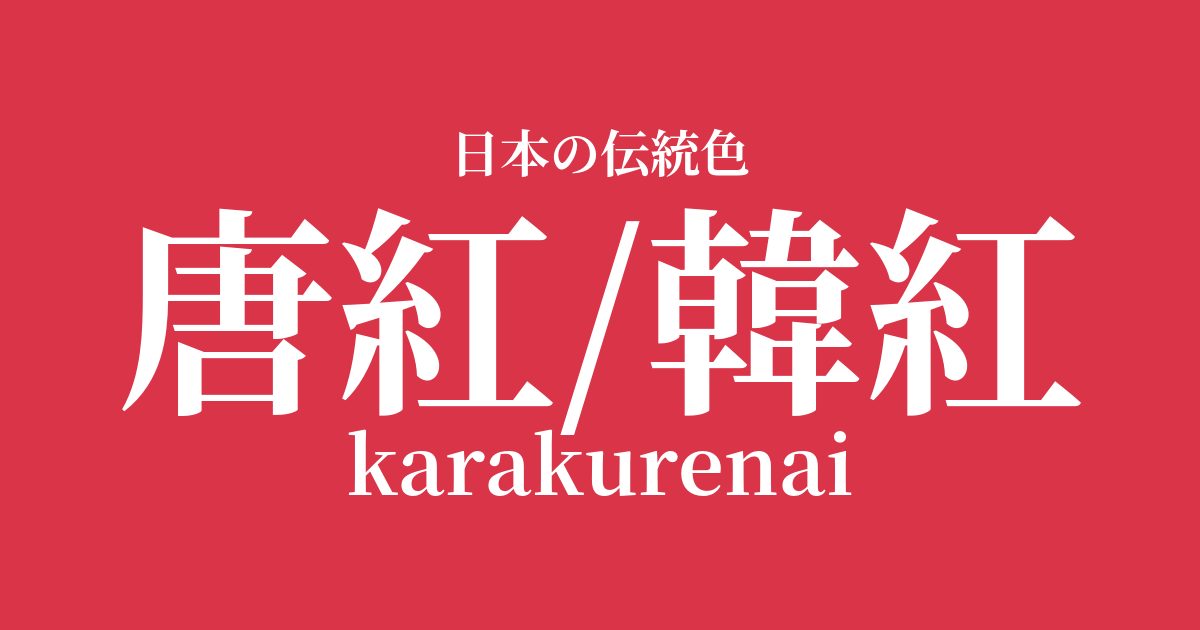
| Japanese color name | Karahong/Hanhong |
|---|---|
| reading | karakurenai |
| HEX | #D93448 |
| RGB | 217, 52, 72 |
- What are "Tang Red" and "Korean Red"? Origin and etymology.
- Historical background of Chinese red and Korean red
- Related literature, waka poetry, and seasonal words
- Color scheme preview
- A proposed color scheme using crimson and Korean red.
- Practical Scenes
- FAQ
- A Japanese color similar to "karakurenai" (Chinese red) or "hanbeni" (Korean red).
What are "Tang Red" and "Korean Red"? Origin and etymology.
Karakurenai is a traditional Japanese color referring to a vibrant red. In ancient Japan, "Tō" and "Kan" referred to foreign countries, particularly China and the Korean Peninsula, while "Kurenai" meant a deep red color dyed with safflower. Therefore, "Karakurenai" signifies a vibrant and precious crimson color dyed using techniques introduced from foreign countries.
The dye used, safflower, is believed to have been introduced to Japan via the Korean Peninsula during the Asuka period. It was highly valued because it could produce a much more vivid red color than the madder dye that had been the dominant dye until then.
Safflower is believed to have originated in Egypt and spread to China via the Silk Road. When it first arrived in Japan, the dyeing technique was highly advanced, and only a small amount of pigment could be extracted from a large quantity of safflower petals, making crimson an extremely expensive color. For this reason, only a select few, such as members of the imperial family and high-ranking nobles, could use it. Due to its rarity and beauty, crimson became more than just a color name; it came to strongly symbolize wealth and power.
Historical background of Chinese red and Korean red
During the Heian period, crimson was considered one of the "forbidden colors," permitted only to those of high social standing. The Engishiki, a compilation of regulations concerning court ceremonies and clothing, records that the wearer's rank was strictly determined by the shade of safflower dye used. In particular, a deep crimson could only be worn by the emperor, members of the imperial family, or those of equivalent status.
This color played an important role as a symbol of the splendor of court culture.
As time passed and the samurai class rose to power, the system of forbidden colors gradually became a mere formality. From the Muromachi period to the Azuchi-Momoyama period, powerful warlords and daimyo sometimes used safflower red in their luxurious clothing to demonstrate their power. Furthermore, in the Edo period, safflower dyeing became popular among wealthy townspeople with economic power, and was especially used in the luxurious uchikake (outer robes) of courtesans, becoming a color that ordinary people aspired to.
Thus, crimson transformed from a color reserved for a privileged few to a color that adorned the culture of the wealthy.
Related literature, waka poetry, and seasonal words
The vibrant color of crimson has captivated the hearts of many poets and writers since ancient times, and its name appears in numerous works. Among them, the most famous is the waka poem attributed to Ariwara no Narihira: "Even in the age of the gods, I have never heard of such a thing as the Tatsuta River dyed crimson." This poem describes the unparalleled beauty of the Tatsuta River's surface, where the autumn leaves dye the water like a crimson tie-dye, and it brought the word "karakurenai" (crimson) to widespread public attention.
This song helped establish "karakurenai" as a word used to describe the beautiful red of autumn leaves.
In Heian period literary works such as "The Tale of Genji" and "The Pillow Book," crimson is frequently depicted as the color of clothing worn by noble figures. For example, the "crimson robes" and "crimson hakama" worn by characters are important elements that convey to the reader the character's high status and beauty, as well as the splendor of the scenes in the story. Through these literary works, crimson has been passed down to future generations not merely as a color representation, but as a color symbolizing the elegant aesthetic sense of the imperial court culture.
Even in the age of the gods, such a thing has never been heard: the Tatsuta River is dyed crimson.
Color scheme preview
This is to check the readability of the text when this color is used as the background.
A proposed color scheme using crimson and Korean red.
Pine green (#3A5340)
The vibrant crimson is complemented by the deep, calming green of pine needles. This creates a classic and dignified impression, and the colors have a complementary relationship, almost like complementary colors. It's a traditional combination often seen in the "layered color combinations" of kimonos.
Bellflower color (#564593)
Both crimson and bellflower purple have a history of being treated as noble colors. The combination of vibrant red and deep bluish-purple creates an elegant and lustrous atmosphere. It is a graceful color scheme reminiscent of the attire of Heian-era nobles.
Blue gold (#FABE22)
Turmeric yellow is a vibrant yellow dyed with turmeric, and like crimson red, it is a plant-derived dye. The combination of warm colors gives a cheerful and festive impression. It is an energetic color scheme that also evokes a sense of Japanese aesthetics.
Practical Scenes
Due to its splendor and formality, karakurenai (a deep crimson red) is still often used for special occasions today. In the world of kimono in particular, it is favored for celebratory attire such as furisode (long-sleeved kimono), uchikake (wedding kimono), and Shichi-Go-San (children's festival) celebratory garments. The vibrant red creates a cheerful atmosphere and pairs well with gold and silver embroidery, highlighting the presence of the main subject. Incorporating it as an accent color in accessories such as obi (sash), obi-jime (sash cord), and han-eri (collar) also has the effect of adding elegance to the entire outfit.
In the fields of interior and product design, karakurenai (a deep crimson red) is used to add a Japanese accent to a space. By using it on one wall of wallpaper, cushions, or noren (traditional Japanese curtains), it can bring warmth and a sense of luxury to the entire room. It is also frequently used in traditional crafts such as lacquerware, ceramics, and washi (Japanese paper) products, and is highly regarded both domestically and internationally as a color that symbolizes Japanese aesthetics.
By incorporating crimson into modern designs, it's possible to create a unique style that blends tradition and contemporary sensibilities.