
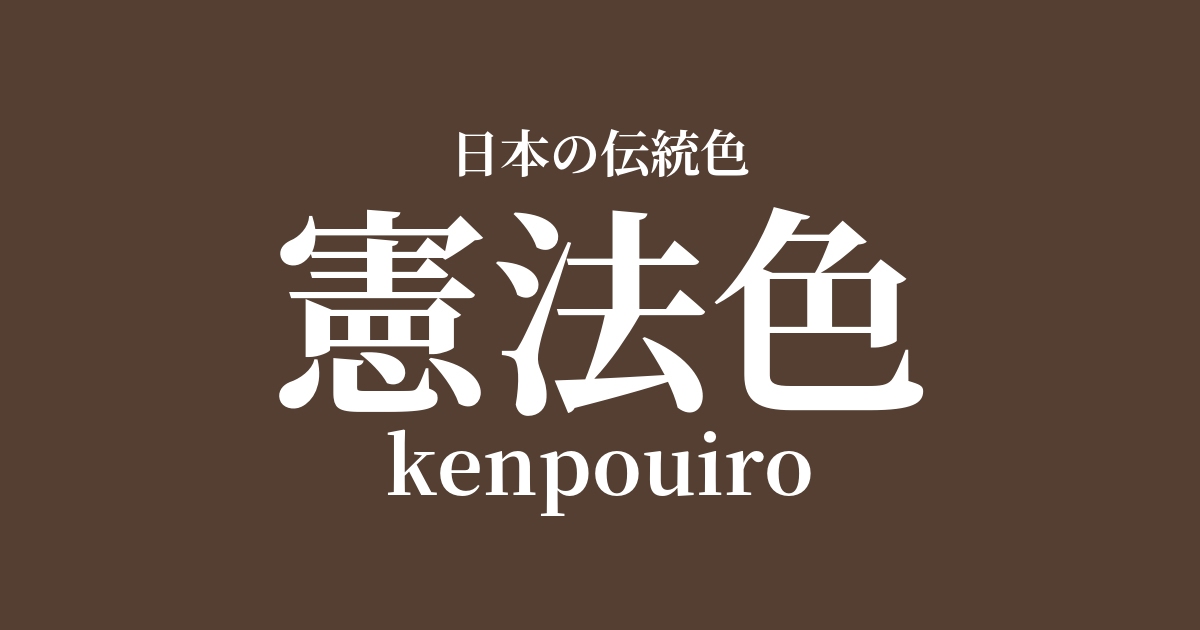
| Japanese color name | Constitutional |
|---|---|
| reading | kenpouiro |
| HEX | #543F32 |
| RGB | 84, 63, 50 |
What is "constitutional color"? Origin and etymology
Kenpo-iro is a very dark brownish-red color that is almost black, and its name is said to originate from Yoshioka Kenpo, a swordsman from the early Edo period. Yoshioka Kenpo was the head of the prestigious Yoshioka-ryu dojo in Kyoto and is also known for the legend of his duel with Miyamoto Musashi. It is said that he favored this dark brown color, and as a result, this dyeing method came to be called "Kenpo-zome," and eventually the color name "Kenpo-iro" became established.
The deep, subdued color was achieved by using dyes such as the bark of the bayberry tree and dyeing with a mordant containing iron.
Constitutional historical background
Constitutional colors were particularly popular from the early to mid-Edo period. At that time, the shogunate frequently issued sumptuary laws, restricting commoners from wearing extravagant clothing. In reaction to this, people developed an aesthetic sense called "48 shades of brown and 100 shades of gray," which involved finding enjoyment in subtle variations within subdued colors such as brown and gray.
Constitutional colors were one of the representative colors that expressed such "sophistication," and were particularly favored for use in men's haori jackets and other garments.
This color, like "Danjuro-cha" (Danjuro's brown), a color favored by the Kabuki actor Ichikawa Danjuro, was one of the trendy colors associated with popular figures of the time. It was embraced by a wide range of people, from samurai to townspeople, and became one of the colors that adorned the city of Edo. Its popularity is recorded in ukiyo-e prints and literary works depicting the customs of the time, and it has etched its place in history as a color symbolizing Edo culture.
Related literature, waka poetry, and seasonal words
The color Kenpo can be found in Edo period literature and ukiyo-e prints. For example, in Ihara Saikaku's ukiyo-zoshi "The Life of an Amorous Man," there is a description of a "Kenpo haori," suggesting that it was a popular color among fashionable people at the time. It also frequently appears as the color of the clothing worn by Edo townspeople and samurai depicted by ukiyo-e artists, making it an important color in conveying the customs of that era.
Although it is not established as a specific seasonal word, its subdued colors sometimes lead to its use in describing autumn and winter scenes.
Color scheme preview
This is to check the readability of the text when this color is used as the background.
Constitutional Color Scheme Proposal
Aphrodisiac tea (#715C1F)
Like the color of the Constitution, this brown-based color was popular during the Edo period. When combined with the yellowish tint of Kobuchi, it creates a deep, calm, and sophisticated Japanese atmosphere. The colors complement each other, resulting in a refined and stylish color scheme.
Blue gold (#FABE29)
The vibrant turmeric color creates a strong contrast with the dark constitutional color, making it an eye-catching accent. It adds vibrancy and energy to the solemn constitutional color, making it a suitable color scheme for a modern and impressive design.
White training (#EDEAE3)
By combining it with a soft, warm white, the heavy feel of the constitutional color is softened, adding a sense of cleanliness and elegance. While the contrast is clear, it gives a gentle and refined impression, making it a versatile color scheme applicable to a wide range of designs.
Practical Scenes
Constitutional colors, with their subdued hue, are still used in various settings today. In the world of traditional Japanese clothing, they are used in men's haori jackets, hakama trousers, and obi sashes, creating a stylish and dignified look. Furthermore, their substantial feel makes them suitable for interior design; incorporating them into wallpaper, furniture, and fabrics can add depth and tranquility to a space.
In web and graphic design, using it as a background or text color helps to convey a sense of luxury or tradition. It is particularly effective in content related to history and culture, as well as on websites of established brands. Depending on how it's combined with other colors, it can appear both modern and classic, making it a highly versatile color.