
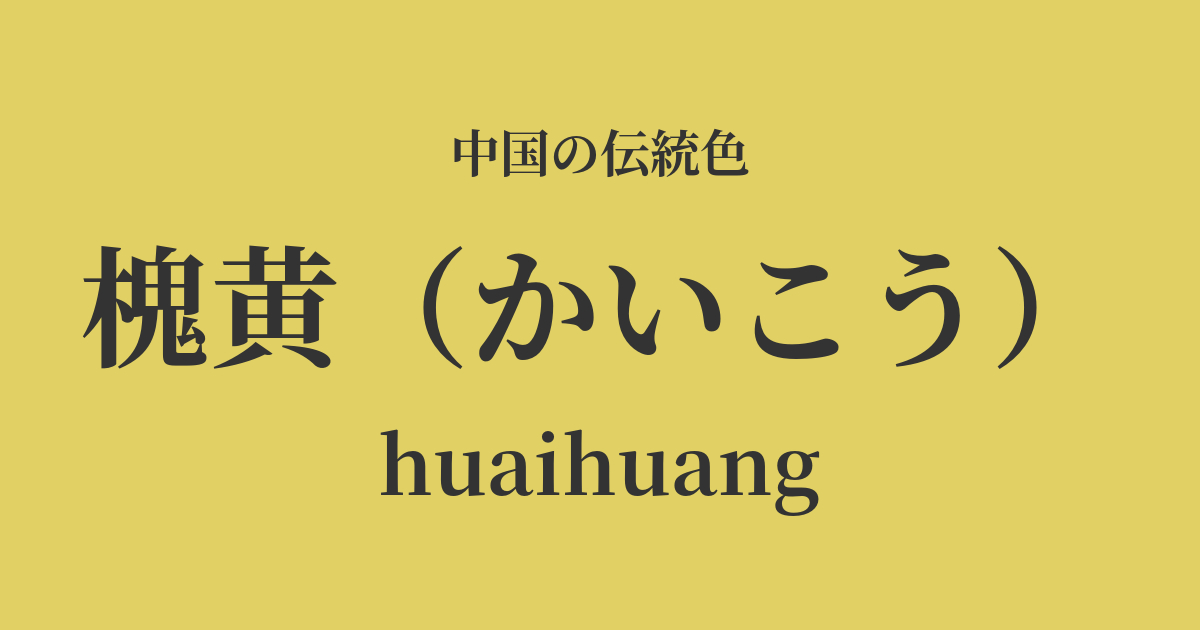
| Color name | Sophia |
|---|---|
| reading | Kaikou |
| pinyin | huaihuang |
| HEX | #E1D063 |
| RGB | 225, 208, 99 |
What is Sophora japonica? Origin and etymology
Kaikō refers to a gentle, slightly greenish yellow color dyed with the flowers of the Japanese pagoda tree (Enju), a deciduous tree belonging to the legume family.
The Japanese pagoda tree (Sophora japonica) is native to China and in summer it produces clusters of small, creamy-yellowish-white flowers. These flowers, when picked and dried, are called "kaika" and have long been valued as a natural dye. Fabrics dyed with kaika have a calm yet bright and elegant hue.
Furthermore, the Japanese pagoda tree itself held special significance in China. During the Zhou dynasty, three pagoda trees were planted in the court garden, and the highest-ranking officials known as the Three Dukes conducted their affairs of state under them. From this story, the pagoda tree came to be a symbol of authority and advancement. The term "kaii" (槐位), meaning "pagoda tree rank," for high-ranking officials also originates from this story. Thus, the color pagoda yellow is not merely a color name, but also has a cultural background derived from an auspicious tree.
Historical background of the Japanese pagoda tree
The color of the Japanese pagoda tree (Sophora japonica) played a particularly important role in history during the Sui and Tang dynasties. Emperor Wen of the Sui dynasty established a system to distinguish the rank of officials by the color of their clothing, and stipulated that yellow robes be worn as everyday work attire. At this time, the color permitted for ordinary officials and commoners to wear was the yellow dye made from the flowers of the Japanese pagoda tree (Sophora japonica).
During the Tang Dynasty, strict rules were established for the emperor, designating more reddish, dignified yellows such as "shao" (reddish-yellow) and "zhe" (boxwood yellow). This meant that others were forbidden from wearing the same yellow as the emperor. However, since pagoda tree yellow was a lighter, gentler yellow than the emperor's color, it continued to be widely used and cherished among officials, literati, and commoners. It was a yellow that stood apart from the yellow symbolizing the emperor's authority, and was closer to people's lives.
Sophora japonica in Chinese art and crafts
Sophora japonica is an indispensable color when discussing the clothing culture of the Sui and Tang dynasties. It likely adorned the landscape of the capital at the time as the color of the robes worn by officials and literati. When silk fabrics are dyed in Sophora japonica, the soft luster that emerges depending on the light further enhances the gentleness of the color, creating an elegant atmosphere.
Furthermore, the Japanese pagoda tree (Sophora japonica) was a popular subject in literati painting due to its auspicious nature. The yellow of the pagoda tree's blossoms, which bloom profusely in summer, is sometimes depicted in paintings as an accent to express a sense of the season. In the world of ceramics, works using yellow glaze sometimes exhibit a color similar to that of the Japanese pagoda tree, and its gentle hue gives the vessels a warm and elegant feel.
Sophora yellow fruit incense
Color scheme preview
This is to check the readability of the text when this color is used as the background.
A color scheme proposal for Sophora japonica.
Blue lotus (#4D5A99)
When combined with the calm, bluish-purple of the blue lotus, the colors complement each other beautifully. This color scheme gives an intelligent, sophisticated, and modern impression.
Matsuka Midori (#BCEE68)
Adding vibrant green pine blossoms creates a natural, lively, and refreshing impression reminiscent of early summer fields and mountains.
Beni Kaido (#F2A0A1)
Combining it with crabapple red, which has a gentle reddish hue like the crabapple blossom, adds warmth and elegance to the overall look. It's a friendly and soft color scheme.
Practical Scenes
In interior design, Japanese pagoda tree (Sophora japonica) brings a calm and bright atmosphere to a space. Incorporating it into wallpaper, curtains, cushions, and other fabrics creates a comfortable feeling, as if the entire room is bathed in warm light. It pairs particularly well with natural wooden furniture.
For fashion, we recommend shirts, blouses, and skirts in the color of Japanese pagoda tree yellow. It blends well with the skin, brightens the face without being too flashy, and gives a gentle, intelligent impression. It will add a touch of elegant color to your everyday outfits.
In web and graphic design, using this color as a background or accent color can convey friendliness and trustworthiness. It is suitable for websites with a natural or traditional theme, or for services where the goal is to instill a sense of security in users.