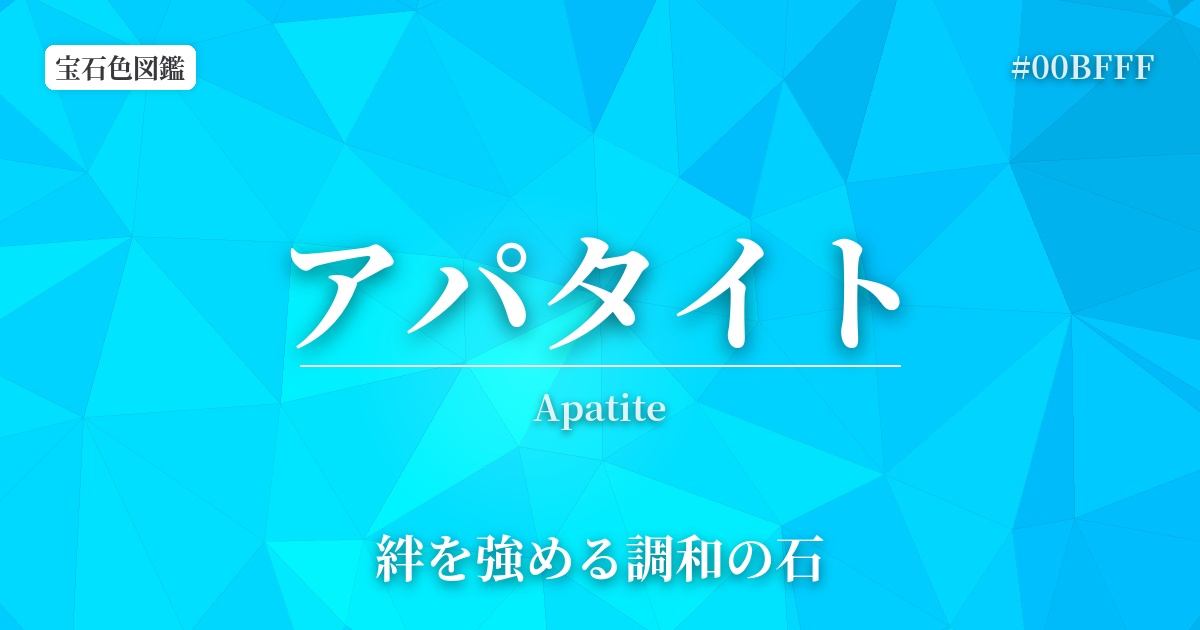
| English name | Apatite |
|---|---|
| Katakana | Apatite |
| HEX | #00BFFF |
| RGB | 0, 191, 255 |
| Mineralogy | Phosphate minerals |
What is apatite? Origin and mineralogy
The name apatite originates from the Greek word "apatao," meaning "to deceive" or "to trick." This is because apatite was easily mistaken for many other gemstones, such as aquamarine, tourmaline, and peridot. Its diverse colors and shapes have long puzzled gemologists throughout history.
Mineralogically, apatite is a group name for phosphate minerals, known for being very similar in composition to human teeth and bones. Much of what is sold as gemstones is fluoroapatite. Gem-quality apatite is found all over the world, including Brazil, Madagascar, Mexico, Myanmar, and Canada.
Tourmaline from Madagascar and Brazil, in particular, is highly popular for its striking neon blue color reminiscent of Paraiba tourmaline. It also comes in a variety of other colors, including green, yellow, pink, and purple, making it a beloved collector's stone.
The history and culture of apatite
Although apatite has been known since ancient times, its history as a gemstone is relatively recent because it has been confused with other gemstones. Its true nature remained a mystery until it was officially named in 1786 by the German geologist Abraham Gottlob Werner.
Before its value as a gemstone was discovered, apatite was primarily used industrially as a raw material for phosphate fertilizers. Phosphorus is an essential element for plant growth, and apatite deposits were an important resource for agriculture.
In the latter half of the 20th century, its beautiful colors, especially the vibrant blue varieties, attracted attention, and it became increasingly popular in the world of jewelry. Because it was relatively affordable yet possessed a beauty comparable to that of high-end gemstones, it became widely accepted among designers and gem enthusiasts.
Apatite and Color Psychology
Apatite is known as the "stone of harmony that strengthens bonds." It is said to smooth relationships with family, lovers, friends, and colleagues, and to support communication. It is believed to act as a bridge to help people with different ways of thinking and values understand each other.
The clear blue color of this gemstone is said to have the effect of releasing mental confusion and feelings of stagnation, and clearing the mind. It is believed to hold energy that liberates the mind from fixed ideas and old assumptions, leading to new ideas and solutions. It is also said to help with self-expression and encourage the honest communication of one's thoughts.
Color scheme preview
This is to check the readability of the text when this color is used as the background.
Apatite color scheme proposal
Navajo White (#FFDEAD)
The vibrant blue of apatite, combined with a warm, creamy white, creates a refreshing and sophisticated impression. It evokes an elegant resort feel reminiscent of the Mediterranean coast.
Sienna (#A0522D)
By combining brown tones, which are close to complementary colors, the colors enhance each other, creating an energetic and modern impression. This color scheme is recommended for a sophisticated and slightly bold urban style.
Lavender (#E6E6FA)
By combining lavender, an intermediate color between blue and purple, a dreamy and calming atmosphere is created. It's a gentle and dreamy color scheme that soothes the mind.
Practical Scenes
In jewelry design, the neon blue of apatite shines as the star of the show. Especially when combined with white gold or platinum, the blue stands out even more, creating rings and necklaces with a cool and modern feel. However, because it has a relatively soft Mohs hardness of 5, it is recommended for use in pendants and earrings rather than rings, which are more susceptible to impact.
In interior design, incorporating apatite blue as an accent color in items like cushions, curtains, or artwork brings vibrancy and freshness to a space. Simply placing apatite blue accessories in a minimalist room with white walls instantly creates a stylish and sophisticated atmosphere.
In web and graphic design, this color can convey both trustworthiness and energy. Using it as a company's corporate color, for attention-grabbing call-to-action buttons, or in service logos will give users a positive and forward-thinking impression.