
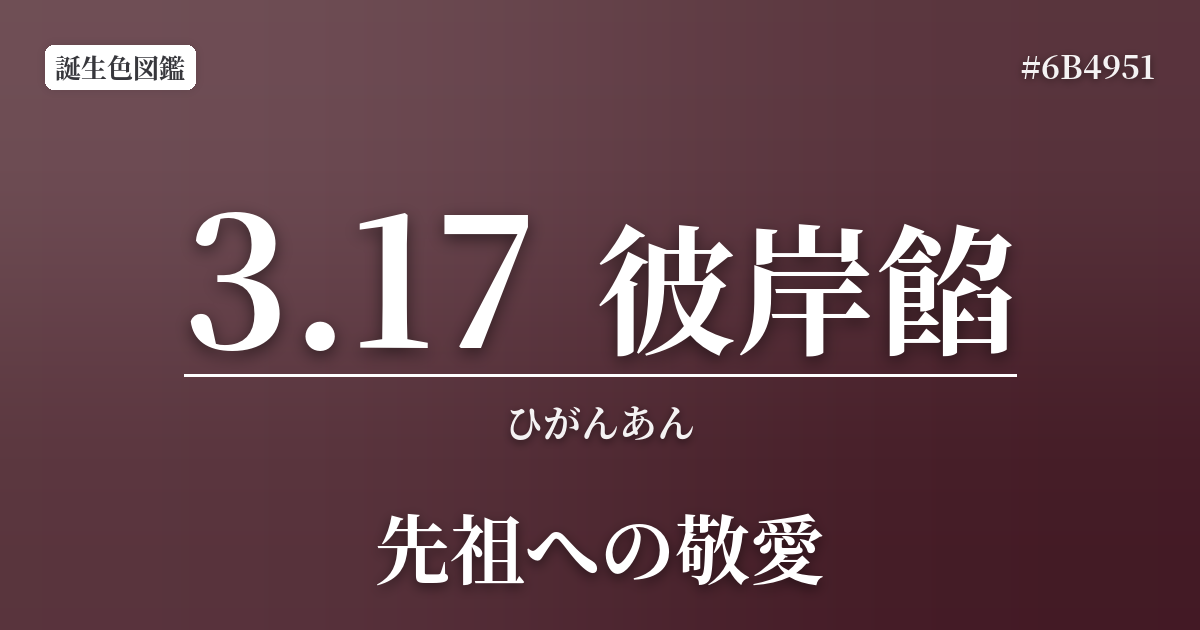
| birthday | March 17 |
|---|---|
| Color name | Higan-an (bean paste for the autumn equinox) |
| HEX | #6B4951 |
| RGB | 107, 73, 81 |
| Color meanings | Respect for ancestors |
- What is "Higan An," the birth color for March 17th?
- The color symbolism "respect for ancestors" and personality
- Connection to the seasons — Spring equinox and botamochi (rice cakes covered in sweet bean paste)
- Color scheme preview
- Color scheme proposal for Higan An (a type of sweet bean paste).
- FAQ
- Related traditional colors
What is "Higan An," the birth color for March 17th?
The birth color for March 17th is "Higan-an" (Equinox Bean Paste). It's a deep, reddish-brown color inspired by the moist bean paste filling of "botamochi" (rice cakes covered in sweet bean paste) eaten during the spring equinox. This color was created by this website, drawing inspiration from beautiful seasonal customs in Japan.
The color of "Higan An" evokes a sense of warmth and depth, reminiscent of carefully cooked red beans. It's a simple, gentle sweetness, a calming color that evokes nostalgic memories. It has the power to soothe the hearts of those who see it, providing a sense of calm and peace.
The color symbolism "respect for ancestors" and personality
People who like this color tend to be calm and kind-hearted. In color psychology, brown symbolizes stability, reliability, and warmth. When red is added to it, it suggests inner passion and deep affection.
They value their connections with family and friends above all else, and also have a side that respects tradition and their own roots. Possessing both a steady and reliable approach to things, and a warm, embracing personality, they are likely to be a deeply trusted presence among those around them.
Connection to the seasons — Spring equinox and botamochi (rice cakes covered in sweet bean paste)
"Higan An" is deeply connected to the customs of the spring equinox. The spring equinox is a seven-day period centered around the spring equinox, with three days before and three days after, during which it is an important Japanese custom to visit the graves of ancestors and offer prayers.
The "botamochi" offered during this time of year is said to be named after the peony flower that blooms in spring. This Japanese confection, made by wrapping glutinous rice in red bean paste, has long been cherished as an offering to express gratitude to ancestors. The belief that the red color of red beans has the power to ward off evil spirits has also contributed to this custom.
Color scheme preview
This is to check the readability of the text when this color is used as the background.
Color scheme proposal for Higan An (a type of sweet bean paste).
Cherry blossom pink (#FEEBF5)
Like botamochi and sakuramochi, this combination evokes the charm of springtime Japanese sweets. The calming colors of the Higan bean paste are complemented by the delicate pink of the cherry blossoms, creating a peaceful and gentle spring scene.
Young leaf color (#B5D36C)
The color of the bean paste and the color of the newly sprouted leaves evoke the beautiful harmony of colors found in nature. The deep hue of the Higan bean paste complements the fresh vitality of the young leaves, creating a soothing color combination.
Generated color (#FBF9F4)
The deep flavor of the Higan bean paste and the natural brightness of the undyed, creamy color complement each other beautifully, creating an elegant color scheme. It gives a simple yet sophisticated impression and creates a warm and inviting atmosphere.