
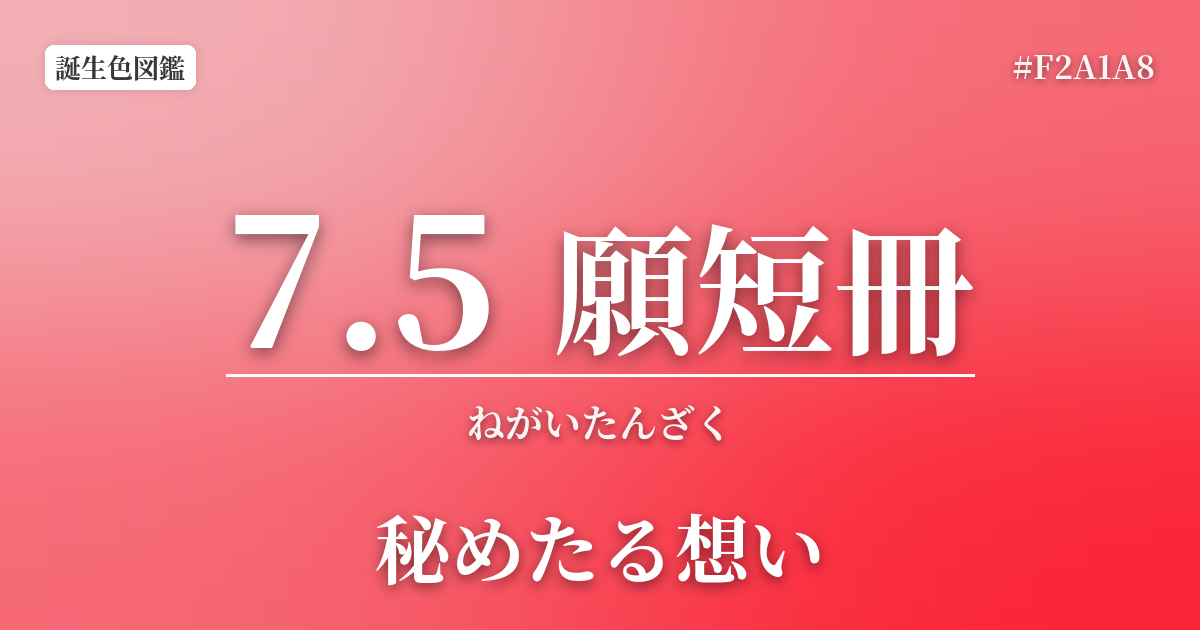
| birthday | July 5th |
|---|---|
| Color name | A strip of paper for writing wishes (negai tanzaku) |
| HEX | #F2A1A8 |
| RGB | 242, 161, 168 |
| Color meanings | Hidden feelings |
What is the "wish strip" associated with the birth color of July 5th?
The birth color for July 5th is "Negai Tanzaku" (wish strip). This birth color is a creative color that our website has uniquely selected, inspired by the Tanabata festival. The color is a soft, gentle pink with a slight reddish tint, reminiscent of the wish strips that adorn the bamboo branches during the Tanabata festival.
The colors of the "wish strips" seem to express the slightly exhilarated feeling and pure emotions hidden within when writing down a wish. They also resemble the color of the sky faintly tinged with red at summer twilight, evoking a somewhat melancholic yet warm scene in the heart. It is a romantic color that embodies quiet prayers and feelings for loved ones.
The color meaning "hidden feelings" and personality
People who like this color tend to have a romantic side, cherishing their inner thoughts and dreams. In color psychology, pink is considered a color that symbolizes love, gentleness, and happiness. The slightly subdued tone of the "Wish Strip" suggests inner richness and quiet passion.
They may appear quiet and reserved, but they often harbor strong convictions and passionate feelings within. Their heightened sensitivity and empathy allow them to gently understand the feelings of those around them, making them excellent listeners. They possess both sensitivity and inner strength.
Connection to the seasons — Tanabata wish strips
The colors of the "wish strips" are deeply connected to Tanabata, a representative summer event. On Tanabata, July 7th, it is customary to decorate bamboo branches with strips of paper on which wishes have been written and offer prayers to the stars.
The strips of paper used for writing wishes often feature five colors (blue, red, yellow, white, and black or purple), which originate from the Five Elements theory of ancient China. The pink color of this "wish strip" evokes the color "red." Red strips of paper are said to represent feelings of "gratitude" towards ancestors and parents. The act of entrusting a wish to a strip of paper perfectly aligns with the color's symbolism of "hidden feelings."
Color scheme preview
This is to check the readability of the text when this color is used as the background.
Color scheme suggestions for wish strips
Sky blue (#A0D8EF)
This combination evokes the night sky of Tanabata (the Star Festival). The warm pink of the wish strips and the clear blue of the sky complement each other, creating a romantic scene of a summer night. The color scheme gives a feeling of coolness and gentleness.
White training (#F3F3F3)
The pure and elegant white of the white cloth highlights the gentle pink of the wish strips. It evokes a pure and sacred atmosphere, like wish strips adorning bamboo branches. This combination gives a modest yet sophisticated impression.
Bamboo green (#7BC9A4)
The fresh, young bamboo-green color, reminiscent of dwarf bamboo, and the pink of the wish strips create a beautiful contrast. The vitality of nature and gentle wishes harmonize, giving a calm and peaceful impression. The color scheme evokes the freshness of early summer.