
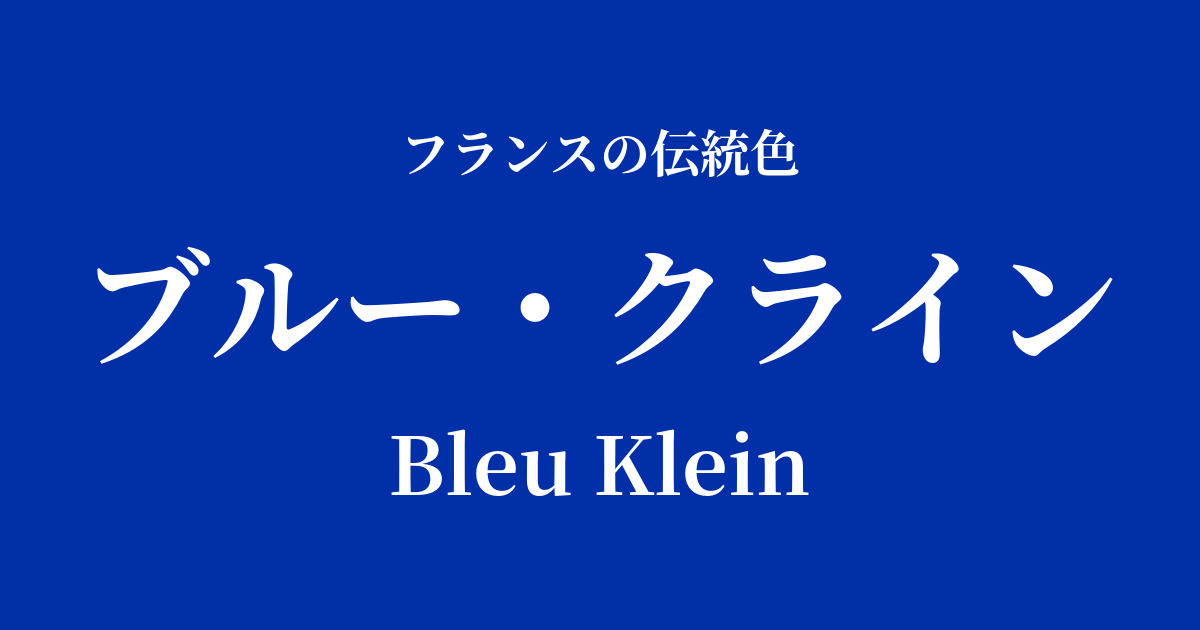
| French | Bleu Klein |
|---|---|
| Katakana | Blue Klein |
| HEX | #002FA7 |
| RGB | 0, 47, 167 |
What is Blue Klein? Origin and Etymology
Blue Klein is not a color rooted in any particular tradition or region, but rather an extremely modern color born from the inquisitive spirit of one artist. Its name comes from the French artist Yves Klein (1928-1962).
Its official name is "International Klein Blue," and it is commonly known as "IKB." Klein was concerned that the inherent vibrant brilliance of the pigment powder was lost when mixed with oils and adhesives. With the help of chemists, he developed a special synthetic resin fixative that could encapsulate the ultramarine pigment particles while preserving the purity of its color to the fullest extent.
In 1960, Klein patented this unique method. It wasn't about a specific hue, but rather the invention of the technique itself for fixing pigments to canvas. His aim was to create an immaterial, spiritual space in which viewers could immerse themselves in the pure energy of the color itself.
The historical background of Blue Klein
The history of Yves Klein is inextricably linked to the contemporary art scene of the mid-20th century. In post-World War II Europe, new forms of artistic expression that were not bound by existing values were being sought. Amidst this, Yves Klein made a highly innovative attempt for the time, making "color" itself the subject of his works.
In 1957, his solo exhibition "The Blue Period (Proposte Monocrome, Epoca Blu)" held at the Apollinaire Gallery in Milan became a turning point that brought him international recognition. He presented 11 identical monochrome paintings, uniformly painted with IKB (Iron Paint), which caused a great shock to the art world. There were no shapes, lines, or narratives; only the seemingly infinite expanse of blue existed.
For Klein, blue was the most immaterial and boundless color, symbolizing the sky and the sea. Through this color, he sought to liberate viewers from the material world and invite them into a pure spiritual realm. His work is highly regarded in art history as a precursor to later movements such as Minimal Art and Conceptual Art.
Blue Klein in the world of art and fashion
Blue Klein established its artistic value through Yves Klein's own diverse body of work. Beyond his representative monochrome paintings, his "Anthropometry" series explored the direct relationship between body and color through performances in which he pressed models, painted with IKB (blue pigment), onto canvases. This symbolic blue was also used in works that utilized natural forces such as fire and water.
Its striking impact extends beyond the art world, constantly inspiring the fields of fashion and design. Many fashion designers have symbolically used this color in their collections. By using this color in minimalist dresses and coats, or in accessories such as bags and shoes, a modern and sophisticated impression can be strongly conveyed.
In interior design, Blue Klein exudes a special presence. Simply incorporating it as an accent wall, cushions, or artwork in this color can tighten the entire space and create a sophisticated, artistic atmosphere.
Blue has no dimensions whatsoever. It transcends dimensions.
Color scheme preview
This is to check the readability of the text when this color is used as the background.
Blue Klein's color scheme proposal
Blanc d'Argent (#EAEAEA)
This is the simplest and most modern combination, maximizing the vibrancy of Blue Klein. It creates a refreshing and sophisticated space reminiscent of the Greek islands.
Jaune d'Or (#FFD700)
Two colors that are close to complementary colors enhance each other, creating a very dynamic and energetic impression. It's ideal for expressing a bold and artistic atmosphere.
Noir (#000000)
The depth and spirituality of the blue Klein are tightened by the black, creating a very chic and intellectual impression. It's a color scheme that is minimalist, powerful, and perfectly suited to a modern design.
Practical Scenes
Blue Klein is a very striking color, so depending on how you use it, it can dramatically change the impression of a space or styling.
In interior design, using it as an accent wall in a living room or study adds depth and an artistic atmosphere to the space. Even if you don't use it on the entire wall, simply adding it as a pop of color with small items like art frames, cushions, or vases will tighten up the overall look of the room and give it a modern feel.
In fashion, a dress or coat in this color can be the centerpiece of an outfit. For a more casual approach, try adding it as an accessory such as a bag, shoes, or scarf. Simply adding it to a simple outfit instantly creates a sophisticated and stylish look.
In web and graphic design, using a key color can leave a strong impression on users, conveying a sense of innovation and originality. However, because it is a very eye-catching color, it is important to place it effectively while making use of white space.