
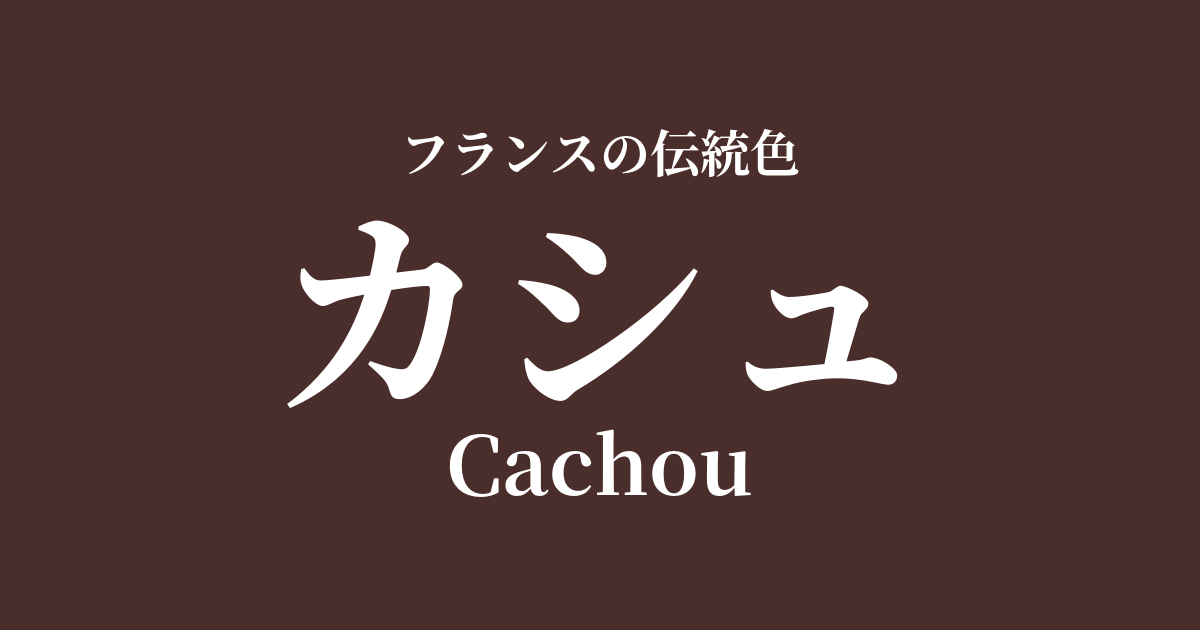
| French | Cachou |
|---|---|
| Katakana | Cashew |
| HEX | #4a2e2b |
| RGB | 74, 46, 43 |
What is "Kash"? Origin and etymology
Cachou is a color derived from the French name for the catechu plant, a member of the legume family (Acacia genus) native to India and Southeast Asia. The extract obtained by boiling down the heartwood and bark of this tree has long been valued as a dye, leather tanning agent, and medicine.
The deep, rich, reddish-brown color of this extract became the name "kash." Its etymology is said to trace back to the Malay word "kacu" or the Tamil word "kasu," reflecting the deep history of the plant itself.
In France, a breath freshener called "Cachou Lajaunie," made with catechu extract, has been popular since the 19th century, and the black lozenges in small yellow tins can still be found in pharmacies today. The color of these lozenges also embodies the essence of catechu itself.
Thus, the color "cashew" is not merely a name for a color, but a color with depth that encompasses the culture brought by a plant from a distant foreign land, as well as the memory of its medicinal properties rooted in people's lives.
Historical background of Kash
Catechu, the raw material for cashew, was not introduced to Europe in earnest until the 17th century, after the Age of Discovery and the subsequent boom in trade by companies such as the East India Company.
Until the invention of inexpensive chemical dyes in the 19th century, cashew was one of the important natural dyes that supported the European dyeing industry for dyeing cotton, silk, and wool. In particular, because it was a "fast" dye with high durability against sunlight and washing, it was highly valued for dyeing everyday fabrics and work clothes, as well as items that needed to withstand harsh environments, such as ship sails and fishing nets.
In French history, cashew-dyed colors were not the flamboyant colors worn by royalty and nobility, but rather practical and essential colors deeply intertwined with people's lives and industries. Traditional textiles from the Provence region of southern France can still be seen in the subdued hues of cashew dye, reflecting its history of being integrated into the local climate and lifestyle.
Cash in the world of art and fashion
In the world of art, deep reddish-brown colors like cashew were indispensable for dramatically depicting light and shadow. In particular, in 17th-century Baroque painting and the chiaroscuro technique used by Rembrandt van Rijn and others, these dark browns gave the painting depth and weight, and had the effect of highlighting the emotions and narrative of the figures.
In the world of fashion, Cache is a color that embodies intelligence, warmth, and composure, and is especially beloved in autumn and winter collections. It is a color that brings out the rich texture of natural materials to the fullest, such as high-quality leather bags and shoes, tweed jackets, and wool coats. Its classic appearance creates a timeless elegance that is not influenced by trends.
Furthermore, in textiles, dyeing lustrous fabrics like velvet and silk satin with cashew dye creates a rich and deep texture that changes depending on how the light hits it. Incorporating it into interior design will add a touch of elegance to any space.
Color scheme preview
This is to check the readability of the text when this color is used as the background.
Cash's color scheme proposal
Rose Pompadour (#EDADC7)
Combining a deep, calming Cache-Coat with the bright and elegant Rose Pompadour creates a sophisticated, mature feminine look. It's not overly sweet, giving a chic and warm impression.
Blue Roi (#2964A2)
The combination of deep brown tones and noble blue-roy creates a classic and sophisticated color scheme where each color complements the others. It conveys a sense of reliability and refinement, making it suitable for formal occasions.
Jaune de Naples (#FFDB58)
The warmth of the Cache-Coat is complemented by the bright, radiant Jaune de Naples, creating a rich and elegant impression reminiscent of a bountiful autumn harvest. This is recommended when you want to achieve a balance between approachability and sophistication.
Practical Scenes
In interior design, cashew is an ideal color for bringing a sense of calm and gravitas to a space. When used in large areas such as a wall, study curtains, or a leather sofa, it creates a warm, inviting, and cozy atmosphere. It also pairs exceptionally well with dark wood furniture and brass lighting, creating a classic and sophisticated space.
In fashion, cashews are an excellent accent color for pulling an entire outfit together. Simply incorporating them into leather bags, belts, or boots adds depth and a sophisticated touch to your look. Combining them with off-white, beige, or grayish blue creates a refined, mature style.
In web and graphic design, using cashew as a background color can convey an image of luxury, reliability, and tradition. While readability needs to be considered when using it as a text color, using it for headings and logotypes, or combining it with gold or cream, can effectively express the world of a luxury brand.