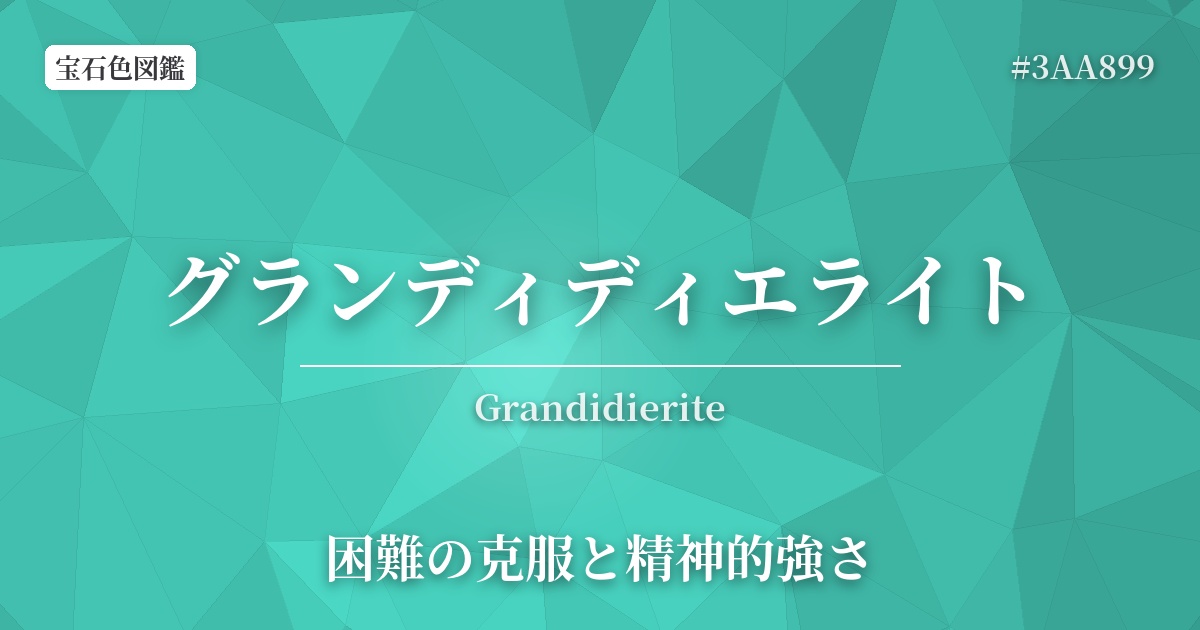
| English name | Grandidierite |
|---|---|
| Katakana | Grandidierite |
| HEX | #3AA899 |
| RGB | 58, 168, 153 |
| Mineralogy | Silicate minerals |
What is Grandidierite? Origin and Mineralogy
Grandidierite is a relatively new gemstone, discovered in 1902 in southern Madagascar by the French mineralogist Alfred Lacroix. It is named in honor of Alfred Grandidier, a French explorer and naturalist who studied the natural history of Madagascar.
As a mineral, it is classified as a silicate mineral containing magnesium, aluminum, and boron. With a Mohs hardness of 7.5, it is hard enough to be used in jewelry. The most striking feature of this gemstone is its "pleochroism." Depending on the viewing angle, it exhibits three different colors: blue-green, colorless (or yellow), and dark green. This property creates the complex and profound hues of grandidierite.
The main source is Madagascar, but gem-quality specimens are extremely rare. Those with particularly high clarity and exceeding 1 carat are especially rare and highly valued, considered a "phantom gem" and coveted by collectors in the global gem market. In recent years, they have also been found in Sri Lanka and other places, but those with the beautiful blue-green color of Madagascar specimens are rare.
The history and culture of the Grandidierite
Because grandidierite was discovered in the early 20th century, it doesn't have a long history associated with ancient civilizations or medieval royalty. However, its history since its discovery is deeply intertwined with its inherent rarity.
Although its rarity was recognized from the time of its discovery, for a long time most of the crystals were semi-transparent to opaque, and it was believed that there were almost no crystals of a quality suitable for cutting into gemstones. In the 2000s, with the discovery of a new deposit in Madagascar, highly transparent crystals finally began to appear on the market, but the quantity remains extremely limited.
Today, grandidierite is among the top 10 rarest and most expensive gemstones in the world, and its very existence is considered a status symbol. Its history is a tale of gemological exploration and discovery, conveying to the present day the miraculous beauty created by the Earth.
Grandidierite and color psychology
The deep, serene blue-green of grandidierite evokes images of tropical seas and deep forests, bringing a sense of calm and tranquility to the viewer. Combining the intelligence and calmness of blue with the harmonious and healing energy of green, this color is said to have the effect of balancing the mind and clarifying thoughts.
As its symbolic meanings include "overcoming difficulties" and "mental strength," this stone is believed to draw out the wearer's core strength, granting them the courage and perseverance to face adversity. It is also said to encourage new perspectives and flexible thinking, paving the way to achieving one's goals.
It is also said to have the power to facilitate communication and support self-expression. It can calm emotional turmoil and help you express your thoughts logically and calmly. Due to its rarity, it is also cherished as a talisman for those who are walking their own unique path.
Color scheme preview
This is to check the readability of the text when this color is used as the background.
Grandidierite color scheme proposal
Antique White (#FAEBD7)
The refreshing blue-green of Grandidierite, combined with warm off-white, creates a clean and sophisticated impression. It evokes a natural and comfortable space reminiscent of a sandy beach and the sea.
Saddle Brown (#8B4513)
The deep brown accentuates the blue-green of the grandidierite, adding a sense of calm and sophistication. The combination of earthy tones, reminiscent of the land and trees, creates a stable and intellectual atmosphere.
Rosy Brown (#BC8F8F)
Adding a muted, soft pink-brown creates an unexpectedly elegant color scheme. It exudes a modern yet somewhat nostalgic atmosphere, adding a unique touch to fashion and interior design.
Practical Scenes
In jewelry design, grandidierite is almost exclusively used in special bespoke pieces and high jewelry due to its rarity and beauty. Its excellent hardness makes it suitable for rings, and when cut with careful consideration to bring out its pleochroism, it emits a unique brilliance.
In the field of interior design, incorporating this sophisticated blue-green into accent walls, artwork, cushions, and other textiles brings tranquility and a sense of luxury to a space. When combined with white, beige, natural wood, and gold hardware, it creates a refined space reminiscent of a resort hotel.
In web and graphic design, it's ideal for brands that want to convey trustworthiness, expertise, and tranquility. Using it as a key color for wellness services, luxury travel agencies, and consulting firms can instill a sophisticated sense of security in users.