
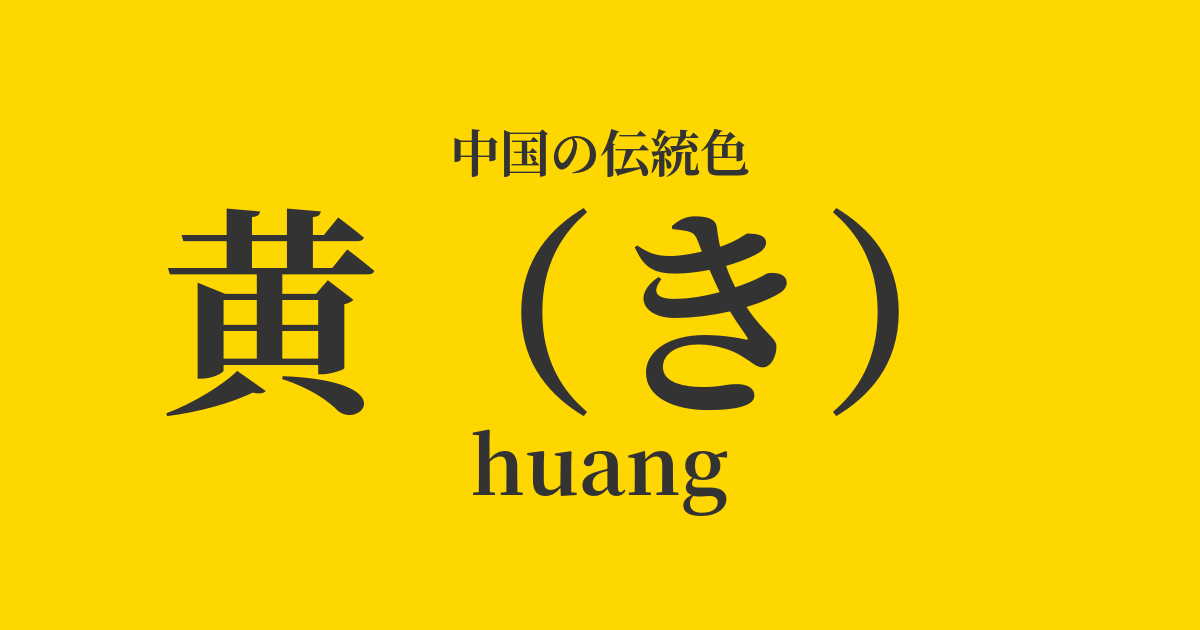
| Color name | 黄 |
|---|---|
| reading | き |
| pinyin | huang |
| HEX | #FFD700 |
| RGB | 255, 215, 0 |
What does "yellow" mean? Origin and etymology
In the Five Elements philosophy, which forms the foundation of Chinese culture, "yellow" symbolizes "earth," the element from which all things grow and return. In terms of direction, it represents the "center," and as a color located at the center of the universe, it held special significance.
Its etymology is said to originate from the Yellow River, the mother river of Chinese civilization, and the Loess Plateau that stretches along its basin. It was the color of fertile land and represented the very source of people's lives and culture.
Furthermore, the character for "yellow" is said to be a pictograph representing an ancient nobleman with a jade ornament (璜) hanging from his waist, and its origin inherently carries an image of nobility. Thus, yellow has been positioned as one of the most important colors in China, both from the perspective of its natural environment and ancient philosophy.
Historical background of yellow
In Chinese history, yellow was officially designated as the color reserved exclusively for the emperor during the Sui Dynasty. Emperor Wen of Sui designated yellow as the color of his everyday attire and forbade his subjects and commoners from wearing it.
This system was continued during the Tang Dynasty and became even more stringent. The "yellow robe," a symbol of the emperor's authority, became a special garment that only the emperor could wear, and yellow became a symbol of absolute power. This custom was continued by the subsequent Song, Yuan, Ming, and Qing dynasties, and for approximately 1300 years, yellow reigned as the color of the emperor.
Especially during the Ming and Qing dynasties, a vibrant "bright yellow" (mei huang) was used as the color for the "long robe" (long robe), a ceremonial garment embroidered with dragons, worn by the emperor. This color was reserved exclusively for the emperor, empress dowager, and empress, while the crown prince used a slightly darker "apricot yellow" (xiang huang), demonstrating a strict distinction in color usage based on social status.
Yellow in Chinese Art and Crafts
Yellow is one of the most symbolic colors in Chinese clothing culture. The "yellow robe," a symbol of the emperor's authority, was a work of art in itself, a pinnacle of craftsmanship, with dragons and auspicious patterns intricately embroidered in gold thread on the finest silk fabric. The vibrant yellow silk fabric conveys a sense of absolute power and dignity to the viewer.
In the field of ceramics, "yellow glaze" was highly valued as porcelain used by the imperial court. In particular, the yellow glaze from the time of Emperor Hongzhi of the Ming Dynasty was also called "Jiao Huang" and was characterized by its soft, warm yellow color reminiscent of chicken fat, and was beloved by successive emperors. These yellow-glazed porcelains were special vessels used in important ceremonies such as religious rituals.
Furthermore, yellow plays an important role in Buddhist art. It is often used to paint the bodies of Buddha statues gold ("konjin") and to represent the light shining from behind the Buddha ("kokō"), and was widely used as a color to express sanctity and solemnity.
You never see the yellow river, the water heaven comes, the torrent reaches the sea, irrecoverable
Color scheme preview
This is to check the readability of the text when this color is used as the background.
Yellow color scheme proposal
Vermilion (#FF4D00)
Yellow and vermilion are both noble colors used in the imperial court. When combined, they create a magnificent impression reminiscent of a grand, powerful, and traditional Chinese royal palace.
Jade color (#00A497)
This combination features yellow, the color of the earth, and jade green, the color of a gemstone full of vitality. The richness and elegance of nature harmonize, creating a calm yet sophisticated impression.
Black (#1C1C1C)
Combining vibrant yellow with deep ink black enhances the beauty of each color, creating a strong contrast. This sophisticated color scheme gives a modern, chic, and intellectual impression.
Practical Scenes
In interior design, yellow is a suitable accent color that brings brightness and vitality to a space. Incorporating it into small items such as cushions, vases, and artwork will give the entire room a vibrant atmosphere. In particular, when paired with dark brown wooden furniture or dark gray walls, the beauty of yellow stands out, creating a sophisticated and luxurious space.
In fashion, yellow is an effective accent color for outfits. It pairs particularly well with basic colors such as black, navy, and white, and simply incorporating it in a scarf, bag, or shoes can add a sophisticated touch to the entire look. When used in glossy materials such as silk or satin, the noble atmosphere of yellow is further enhanced.
In web and graphic design, it's effective when used on buttons and banners to attract user attention. It can also be used as a key color for brand websites that want to convey trustworthiness and authority, or for e-commerce sites that want to create a sense of luxury. However, it can become too overpowering if used over a large area, so it's best to use it sparingly as an accent color.