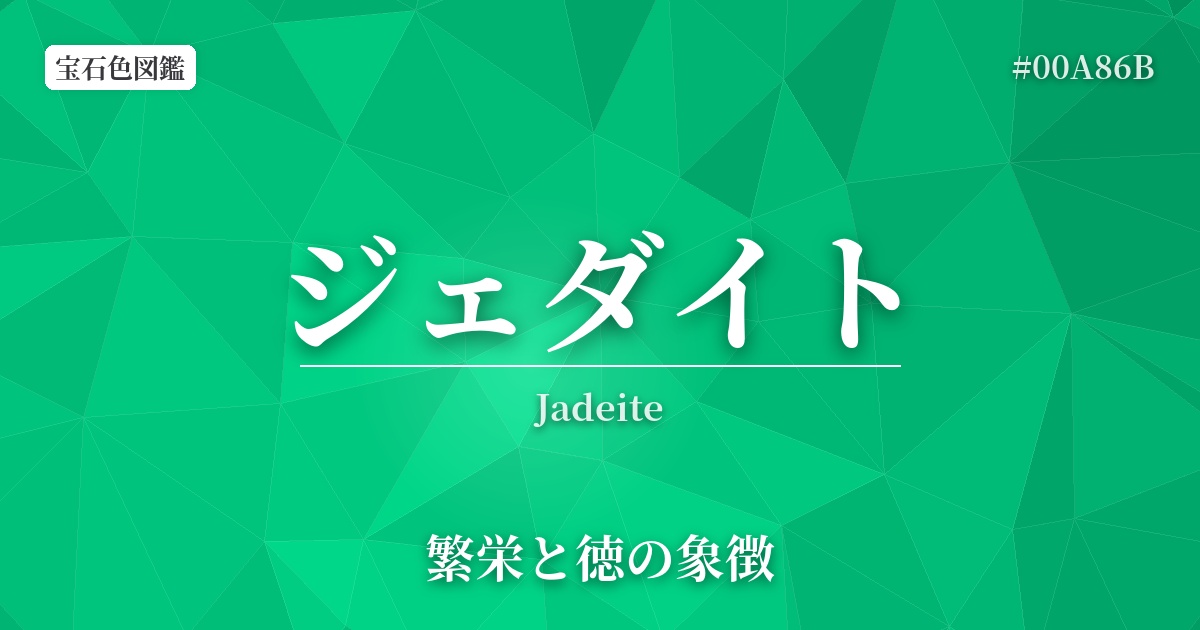
| English name | Jadeite |
|---|---|
| Katakana | Jadeite |
| HEX | #00A86B |
| RGB | 0, 168, 107 |
| Mineralogy | Silicate minerals |
What is Jadeite? Origin and Mineralogy
The name jadeite originates from the Spanish phrase "piedra de ijada," meaning "waist stone." This is because, in the past, it was believed in Central and South America that this stone had the power to heal kidney diseases. There are two types of gemstones commonly called "jade": jadeite (hard jade) and nephrite (soft jade), but jadeite is the one that is more highly valued as a gemstone.
Mineralogically, jadeite is a silicate mineral belonging to the pyroxene group. Its greatest appeal lies in its color; besides the most famous green, it comes in a variety of colors including lavender, white, red, yellow, and black. The particularly valuable vibrant green is created by the chromium and iron contained within the mineral. Among these, the highest quality is called "Imperial Jade" or "Langgan," and boasts exceptional beauty.
Myanmar is famous for producing some of the world's highest quality jadeite. However, jadeite is also found in other locations, including the area around Itoigawa City in Niigata Prefecture, Japan, as well as in Guatemala, Russia, and Kazakhstan.
Jadeite History and Culture
Jadeite has a long history, and in China in particular, it has been treated as a sacred stone, "yū," since the Neolithic period. It was not merely an ornament, but a symbol of authority, wealth, and immortality, and was used in special ceremonies, such as the "yūyi" (jade robe) that covered the body of the emperor.
Its value is not limited to the East. In the Mayan and Aztec civilizations of Central and South America, jadeite was highly valued as an offering to the gods and as ornaments for royalty, and it is said that it was sometimes treated as more precious than gold.
In Chinese culture, jadeite is considered a stone embodying the five virtues of benevolence, righteousness, propriety, wisdom, and trustworthiness, and has been regarded as a symbol of a virtuous person who cultivates character. This belief continues to this day, and jadeite remains cherished by many as an amulet that brings good fortune, health, and prosperity.
Jadeite and Color Psychology
The deep, vibrant green color of jadeite symbolizes the vitality of nature and serene harmony. It is said that gazing at this color brings peace and tranquility to the mind, balancing emotions. Furthermore, it evokes positive energy such as regeneration and growth, and is believed to have a healing effect on the viewer.
Known as a "symbol of prosperity and virtue," jadeite is believed to bring success and abundance to its owner. Furthermore, it is said to cultivate wisdom, composure, and compassion for others, promoting personal growth. Historically, it has been cherished as a powerful amulet protecting against misfortune and disaster, and many people carry it as a personal talisman.
Color scheme preview
This is to check the readability of the text when this color is used as the background.
Jadeite color scheme proposal
Ivory (#FFFFF0)
The vibrant green of the jadeite and the soft white of the ivory complement each other beautifully. It combines oriental elegance with a modern cleanliness, creating a refined and sophisticated impression.
Gold (#FFD700)
This combination has been favored by royalty and nobility since ancient times. The green of the jadeite and the gleam of gold combine to create a luxurious and dignified impression, symbolizing wealth and prosperity.
Charcoal (#36454F)
The deep charcoal gray accentuates the vibrant green of the jadeite, creating a sophisticated and intellectual atmosphere. It's a modern, understated, and chic color scheme for adults.
Practical Scenes
In the world of jewelry, jadeite is often cut into smooth cabochons to showcase its color and texture, and is popular for use in rings, pendants, and bracelets. It enjoys immense popularity, especially in East Asia, where it is highly valued as an exquisite carving featuring motifs such as dragons and plants.
In interior design, incorporating this green color as an accent wall, cushion, or artwork brings vitality and a refined sense of calm to a space. By combining it with white, beige, or natural wood-grain materials, you can easily create an oriental modern feel or a botanical atmosphere that evokes nature.
The color of jadeite is also effective in the fields of fashion and web design. When used for buttons and headings on a website, it conveys a sense of trust and sophistication to the user. In fashion, simply incorporating this color into accessories such as scarves and bags can tighten up the overall look and create a refined impression.