
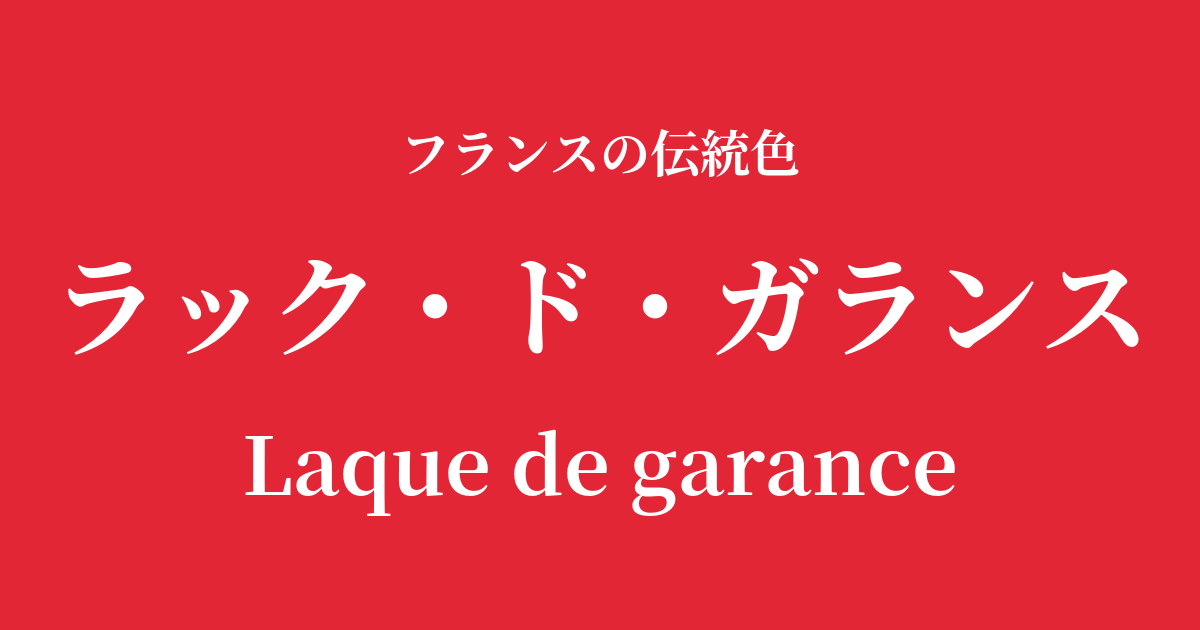
| French | Laque de garance |
|---|---|
| Katakana | Lac de Garance |
| HEX | #E32636 |
| RGB | 227, 38, 54 |
What is Lac de Garance? Origin and Etymology
Laque de garance, as its name suggests, is a traditional French color meaning "madder lake pigment." This vibrant and passionate red is made from the roots of the madder plant.
Madder, which has been used as a dye since the time of ancient Egypt, contains a red pigment called alizarin in its roots. When this pigment is extracted and mordants such as alum are added to make an insoluble pigment, it becomes a "lake pigment," also known as lac de garance. This transparent yet powerful red has been highly valued in the world of painting and dyeing since ancient times.
Historical background of Lac de Garance
Lac de Garance has played a very important role in French history. In particular, during the reign of Louis XIV in 17th-century France, this color was frequently used in the opulent tapestries produced at the Royal Gobelins Manufactory, becoming one of the colors that symbolized royal authority and wealth.
Perhaps more widely known is the uniform of the French Army from the 19th century to the early stages of World War I. Soldiers' trousers were dyed this bright red, known as "garance." This is said to have had an economic purpose: to protect madder cultivation, which was an important domestic industry in France at the time. However, this color, which stood out conspicuously on the battlefield, disappeared with the realities of modern warfare.
During the French Revolution, it is said that madder dye was used for the red color of the tricolor flag, giving it an aspect of being a color that symbolizes freedom and passion.
Lac de Garance in the world of art and fashion
In the art world, Lac de Garance has captivated many painters. This color was especially indispensable to Impressionist painters who pursued the expression of light and color. Pierre-Auguste Renoir is said to have skillfully used this translucent red to depict the soft complexion of his figures and the vibrancy of their dresses.
Going back even further in time, we can see traces of this technique in the works of the Dutch master Johannes Vermeer. The deep hues of the red clothing worn by his figures and the textiles in his interiors are often analyzed as being due to lac de garance (Madder Lake). By repeatedly applying transparent layers, he was able to express a unique texture that allowed light to pass through.
In textile culture, madder dyeing has been widely used in dyed and woven goods that enrich the lives of ordinary people, such as "toile pente," a traditional printed fabric from the Provence region of southern France, thus enriching the culture.
Color scheme preview
This is to check the readability of the text when this color is used as the background.
Color scheme proposals for Lac de Garance
Blue Roi (#002D62)
This combination of colors symbolizes the French royal family. It creates a powerful, classic contrast reminiscent of the tricolor, giving an impression of elegance and dignity.
Vert Épinard (#17462E)
The combination of red and green, which are close to complementary colors, vividly enhances each other's beauty. It gives a vibrant, slightly nostalgic, and warm impression.
Blanc d'Argent (#E6E6E6)
The vibrant red is gently complemented by the pure silvery-white. This creates a modern and sophisticated atmosphere, elegantly softening the passionate impression of Lac de Garance.
Practical Scenes
In interior design, lace de garance adds a dramatic accent to a space. When incorporated partially through cushions, rugs, or artwork, it brings warmth and energy to the entire room. In particular, pairing it with gold, brass, or dark wood furniture creates a classic and sophisticated atmosphere.
In the world of fashion, this color is a star color that attracts attention. Choosing it for a dress or coat on a special occasion will give you a confident and glamorous impression. Furthermore, using it as an accent color in a scarf, bag, or lip color will make the entire outfit look more vibrant.
In web and graphic design, call-to-action buttons are effective for attracting attention, and they are also effective in sections where you want to convey the brand's passion. However, using them too much can be overwhelming, so it's best to use them as accents while making good use of white space.