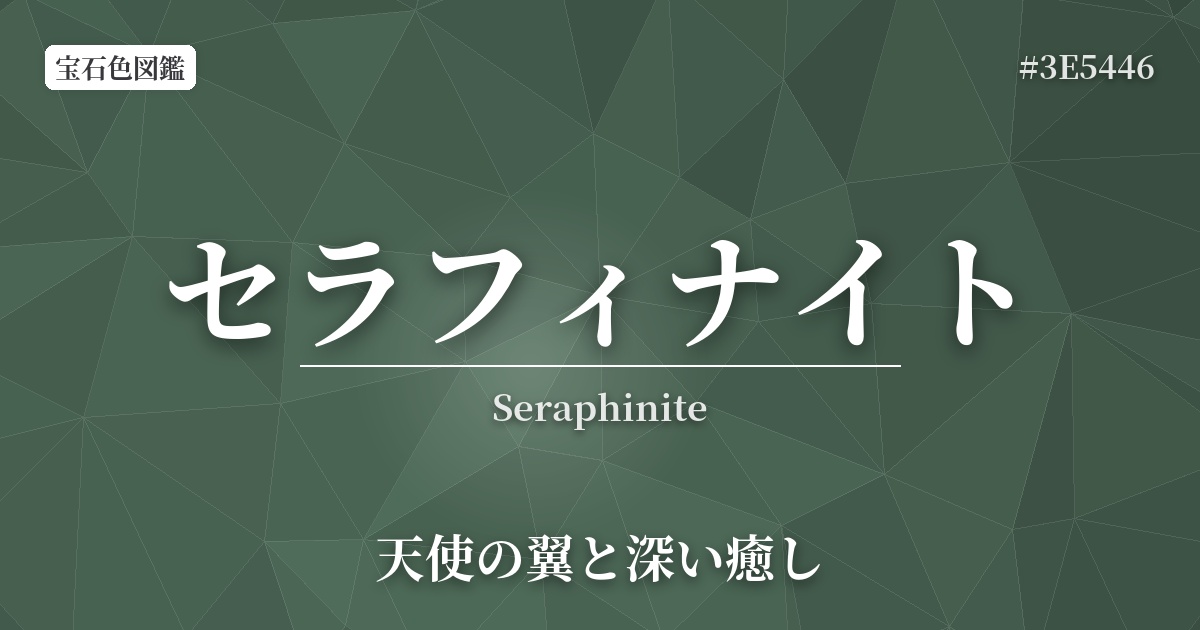
| English name | Seraphinite |
|---|---|
| Katakana | Seraphinite |
| HEX | #3E5446 |
| RGB | 62, 84, 70 |
| Mineralogy | Silicate minerals |
What is seraphinite? Origin and mineralogy
The name seraphinite derives from the seraphim, the highest-ranking angels in Christianity. This is because of the silvery-white feather-like patterns found inside the stone, which resemble angel wings. When light hits these delicate patterns, they emit a silky sheen (chatoyancy), captivating the viewer's heart.
Mineralogically, it is classified as a type of chlorite called "clinochlore." Its distinctive feather-like pattern is created by the inclusion of minute mica crystals in a specific direction. The sight of silvery patterns dancing across a deep forest green to grayish-green background possesses a unique and unparalleled beauty.
The main source of seraphinite is limited to the area around Lake Baikal in the Siberian region of Russia. This rarity, being found only in this limited area, is one of the factors that increases the value of seraphinite.
The history and culture of seraphinite
Seraphinite has only recently become known worldwide as a gemstone. Named in 1888 by the Russian mineralogist Nikolai Koksharov, it wasn't until the latter half of the 20th century that it began to circulate in the market as jewelry and a healing stone. Therefore, it doesn't have a history associated with ancient civilizations or royal jewelry, but its mystical beauty has earned it the title of "Angel's Stone," and it continues to weave new stories for people today.
Seraphinite and color psychology
Seraphinite, as its name suggests, is considered a stone that symbolizes a connection with "angels." It is said to make it easier to receive messages from celestial beings, or to act as a protective amulet that gently watches over and protects its owner. Its deep green color symbolizes nature and vitality, and it is a healing color that balances the mind and body.
As a power stone, it is said to possess a very delicate and gentle energy, bringing a deep sense of security and helping to release stress and anxiety accumulated deep within the heart. It is also popular as a stone that encourages self-reflection and supports spiritual growth and transformation.
Color scheme preview
This is to check the readability of the text when this color is used as the background.
Color scheme proposal for seraphinite
Antique White (#FAEBD7)
When combined with the deep green of seraphinite, it creates an elegant and organic atmosphere. The result is a sophisticated, natural style.
Silver (#C0C0C0)
It resonates with the silvery patterns contained within the stone, maximizing its mystical and celestial charm. It gives off a cool and spiritual impression.
Chestnut (#954535)
The warm brown, reminiscent of forest trees, adds depth and stability to the seraphinite green. It's a calm, earthy color scheme.
Practical Scenes
In the world of jewelry, seraphinite is almost always cut into a cabochon to best showcase its beautiful feather-like pattern. Its delicate beauty is particularly striking in pendant tops, brooches, and large earrings. However, because it is very soft with a Mohs hardness of 2-2.5, care must be taken when using it in rings or bracelets, which are susceptible to impact.
In interior design, its deep green and silver patterns bring tranquility and a sense of luxury to a space. When used as decorative objects, inlays for furniture, or tiles for accent walls, it can create a calm and mysterious atmosphere, reminiscent of the depths of a forest.
In website and graphic design, the color seraphinite (#3E5446) is suitable for brand images associated with wellness, spirituality, natural cosmetics, and luxury resorts. Used as a background or accent color, it conveys a sense of calm, trustworthiness, and sophistication.