
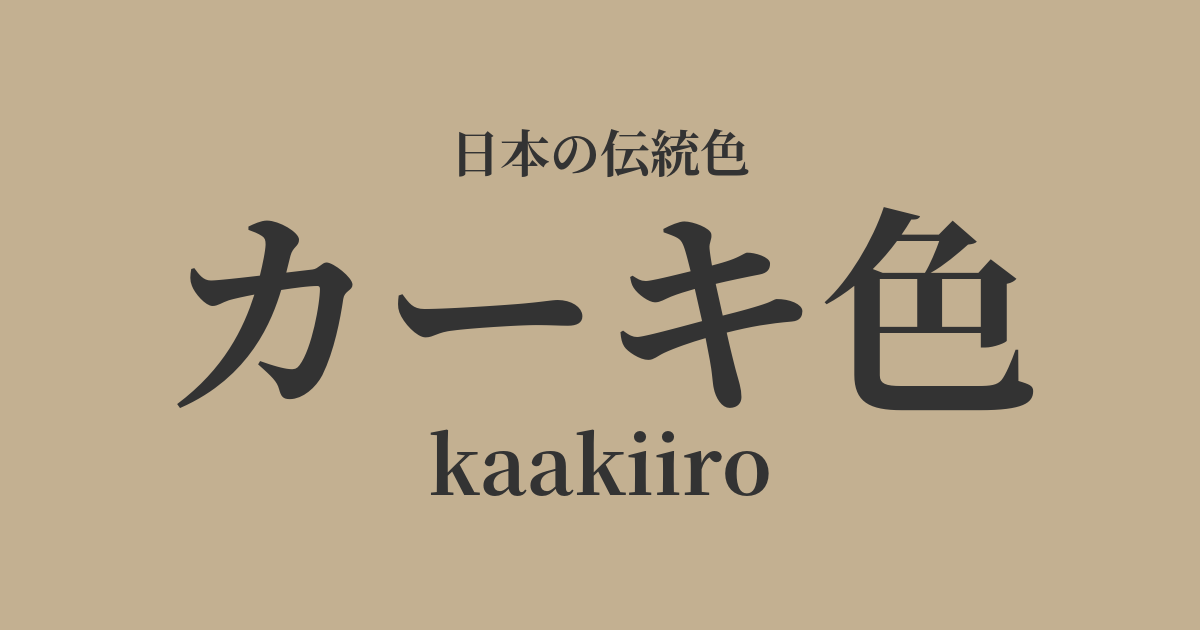
| Japanese color name | Khaki |
|---|---|
| reading | kaakiiro |
| HEX | #C3B091 |
| RGB | 195, 176, 145 |
What is khaki? Origin and etymology
The word khaki originates from the Hindi and Urdu word "khaki," meaning "dust." This is believed to be even older, stemming from the Persian word "khak," meaning "earth." It is said that in the mid-19th century, British troops stationed in India took advantage of the fact that their white uniforms were easily stained with dirt, and dyed them with curry powder and mud to enhance their camouflage.
This dusty color came to be called "khaki" and spread throughout the world as the color of military uniforms.
Khaki was introduced to Japan during the Meiji era and was primarily adopted as the color for army uniforms. At the time, it was widely known in Japan as "tsuchi-iro" (earth color) or, due to its use, "kokubō-shoku" (national defense color). Although it was a foreign color name, it was an earth tone that blended well with the Japanese climate, so after the war, its military connotations faded, and it became deeply ingrained in people's lives as a color for fashion and everyday items.
The historical background of the color khaki
The history of khaki in Japan is deeply intertwined with the modernization of military equipment during the Meiji era. In the Russo-Japanese War, which broke out in 1904 (Meiji 37), the Japanese Army fully adopted khaki uniforms, which were superior as camouflage, replacing the traditional dark blue uniforms. This is said to have had the practical effect of making it more difficult for soldiers to be spotted by the enemy on the battlefield.
Later, during the Showa era, as the wartime regime intensified, khaki was designated as the "national defense color" and was even used in the national uniform, becoming widely worn by ordinary citizens. During this period, khaki was seen as a color symbolizing practicality, strength, and the spirit of protecting the home front. After the war, its image underwent a complete transformation, and it has acquired new value in times of peace as a staple color in outdoor wear and casual fashion.
Related literature, waka poetry, and seasonal words
"Khaki" is a foreign color name that became popular in modern times, so it does not appear directly in classical literature such as The Tale of Genji or in traditional Japanese poetry. However, its hue is close to the traditional Japanese colors "ochre" and "earth," and these colors have long been recognized as representing the earth and nature.
In modern literature, particularly in works depicting war, "khaki" or "military color" frequently appears as a color symbolizing the atmosphere of the era. Depicted as the color of soldiers' uniforms or civilian clothing, it adds realism and tension to the stories, leaving a strong impression of the social conditions of the time on the reader. Through these works, khaki transcends being merely a color name, taking on meaning as a symbol that evokes memories of a specific era.
Color scheme preview
This is to check the readability of the text when this color is used as the background.
Khaki color scheme proposal
Indigo (#243A6A)
The warmth of khaki's earthy tones combined with the deep intelligence of indigo creates a sophisticated, mature impression. These two colors complement each other, creating a classic yet modern atmosphere, making this a popular color combination in fashion and interior design.
Persimmon color (#ED6D3D)
The combination with persimmon, which belongs to the same earth tone family, creates a rich and warm harmony reminiscent of autumn foliage and harvest. The vibrant persimmon accentuates the calmness of khaki, resulting in a color scheme that gives an energetic and natural impression.
White training (#FFFFFF)
When combined with a clean, bright white, the earthy tone of khaki is neutralized, resulting in a clean and refreshing impression. The clear contrast creates definition in the space, making it suitable for natural and minimalist designs.
Practical Scenes
In the world of fashion, khaki is an essential color for classic items such as trench coats, military jackets, and chinos. Its versatility makes it suitable for a wide range of styles, from casual to formal, and it's particularly valued as a base color in earth-toneコーディネートs.
In interior design, using it in wallpaper, sofas, rugs, etc., creates a calming and relaxing space. It pairs exceptionally well with natural materials such as wood and houseplants, and is effective in creating natural, industrial, and vintage-style spaces.
In web design and graphic design, its subdued tones evoke a sense of trust and stability, making it popular as a background or accent color. It is particularly favored on websites of outdoor brands, organic product companies, and companies focused on sustainability.