
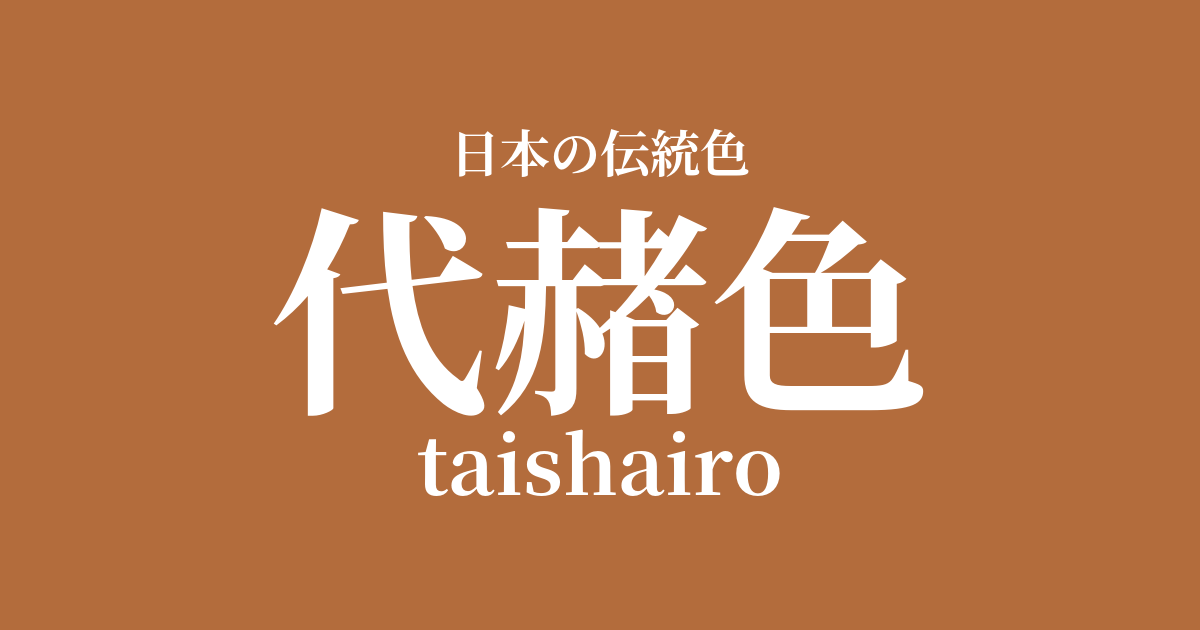
| Japanese color name | ochre |
|---|---|
| reading | taishairo |
| HEX | #B36C3C |
| RGB | 179, 108, 60 |
What is ochre? Origin and etymology
Daisha refers to a yellowish-reddish-brown color. Its name originates from a high-quality red clay called "daisha" that was produced in Daizhou (present-day Dai County) in Shanxi Province, China. This daisha is a natural mineral pigment whose main component is ferric oxide, and it has been used as a paint and dye all over the world since ancient times. In Japan, a similar red clay is called "soho" and has been deeply rooted in people's lives since ancient times as one of the most primitive pigments.
The use of "soho" (red) in Japan is very ancient, with traces of its use found in the coloring of Jomon period pottery and clay figurines. It was also widely used as a red pigment in Haniwa (clay figures) and murals in burial mounds during the Kofun period. Thus, soho is not a color derived from a specific dye, but rather a natural and simple hue obtained from the red clay of the earth itself, and is considered one of the important colors that form the foundation of Japanese color culture.
The historical background of ochre
The history of ochre is deeply intertwined with its history as a pigment. In Japan, red pigments are believed to have been used since the Paleolithic period, and their use can be confirmed in many archaeological artifacts, such as Jomon pottery and murals in burial mounds. In particular, the vividly colored murals of the Takamatsuzuka and Kitora burial mounds in Asuka Village, Nara Prefecture, effectively utilize ochre-based red pigments, conveying to us the advanced color techniques of that time.
From the Heian period onward, ochre continued to be used as an important pigment in various fields, including architectural decoration of shrines and temples, Buddhist statues, and paintings. In the Edo period, it became an indispensable pigment for painting (akae) on porcelain such as Imari ware and Kutani ware, and it became widely used in crafts that colored the lives of ordinary people. In this way, ochre is one of the fundamental colors that has supported Japanese art and crafts across generations.
Related literature, waka poetry, and seasonal words
The color ochre, derived from the word "soho" (ochre), which is the raw material for the color, appears as far back as the ancient Japanese poetry anthology, the Manyoshu. The word "sohobune" (ochre boat) is mentioned, referring to a boat whose hull was painted red with ochre. This suggests that people at the time painted their boats with colors for the purpose of warding off evil or for decoration, indicating that color was an integral part of their lives.
While the color "daishaku" (a shade of reddish-brown) is not frequently used as a direct term in Heian period literature such as "The Tale of Genji," descriptions of painting building pillars and furnishings with "tan" (a shade of red) are scattered throughout. This "tan," like ochre, refers to a red pigment and is an important element that reveals the sense of color and aesthetics of the aristocratic society of the time. From these descriptions, it can be inferred that daishaku-like colors were recognized as colors symbolizing sanctity and splendor.
Who will take my beloved, who is clinging to the bow of the red ship?
Color scheme preview
This is to check the readability of the text when this color is used as the background.
Ochre color scheme proposal
Indigo (#165E83)
This traditional Japanese color scheme features the warmth of ochre and the deep blue of indigo, complementing each other beautifully. This combination, often seen in pottery and textiles, creates a sophisticated impression of gravitas and tranquility.
Moss color (#69821B)
The ochre-red earth and deep moss green create a natural harmony reminiscent of the earth and forests. The combination of earth tones is easy on the eyes and is suitable for calm and reassuring spaces and designs.
Color produced (#FBFBF4)
Combining a warm ochre with a bright, soft off-white creates an overall light and sophisticated impression. This is effective when you want to achieve both warmth and cleanliness in a Japanese modern interior or web design.
Practical Scenes
In kimonos and Japanese accessories, ochre is a particularly suitable color for expressing the feeling of autumn. Incorporating it into obi sashes, obi ties, and haori jackets adds depth and warmth to the outfit, creating a calm and mature atmosphere. It also pairs exceptionally well with other earth tones, deep greens, and indigo.
In interior design, using ochre in accent walls or fabrics can create a warm and inviting space. It pairs particularly well with wooden furniture and houseplants, making it ideal for those who prefer a natural and calming atmosphere. Even incorporating it partially with cushions or rugs can add warmth to the entire room.