
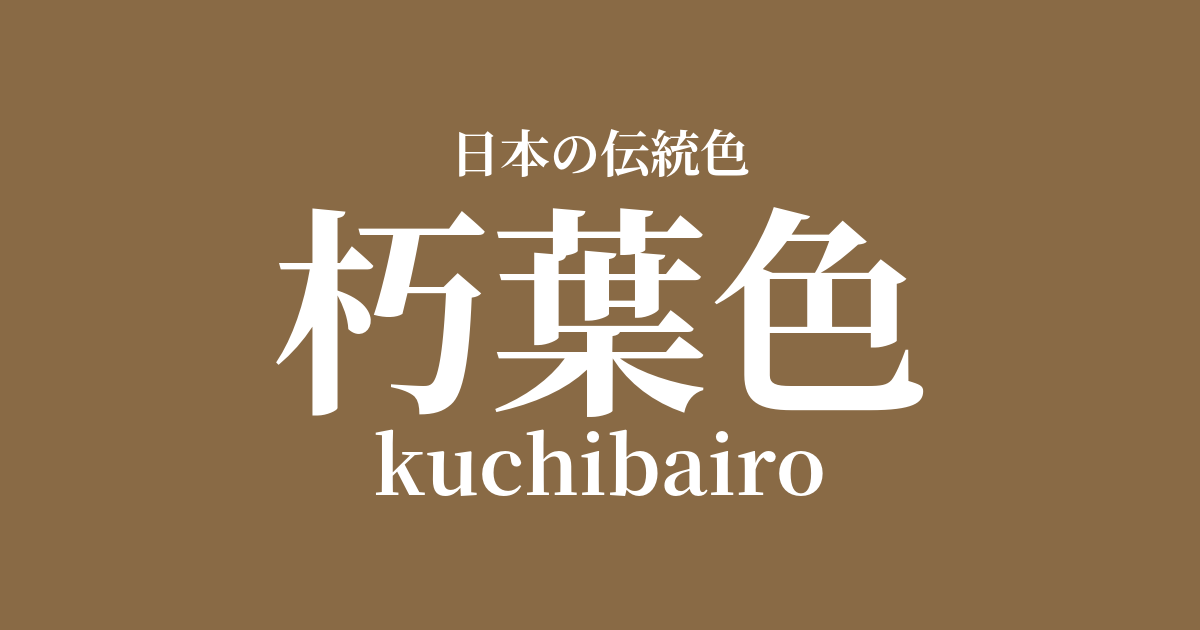
| Japanese color name | Withered leaf color |
|---|---|
| reading | kuchibairo |
| HEX | #896A45 |
| RGB | 137, 106, 69 |
What is "withered leaf color"? Origin and etymology.
As the name suggests, the color of decaying leaves, as they fall from trees in autumn and return to the soil, is derived from the color of decaying leaves. It is a color name born from the Japanese sensibility of finding beauty in the changing seasons of nature. Decaying leaves are not a single color, but rather a wide range from reddish to yellowish, and in the Heian period, they were given detailed names such as "red decaying leaves," "yellow decaying leaves," and "blue decaying leaves" to distinguish them by subtle differences in hue.
These colors are believed to have been created by combining plant dyes such as gardenia, Japanese knotweed, and sappanwood.
Historical background of the withered leaf color
The color of withered leaves was particularly favored during the Heian period. It frequently appeared in literary works such as "The Tale of Genji," and by being depicted as the color of the characters' clothing, it played an important role in expressing the characters' feelings and the sense of the season. Heian aristocrats were keenly aware of the subtle changes in the color of withered leaves and incorporated them into the layering of their clothing, thus building a sophisticated color culture. It continued to be used in the attire and furnishings of samurai families from the Kamakura period onward, making it one of the colors that has been cherished across generations.
Related literature, waka poetry, and seasonal words
The color of withered leaves has been celebrated in many literary works as a symbol of autumn scenery and the poignant beauty of things. In the "Autumn Leaves" chapter of "The Tale of Genji," there is a scene in which Hikaru Genji wears withered leaf-colored clothing, highlighting its elegance. Furthermore, withered leaves are also used as a seasonal word for autumn, and in the world of waka and haiku poetry, they have functioned as a word to express a sense of melancholy for the passing season and a deep insight into the laws of nature.
Through these works, it becomes clear that the color of withered leaves is not merely a color, but is deeply intertwined with the spiritual culture of the Japanese people.
As the autumn leaves fall from the rocky cliffs of the deep mountains, the withered leaves below appear even more vibrant in color.
Color scheme preview
This is to check the readability of the text when this color is used as the background.
A proposed color scheme in a faded leaf color.
Persimmon color (#EA7243)
The combination of withered leaf color and persimmon color, both representative of autumn, evokes the scenery of deepening autumn. The harmony of the warm colors creates a warm and calming impression. This color scheme is suitable for creating a traditional Japanese atmosphere.
Tokiwa (#007B43)
The combination of decaying leaf color and evergreen color, which remains green even in winter, expresses the cycle of life and the changing seasons. These contrasting colors found in nature complement each other, creating a powerful yet calming impression.
Indigo (#274A78)
Combining deep indigo with withered leaf brown creates an intelligent and sophisticated impression. The yellowish-brown withered leaf brown enhances the depth of the indigo, while the indigo tones down the warmth of the withered leaf brown, resulting in a modern and calm atmosphere. This color scheme is suitable for both Japanese and Western styles.
Practical Scenes
With its calming hue, the color of withered leaves is widely used in the world of traditional Japanese clothing. It is especially often incorporated into kimonos, obi sashes, and accessories worn during the autumn season, making it an ideal color for expressing a sense of the season. Its warm, naturally derived tone gives the viewer a sense of comfort and elegance.
In interior design, incorporating a faded leaf color into accent walls, furniture, and fabrics brings warmth and depth to a space. It pairs exceptionally well with natural materials such as wood and earthen walls, creating a natural and calming atmosphere. It is suitable for Japanese modern and country-style interiors.
In web and graphic design, withered leaf green can be used as a background or accent color. As one of the earth tones, it has a high affinity with brand images themed around nature and history, such as organic products and traditional crafts. It is an effective color when you want to convey a sense of trust and stability.