
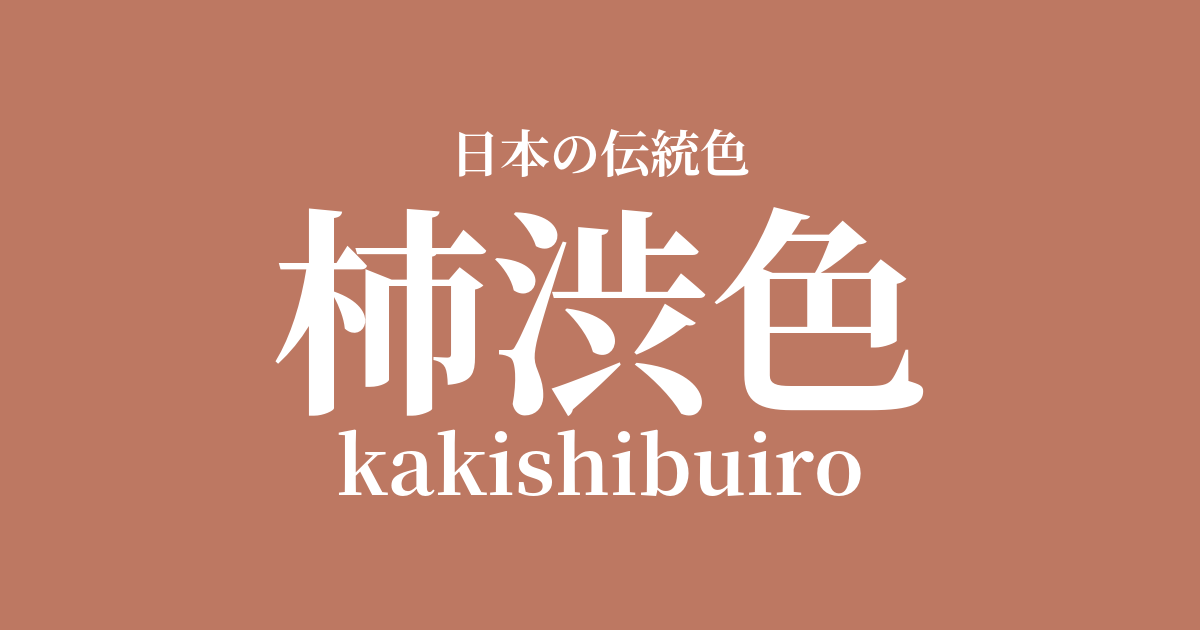
| Japanese color name | Persimmon color |
|---|---|
| reading | kakishibuiro |
| HEX | #BD7862 |
| RGB | 189, 120, 98 |
What is persimmon tannin color? Origin and etymology
Kakishibu color refers to a reddish-brown color achieved by dyeing with "kakishibu," a liquid obtained by fermenting and aging the juice extracted from unripe, green persimmons. This kakishibu has long been known for its waterproofing, preservative, insect-repellent, and strengthening properties, and has been widely used not only as a dye but also as a paint. Its unique hue is characterized by its oxidative properties when exposed to sunlight and air, deepening over time.
It can be described as a color that is deeply rooted in Japanese life, possessing both practicality and a simple beauty.
Historical background of persimmon color
The history of using persimmon tannin is long, and it is mentioned as "kaki no abura" (persimmon oil) in the Wamyō Ruijushō, a dictionary compiled during the Heian period. At that time, it is said to have been mainly used for waterproofing and preserving paper and wood. From the Kamakura period to the Muromachi period, it was also used to reinforce the clothing and armor of samurai.
During the Edo period, persimmon tannin became widely used as an indispensable part of everyday life for ordinary people. In particular, it was used to coat Japanese umbrellas, fishing nets, sake bags, raincoats, and fan frames, and was highly valued for increasing the durability of daily necessities. Persimmon tannin also played an important role in the field of crafts, such as being used to bond and reinforce the paper used in Ise-katagami (Ise stencil paper).
After the Meiji era, the demand for persimmon tannin temporarily declined when inexpensive, high-performance chemical paints and dyes appeared. However, in recent years, its safety, environmental friendliness, and unique texture that improves with use have been re-evaluated, and it is once again attracting attention in fields such as clothing, building materials, and interiors.
Related literature, waka poetry, and seasonal words
Persimmon brown, due to its practicality, was a color closely tied to the lives of ordinary people and rarely appeared in the opulent literary works depicting aristocratic culture. However, when depicting life in rural or fishing villages, its simple hue is sometimes used to symbolize the everyday life of the people. As the color of well-worn tools and work clothes, it expresses a steady and robust way of life.
In the world of haiku, "persimmon tannin" itself is treated as a seasonal word for autumn. This stems from the fact that the persimmons used as the raw material ripen in the autumn, and that the process of making persimmon tannin is traditionally carried out in the autumn. The process of applying persimmon tannin and its scent evoke images of the bountiful autumn harvest and preparations for winter, and have been used as a subject for haiku that evokes a strong sense of the season.
The scent of persimmon tannin lingers on this paper garment.
Color scheme preview
This is to check the readability of the text when this color is used as the background.
A color scheme proposal in persimmon tannin.
Indigo (#274054)
Persimmon brown and indigo blue are both practical colors that have been used in the daily lives of ordinary people in Japan since ancient times. The combination of the simple and warm persimmon brown and the deep, calming indigo blue creates a traditional and reassuring color scheme. It is suitable when you want to emphasize a Japanese aesthetic.
Maroon (#764D3B)
Combining persimmon brown with a brownish chestnut brown creates a natural and unified color scheme. The combination of earth tones gives a calm and peaceful impression. It also pairs very well with designs that make extensive use of natural materials such as wood and earth.
Blue gold (#FABE22)
The vibrant yet distinctly Japanese turmeric color adds brightness and elegance to the subdued tones of persimmon tannin. This color scheme evokes the autumn harvest and colorful foliage, expressing richness and warmth. Using it as an accent color tightens the overall design.
Practical Scenes
In the world of kimonos, "persimmon tannin dyeing" is known for its unique texture and the way it ages beautifully. It's particularly popular for everyday wear, work clothes, and obi sashes, appealing for its durability and the way it develops a richer character with use. Its simple, subdued colors are easy to coordinate with other colors.
In interior design, using persimmon tannin color in wallpaper, building materials, and furniture creates a warm and calming atmosphere. It harmonizes well with Japanese modern styles and natural spaces that utilize natural materials. It also pairs exceptionally well with materials such as wood, tatami mats, and Japanese paper.
In web and graphic design, earth tones can be used as background or accent colors. They are effective when you want to convey an image of trustworthiness, tradition, or nature. When combined with other calming colors, they can express a sophisticated Japanese atmosphere.