
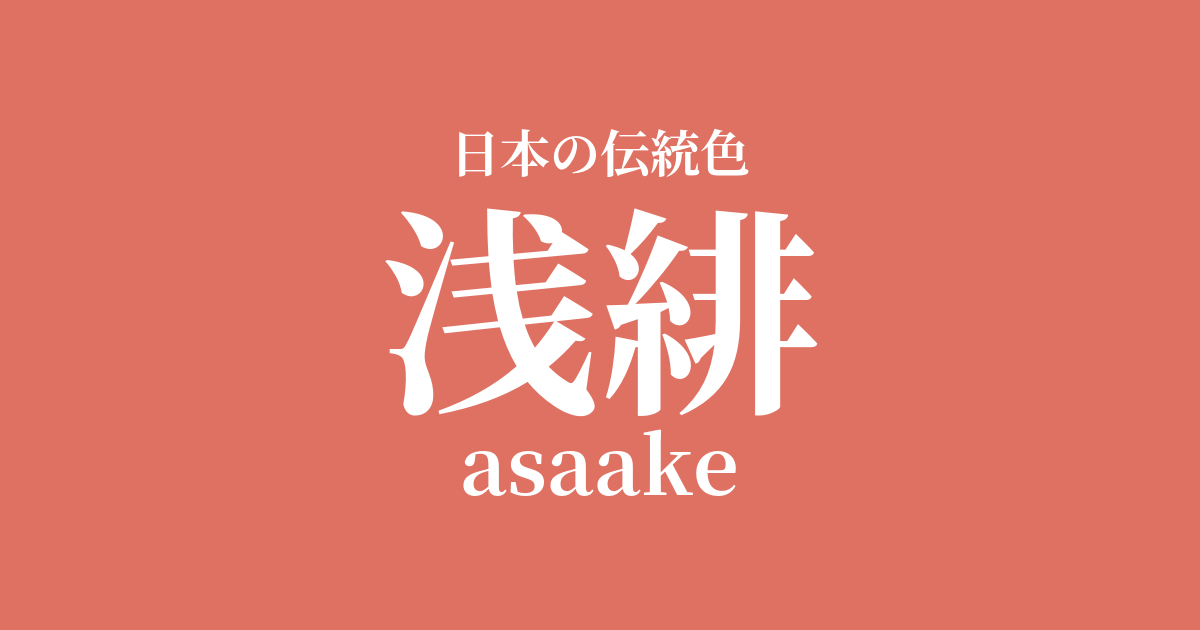
| Japanese color name | Asahi |
|---|---|
| reading | asaake |
| HEX | #DF7163 |
| RGB | 223, 113, 99 |
What is Asahi? Origin and Etymology
Asaake refers to a pale reddish-yellow color dyed using the roots of the madder plant. The character "緋" can also be read as "ake," meaning crimson or deep red, but the addition of "浅" indicates its lighter shade. It is said to have been called "asakiake" in the past. This color is a relatively light dye among madder dyes, and as its name suggests, it expresses a gentle and soft red, like the sky at dawn or a flame just beginning to burn.
Historical background of light crimson
Asabi (light crimson) was considered the second most noble color after ōni (yellowish-orange), which was designated as the color of the robe worn by the emperor in the Engishiki, a legal code of the Heian period. Specifically, it was one of the "forbidden colors" that no subject other than the crown prince was permitted to wear. Due to this regulation, asabi was strictly controlled as a color symbolizing high status, and only those of special status were allowed to wear it.
For this reason, light crimson has left its mark on history as a color that is more than just a color, but one that carries authority and prestige.
As time went on, the system of forbidden colors gradually became a mere formality, but the noble image associated with light crimson was passed down to later generations. In samurai society, light crimson and scarlet were sometimes used in weapons and clothing, but their use was still considered limited. In the Edo period, safflower dyeing became popular among commoners, but traditional light crimson dyed with madder continued to be recognized as a special color due to its historical background.
Related literature, waka poetry, and seasonal words
In "The Tale of Genji," a representative work of Heian literature, various traditional colors are depicted as the colors of the characters' clothing, and "asahi" (light crimson) is said to be one of them. It is said that by depicting the color of the clothing and furnishings of noble characters, it had the effect of expressing the high status and refined aesthetic sense of those characters. In a story where color plays an important role, asahi is effectively used as a color that symbolizes noble characters.
While the color light crimson itself is rarely treated as a seasonal word, related words like "crimson" and "madder red" are sometimes used as seasonal words for autumn. This is because the madder plant has red roots that are harvested in autumn, and thus it is associated with autumn scenery such as the sunset sky dyed crimson. In literary works, the color light crimson can be found in the changing seasons of nature, such as the sunrise or sunset sky, or the beginning of autumn leaves.
I plant a marker in the crimson field; my longing heart is at your mercy.
Color scheme preview
This is to check the readability of the text when this color is used as the background.
Light Crimson Color Scheme Proposal
Dark blue (#0F2350)
The warm red of light crimson and the deep, calming blue of dark indigo are close to complementary colors, enhancing each other's beauty. This color scheme gives a classic and dignified impression, reminiscent of the attire of Heian period aristocrats. It is also highly visible, bringing stability and elegance to the design.
Color produced (#FBFBF4)
The gentle reddish hue of the light crimson is enhanced by the natural, soft white of the off-white. The overall color scheme is bright, warm, and gives a calm impression. It is suitable for interiors with a Japanese aesthetic and web designs with a natural atmosphere, creating a friendly and approachable feel.
Young bamboo green (#78B474)
The light crimson red and the vibrant green of young bamboo green are contrasting colors that enhance each other's saturation. They evoke a sense of vitality and freshness, like the young leaves and flowers of spring. Although they are traditional colors, they give a modern and lively impression, making them effective for package design and as accent colors.
Practical Scenes
In the world of kimono, light crimson is sometimes used for formal wear such as visiting kimonos and furisode (long-sleeved kimonos). When used in clothing for young women in particular, it can achieve both elegance and sophistication. When incorporated as an accent in accessories such as obi (sash) and obi-jime (sash cord), it adds warmth and a noble impression to the entire outfit.
In interior design, incorporating light crimson into accent walls, cushions, curtains, and other fabrics brings warmth and sophistication to a space. When added to a natural space based on white or wood tones, it creates a striking Japanese modern impression. Adjusting the color temperature of the lighting will reveal an even deeper expression.
In web and graphic design, light crimson is an effective accent color for buttons and headings that you want to attract attention. Combining it with an off-white or light gray background creates an elegant and calm impression while maintaining readability. It is particularly well-suited to content related to Japanese tradition and culture.