
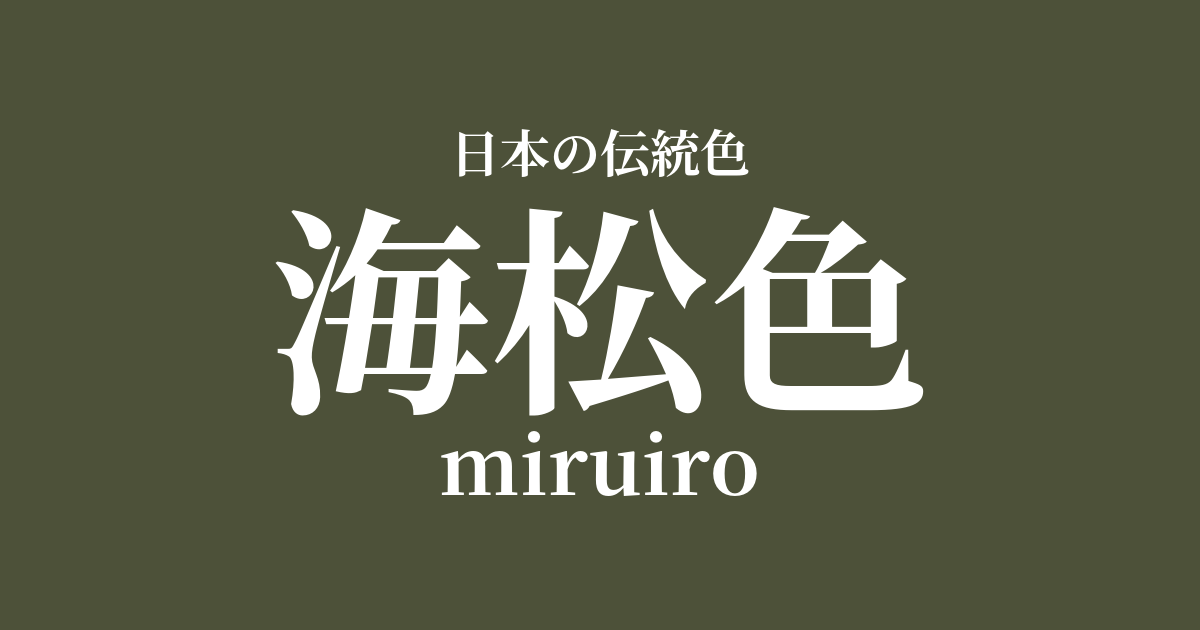
| Japanese color name | sea pine color |
|---|---|
| reading | miruiro |
| HEX | #4D5139 |
| RGB | 77, 81, 57 |
What is "Miru-iro" (seaweed green)? Origin and etymology.
The name "miru-iro" (seaweed green) originates from "miru," a type of green algae that grows on rocky reefs in shallow seas. This seaweed has been used for food and medicine since ancient times. Its deep, slightly muted yellowish-green color is considered the direct origin of the color name. Miru gets its name from its resemblance to pine needles, and its hue has become established as one of the colors that symbolize the Japanese view of nature.
The word "umimatsu" (seaweed) was used in waka poetry as a pun on the homophone "miru" (to see), expressing a wish to meet a loved one. It was also associated with "miru," meaning to rule or govern, and was therefore considered an auspicious word. These wordplays and auspicious connotations contributed to the fact that the color "umimatsu" (seaweed) became more than just a color description; it became a color with a cultural background that people cherished.
The historical background of the seaweed color
The history of the seaweed green color is long, dating back to the Heian period. The section on the Imperial Sewing Bureau in the Engishiki (a compilation of laws and regulations from the Heian period) describes the dyes and methods for dyeing seaweed green, indicating that it was recognized as an official color even then. Heian aristocrats favored this color, and the combination of "seaweed green" and "miru" (海松) even existed in the "layered color combinations" of clothing.
During the Kamakura period, its subdued hue and auspicious connotations made it popular among the samurai class. In particular, it is said that this color was sometimes used in armor and clothing as a good luck charm to pray for victory in battle. In the Edo period, it became popular among commoners as well, and was widely used in kimonos, obi sashes, and accessories.
Related literature, waka poetry, and seasonal words
The color "miru-iro" (seaweed green) can also be found in classical literature. A prime example is the "Matsukaze" chapter of "The Tale of Genji." Among the garments that Lady Akashi gives to Hikaru Genji is a fabric of "miru-iro," which is effectively used as a color symbolizing the seaside scenery and the emotions of the characters.
In the world of Japanese poetry, "umizu" (seaweed) frequently appears as a pun on "miru" (to see), and was used to express feelings of love or longing for reunion. For example, the poem "Wabinureba ima wa ta onaji Naniwa naru mi o tsukushite mo awamu to zo omou" (I am weary now, but I will risk my life in Naniwa) also refers to the sea of Naniwa where umizu can be found. Furthermore, umizu itself is sometimes used as a summer seasonal word in haiku.
For your sake, the seaweed I cut at the offshore harbor—will the sleeves of this fisherman's robe not get wet?
Color scheme preview
This is to check the readability of the text when this color is used as the background.
A proposed color scheme in seaweed green.
Kutsuha color (#915E33)
The deep green of seaweed and the reddish-brown of withered leaves are both earth tones found in nature. They evoke autumn forests and desolate landscapes, creating a calm, profound, and traditional harmony. This is a classic color scheme also seen in the layered color combinations of kimono.
White training (#F3F3F3)
Combining a deep, muted seaweed green with a clean, bright white creates a strong contrast. The richness of the seaweed green is highlighted, giving an impression of cleanliness and elegance. This sophisticated color scheme is easy to apply to modern designs.
Suou (#9E3D3D)
The yellowish-green of seaweed and the reddish-purple of sappanwood are close to complementary colors, vividly enhancing each other's beauty. This combination gives a strong, slightly lustrous impression, reminiscent of the sophisticated aesthetic of the Edo period. It is a unique yet harmonious color scheme.
Practical Scenes
In traditional Japanese clothing, the seaweed green color is widely used for kimonos, obi sashes, and haori jackets due to its calm and dignified appearance. It is particularly popular as a base color for men's kimonos and elegant visiting kimonos that can be worn by people of all ages. When combined with colors such as withered leaf green or brown, it can also evoke the feeling of autumn.
In interior design, it is useful for creating a Japanese modern space. Incorporating it as an accent in wallpaper, sliding doors, or cushions brings depth and tranquility to a room. Because of its natural color, it goes very well with solid wood furniture and tatami mats.
In web design and graphic design, using it as a background or key color can convey a sense of tradition and reliability. It is suitable for websites of long-established companies and content that promotes Japanese culture. When combined with white or off-white, it can create a sophisticated impression.