
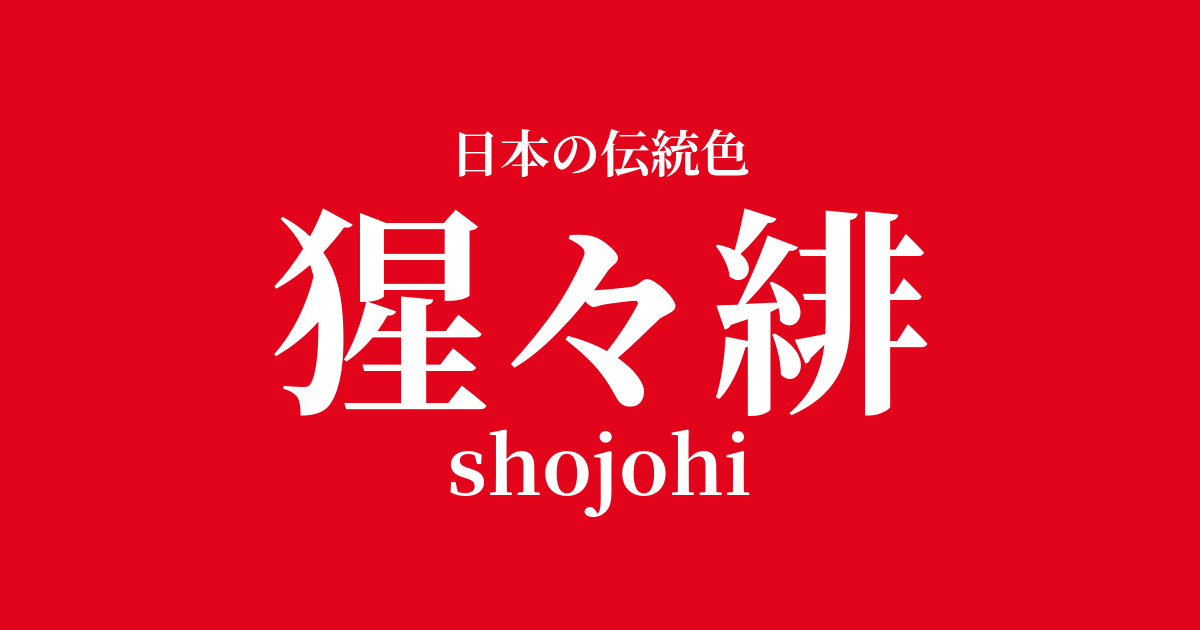
| Japanese color name | scarlet |
|---|---|
| reading | shojohi |
| HEX | #E2041B |
| RGB | 226, 4, 27 |
What is Shōjōhi? Origin and etymology
The origin of the term "shōjōhi" (猩々緋) comes from the mythical Chinese creature "shōjō." The shōjō is a mythical creature with a red face that is said to understand human language and love sake. Its blood is said to be an extremely vivid red, and it is believed that any cloth dyed with it will never fade. From this legend, an extremely vivid crimson color came to be called "shōjōhi." This mythical creature also plays an important role in the Noh play "Shōjō."
Another possible origin is the dye made from cochineal insects, which were brought to Japan through trade with the Nanban (Southern Barbarians). Woolen fabrics (rasha) dyed with this dye had a vivid red color that could not be achieved with conventional Japanese dyes. A leading theory suggests that this bright crimson imported from abroad was likened to the blood of the legendary orangutan and called "shōjōhi" (瞩瞩緋).
Historical background of the color Shōjōhi
Shōjōhi (a type of scarlet) became widely known in Japan thanks to the Nanban trade (trade with European countries) from the late Muromachi period to the Azuchi-Momoyama period. Portuguese and Spanish merchants brought "Shōjōhi Rasha," a woolen fabric dyed with cochineal. This vivid red could not be achieved with Japanese dyes at the time and was highly valued by powerful figures such as Oda Nobunaga and Toyotomi Hideyoshi.
In particular, Sengoku period warlords had their battle jackets made from shōjōhi woolen cloth and wore them on the battlefield. This was because its vivid color was considered a symbol of authority and martial prowess. In the Edo period, shōjōhi became popular among wealthy townspeople and was used in kimonos, obi sashes, and furnishings. However, because the raw materials were imported and expensive, it remained a color that ordinary people could not afford but longed for.
Related literature, waka poetry, and seasonal words
Shōjōhi (a type of reddish-brown) has been symbolically used in literature and performing arts due to its vividness. Particularly famous is the Noh play "Shōjō." In this story, a Shōjō appears to a filial sake seller and gives him a sake jar that never runs out. The vivid red of the costume worn by the Shōjō when he dances strongly reinforces the image of this color.
In early modern Japanese literature, the color of scarlet appears as a luxurious color for clothing in works such as Ihara Saikaku's "The Life of an Amorous Man." It was often depicted as a color symbolizing wealth, splendor, and sometimes even exoticism. Although not directly a seasonal word, its vivid red color is sometimes indirectly used in haiku and other poetry to evoke images of strong summer sunlight or festival scenes.
A scarlet felt carpet is laid out, and the hina dolls are placed on it.
Color scheme preview
This is to check the readability of the text when this color is used as the background.
Scarlet color scheme proposal
Pine green (#335436)
The complementary relationship between red and green creates a color scheme where each enhances the other. The vibrancy of the scarlet is balanced by the depth of the pine green, giving a powerful yet calm impression. This is a traditional color combination often seen in samurai warriors' battle surcoats, and it exudes a dignified atmosphere.
Golden (#E6B422)
The combination of the vibrant and authoritative colors of the scarlet hue is further enhanced by the gold. This color scheme symbolizes the opulent culture of the Azuchi-Momoyama period and is suitable for festive occasions and special decorations. It creates a very rich and eye-catching impression.
Lapis Lazuli (#192F60)
The contrast between vibrant red and deep blue creates a modern and sophisticated impression. Respecting the strength of each color, the overall effect is refined and dignified. This color scheme has a strong visual impact and is easily memorable.
Practical Scenes
In the world of kimono, Shōjōhi (a type of reddish-brown) is often used for formal wear such as furisode (long-sleeved kimono) and uchikake (wedding kimono). In particular, its vibrant red color creates a celebratory atmosphere when used for bridal attire or celebratory occasions. Incorporating it as an accent in accessories such as obi (sash), obiage (sash scarf), and obijime (sash cord) also has the effect of making the entire outfit more elegant and refined.
In interior design, it is effective to use it as an accent color in cushions, rugs, or parts of wallpaper. It adds energy and warmth to the space and becomes a focal point that draws the eye. When combined with wood or neutral colors such as black and white, the vibrancy of the scarlet color stands out, creating a modern and sophisticated space.
In web and graphic design, the color Scarlet (or crimson) is used for buttons, headings, and logos that you want to attract attention. Its strong appeal helps guide the user's gaze and highlight important information. However, because it can create a feeling of oppression if used over a large area, it is recommended to use it effectively as an accent color.