
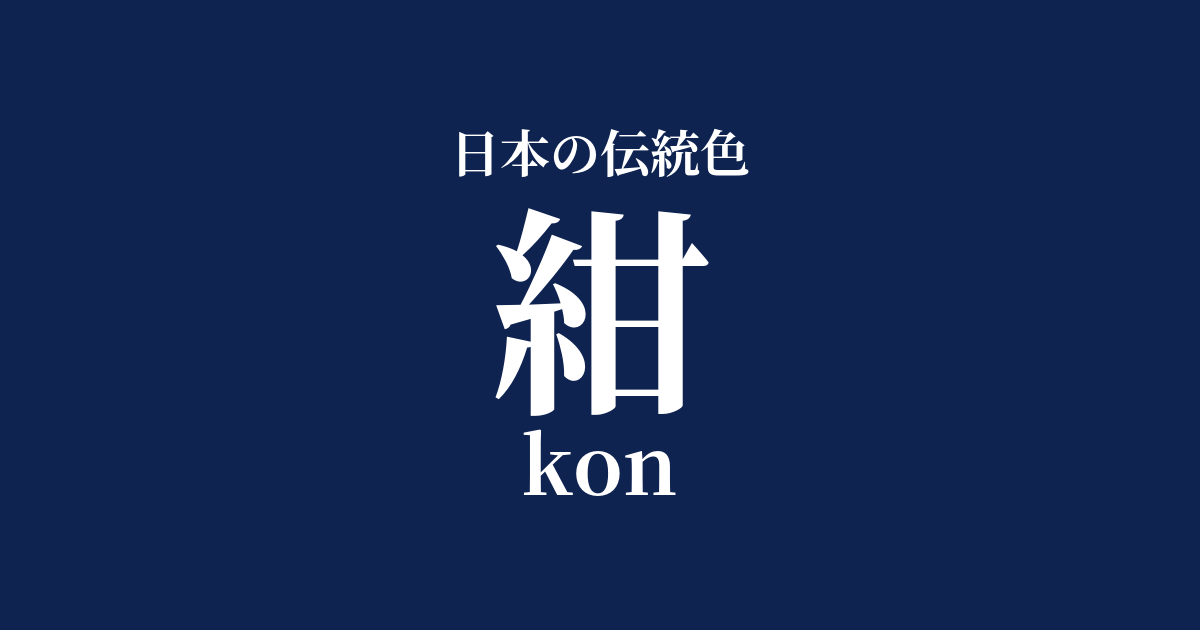
| Japanese color name | 紺 |
|---|---|
| reading | kon |
| HEX | #0F2350 |
| RGB | 15, 35, 80 |
What is "navy blue"? Origin and etymology
Navy blue refers to the deepest shade of color that can be achieved through indigo dyeing. Its origin is said to be derived from the Chinese word "kan." Indigo dyeing is a dyeing technique that uses a dye (sukumo) made by fermenting the leaves of the indigo plant, which belongs to the Polygonaceae family. The color gradually deepens as the process of dipping the fabric in the dye and exposing it to the air is repeated many times. The deep, purplish-blue color obtained in the final stage of this process is called navy blue.
The famous proverb, "Born from indigo, yet bluer than indigo," refers to the fact that repeated dyeing results in a blue far deeper and more vibrant than the original color of the indigo leaves. As this saying suggests, the deep blue color achieved through many layers of meticulous dyeing is a symbolic color that can be considered the culmination of indigo dyeing techniques. Its depth and durability have made it beloved by many people since ancient times.
The historical background of navy blue
The history of navy blue is long, with its existence confirmed as far back as the Nara period. During the Heian period, it was used as the color of court nobles' attire, and records show that it was treated as a noble color second only to deep purple within the system of "forbidden colors" and "permitted colors" that indicated rank. In this era, navy blue was a special color worn by people of high status.
With the rise of the samurai class in the Kamakura period, navy blue became particularly favored by them. One reason for this was that the deep indigo color, known as "kachi-iro," was considered auspicious because it sounded similar to "kachi" (victory). It also suited the samurai's spirit of simplicity and strength, and was frequently used in the decoration of armor, such as the lacing threads.
During the Edo period, cotton cultivation spread, and indigo dyeing became widespread among the common people. Indigo-dyed clothing, known for its durability, resistance to fading, and antibacterial and insect-repellent properties, was highly valued as work clothes and everyday wear. Among them, the deepest navy blue was a color that ordinary people aspired to. During this era, indigo blue, which became deeply rooted in Japanese life, began to attract attention from overseas as "Japan Blue."
Related literature, waka poetry, and seasonal words
Due to its deep and serene hue, navy blue has been used in literary works to represent the night sky, the deep sea, silence, and solemnity. In classical Heian period literature, including "The Tale of Genji," navy blue is depicted as the color of the characters' clothing, playing an important role in symbolizing their social status, dignity, and emotions.
While there aren't many works in the world of waka and haiku that directly feature the color navy blue as their theme, its presence can be felt indirectly, such as when summer night skies are described as "navy blue skies" or when poems are written about indigo-dyed clothing. In particular, haiku from the Edo period onward, when indigo dyeing became deeply rooted in the lives of ordinary people, often feature navy blue ikat kimonos, conveying the atmosphere of daily life at that time.
While the word "navy blue" itself doesn't directly exist as a seasonal word, the "indigo flower," the raw material for indigo dye, is considered an autumn seasonal word. When you consider how this delicate flower gives rise to such a deep and beautiful navy blue, you can feel the profound depth of Japan's color culture as the seasons change.
The loofah flowers have bloomed in the dark blue ikat pattern.
Color scheme preview
This is to check the readability of the text when this color is used as the background.
Navy color scheme proposal
White (#FFFFFF)
The combination of navy blue and white is a fundamental color scheme that conveys cleanliness and elegance. It has been used for centuries in traditional Japanese patterns such as the seigaiha (wave pattern) and in yukata (summer kimono) designs. The strong contrast enhances each other's beauty, creating a clear and dignified impression.
Golden (#E6B422)
Combining deep navy blue with shimmering gold creates a luxurious and dignified impression. This combination, also seen in screen paintings and armor decorations from the Azuchi-Momoyama period, achieves a balance of dignity and splendor. It is suitable for special occasions and designs where a sense of luxury is desired.
Crimson (#B7282E)
The deep blue of navy and the deep red of madder, reminiscent of twilight, are close to complementary colors, yet they exhibit a calm harmony. Evoking the colors of the sky before nightfall, they create an emotional and profound impression. They enhance each other's beauty while creating a dramatic atmosphere.
Practical Scenes
In the world of kimono, navy blue is a basic color widely used by both men and women. It is especially a popular and standard color for men's kimono, hakama, and yukata. Furthermore, navy blue kimono with white or gold patterns gives a stylish and sophisticated impression, making it suitable for a wide range of occasions, from formal to casual.
In interior design, navy blue has the effect of bringing calmness and depth to a space. When used in large areas such as wallpaper, curtains, and sofas, it can create an intelligent and modern atmosphere. Combining it with white, gray, or wood-grain furniture allows for the creation of a sophisticated space without becoming too heavy.
In web and graphic design, navy blue is frequently used to express trustworthiness and integrity. It tends to be a popular choice for corporate colors, and for websites of financial institutions and educational institutions. When used as a background color, it can also enhance the readability of white text.