
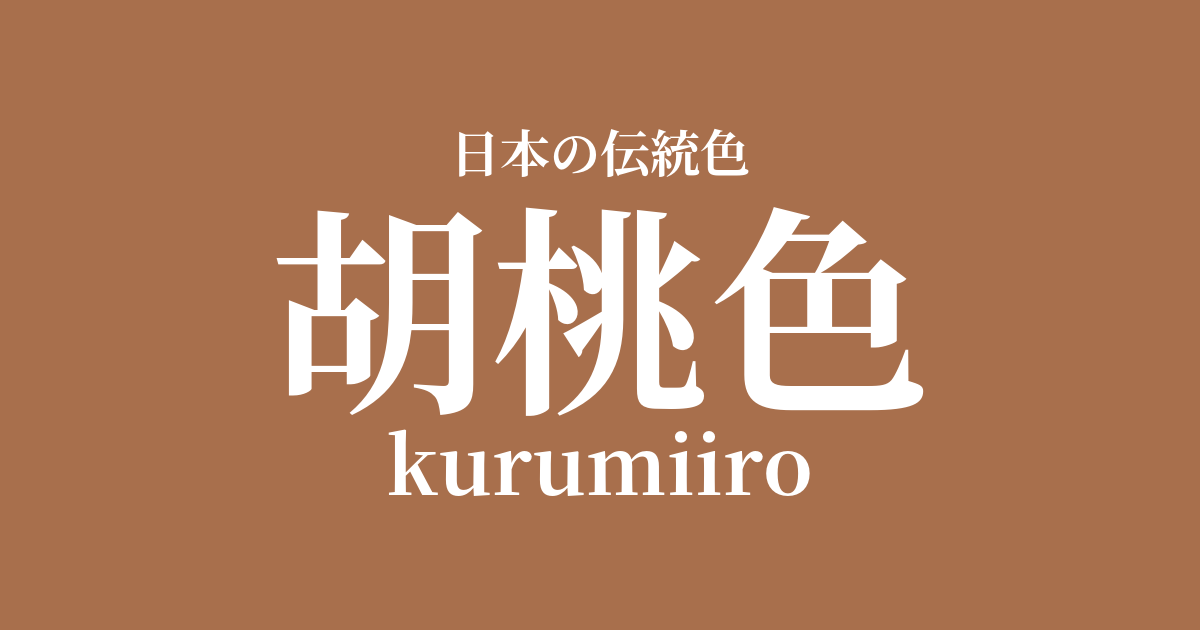
| Japanese color name | Walnut color |
|---|---|
| reading | kurumiiro |
| HEX | #A86F4C |
| RGB | 168, 111, 76 |
What is walnut color? Origin and etymology
Walnut brown is a reddish-brown color achieved by dyeing with the bark, unripe walnut skins (green walnuts), and root bark of the walnut tree. Walnut dyeing has long been known as a durable dye that is resistant to sunlight and washing, and it dyes relatively well even without special mordants. Depending on the part of the walnut tree used for dyeing, the type of mordant, and the material being dyed, a wide range of shades can be expressed, from yellowish-brown to grayish-brown.
Those natural, simple, and warm colors have become deeply rooted in people's lives.
The Japanese character for "walnut" (胡桃) is said to have been given when it was introduced from China, meaning "peach from the land of the Hu (Western nomadic peoples)." It has grown wild in Japan since ancient times, and has been unearthed from Jomon period ruins. Because the dyeing technique using this familiar plant did not require any special skills or tools, it became widely popular among ordinary people. As a dye closely tied to daily life, its color became familiar to people and became established as one of Japan's traditional colors.
Walnut-colored historical background
The history of walnut dyeing is very old, and although its origins are uncertain, there are fabrics among the treasures of the Shōsōin that are believed to have been dyed with walnuts. From this, it is thought that the dyeing technique was established at least by the Nara period. From ancient to medieval times, it is said that it was used to dye the clothes and armor of samurai due to its durability.
During the Heian period, unlike the vibrant colors popular among the aristocracy, walnut brown was primarily a practical color used by commoners and the samurai class. However, in the Edo period, due to the shogunate's sumptuary laws, subdued colors such as brown and gray became popular among commoners. Walnut brown was one of these diverse colors, known as "forty-eight shades of brown and one hundred shades of gray," and it became widely used in kimonos and accessories, becoming a more common color that permeated people's lives.
Related literature, waka poetry, and seasonal words
The color walnut yellow doesn't often appear directly as "walnut yellow" in literary works. However, walnuts, the source of the dye, have long been celebrated in waka and haiku poetry as part of the natural landscape and daily life of Japan. In the world of haiku in particular, "walnut" is used as a seasonal word for autumn, symbolizing the harvest season and the preparations for winter.
For example, Matsuo Basho wrote the haiku, "The figure of someone cracking walnuts, hibernating in winter," which depicts a person cracking walnuts in a quiet winter room. This haiku doesn't describe the color of walnuts themselves, but it evokes the warm, homey atmosphere that walnuts bring, and the activities undertaken to survive the harsh winter. In this way, walnuts have been treated in Japanese literature as a motif that evokes richness and the warmth of everyday life.
The figure of someone cracking walnuts from behind, or hibernating in winter
Color scheme preview
This is to check the readability of the text when this color is used as the background.
Walnut-colored color scheme proposal
Chestnut skin tea (#6D3C14)
The combination of walnut brown and chestnut brown, both plant-derived browns, creates a natural and warm harmony. The deep chestnut brown complements the walnut brown, giving the overall look a sense of calm and sophistication. This color scheme is suitable for autumn attire and interior design.
Blue gold (#FABE29)
By combining it with a vibrant yellow turmeric color, the calm impression of walnut brown is given brightness and vibrancy. This color scheme evokes the autumn foliage and harvest, and the resulting visual contrast makes it effective as an accent for accessories and designs.
鶸Menghuang (#82AE46)
The bright green of young leaves, known as "hisagi-moegi," is almost a complementary color to the brownish "kurumi-iro," and they enhance each other's beauty. This color scheme evokes trees and leaves in nature, creating a vibrant sense of life and tranquility. It is well-suited for designs with a natural atmosphere.
Practical Scenes
In the world of kimono, walnut green is a common color found in everyday kimono fabrics such as pongee silk and cotton. Its simple and timeless hue makes it easy to coordinate with a wide range of obi sashes and accessories. Especially in autumn, it's a valuable color for expressing the season and creating a calm, mature look.
In interior design, walnut contributes to creating a warm and calming space. Incorporating it into flooring or wooden furniture creates a natural and inviting atmosphere. Furthermore, using it in fabrics such as wallpaper, curtains, and cushions brings a gentle sense of unity to the entire room.
In web and graphic design, earth tones are often used to convey a sense of trust and security. When used as a background color, they enhance other colors while creating a visually pleasing layout. They are particularly well-suited for designs that want to convey the image of organic products, traditional crafts, or natural lifestyle brands.