
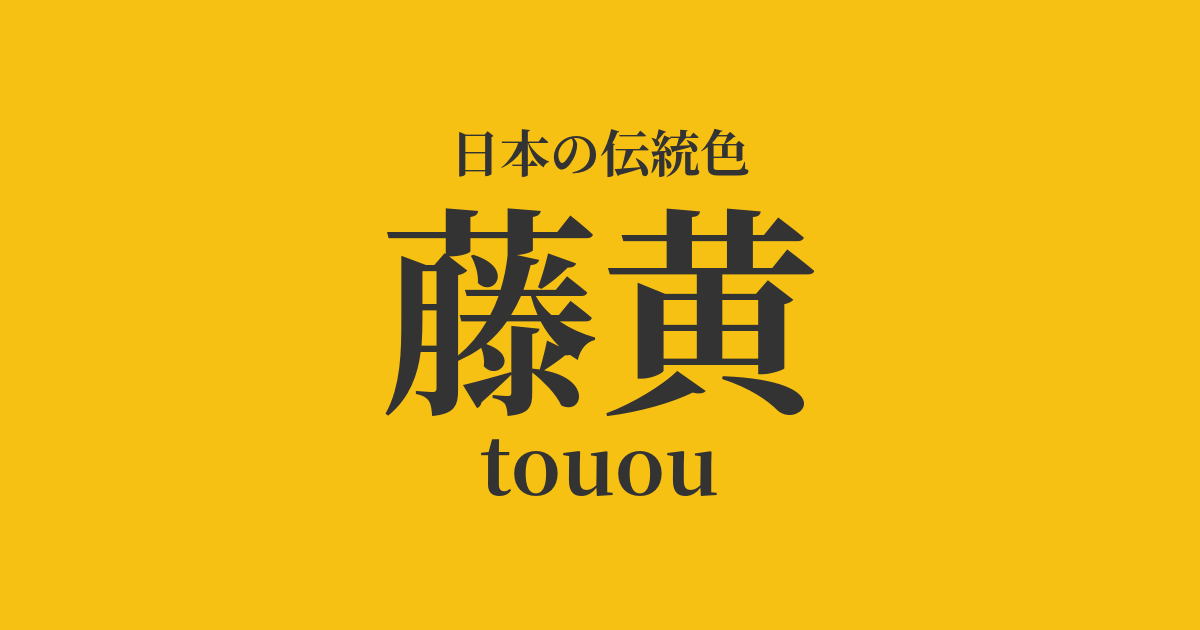
| Japanese color name | Fujio |
|---|---|
| reading | touou |
| HEX | #F7C114 |
| RGB | 247, 193, 20 |
What is Fuji-ō? Origin and etymology
The name "Tōō" (藤黄) originates from a yellow pigment made from the sap of the gamboji tree, a plant belonging to the Hypericaceae family that grows naturally in Southeast Asia. It is made by hardening the yellow, milky resin that oozes out when the trunk is wounded, and is characterized by its vivid and translucent hue. It has no direct relation to the color of wisteria flowers, and it is said that the name "Tōō" was introduced to Japan from its Chinese name "Tōhō" (藤黄) and became established with the reading "Tōō".
In the past, it was used as medicine, but it was mainly valued as a paint and dye.
Fuji-ō (藤黄) is sometimes confused with "shiō" (梅黄), another yellow pigment, but the two are completely different substances. Fuji-ō is an organic pigment made from plant resin, while shiō is an inorganic pigment made from arsenic sulfide minerals, with arsenic as its main component. Shiō is poisonous, but Fuji-ō is plant-derived, and its properties and color are different. In Japanese painting and other arts, there is a history of using each pigment separately, taking advantage of their respective characteristics.
Historical background of Fujioh
Wisteria yellow has been used as a pigment since ancient times, and is believed to have been introduced to Japan during the Nara period via China. It has been suggested that this pigment may have been used in the treasures of the Shōsōin. From the Heian period onward, its vibrant yellow color was used in many paintings, such as Buddhist paintings and illustrated scrolls. In particular, it played an important role as a substitute for gold and when mixed with other colors to create green, among others.
During the Edo period, wisteria yellow began to be used in woodblock prints for ukiyo-e (woodblock prints). Many of the vivid yellows seen in the works of famous artists such as Katsushika Hokusai and Utagawa Hiroshige are attributed to wisteria yellow. Due to its excellent color rendering, it was an indispensable color for expressing the splendor of popular culture. Furthermore, because it is easily soluble in water, it was widely used as a watercolor paint and had a great influence on the coloring techniques of Japanese painting.
Related literature, waka poetry, and seasonal words
While the color name "fuji-ō" (wisteria yellow) rarely appears directly in waka poetry or stories, works of art and crafts that likely used this color have adorned the backgrounds of many literary works. It is presumed that the dazzling costumes and furnishings depicted in court literature such as "The Tale of Genji" used a vivid yellow like fuji-ō. As a pigment, fuji-ō was an important element supporting the color culture of the time.
While "fuji-ō" (wisteria yellow) is not a recognized seasonal word in Japanese poetry, the colors it evokes, such as "yamabuki" (Japanese kerria) and "nanohana" (rapeseed blossoms), are well-known spring seasonal words. The vibrant yellow of these flowers has long been celebrated in Japanese poetry and has been cherished as a symbolic color announcing the arrival of spring. The bright and vibrant hue of fuji-ō is deeply intertwined with the imagery of spring in Japanese literature.
Color scheme preview
This is to check the readability of the text when this color is used as the background.
A color scheme proposal for wisteria yellow.
Navy blue (#192F60)
The bright yellow of the wisteria yellow and the deep blue of the dark blue are almost complementary colors, and they strongly enhance each other. This creates a powerful and impressive contrast, a classic and dignified color scheme often seen in ukiyo-e prints.
Tokiwa Midori (#028760)
The combination of vibrant yellow and deep green evokes images of vibrant natural landscapes, such as rapeseed blossoms and young leaves. The warmth of the wisteria yellow and the calming presence of evergreen green harmonize to create an impression that is both lively and stable.
White Gun (#89C3EB)
Combining the warm color of wisteria yellow with the cool color of light blue creates a refreshing and light atmosphere. This color scheme, reminiscent of the blue of the sky and the yellow of sunlight, is suitable for modern and open designs.
Practical Scenes
In traditional Japanese clothing, wisteria yellow is used in accessories such as obi sashes, obiage sashes, and han-eri collars to add vibrancy and brightness to the entire outfit. It is especially striking when paired with dark-colored kimonos such as navy, green, and brown, creating a sophisticated and stylish impression. It is also a popular color for children's kimonos and celebratory attire.
In interior design, it's most effective when used as an accent color. Incorporating lavender yellow into cushion covers, art panels, or small pieces of furniture brings warmth and vibrancy to a space. It blends well with both modern spaces based on white and gray, and natural spaces that make extensive use of wood.
In the fields of web design and graphic design, the high visibility of lavender yellow is noteworthy. Using it for website buttons, banners, and icons can effectively attract user attention and guide them to important information. It's a suitable color when you want to convey a friendly and energetic impression.