
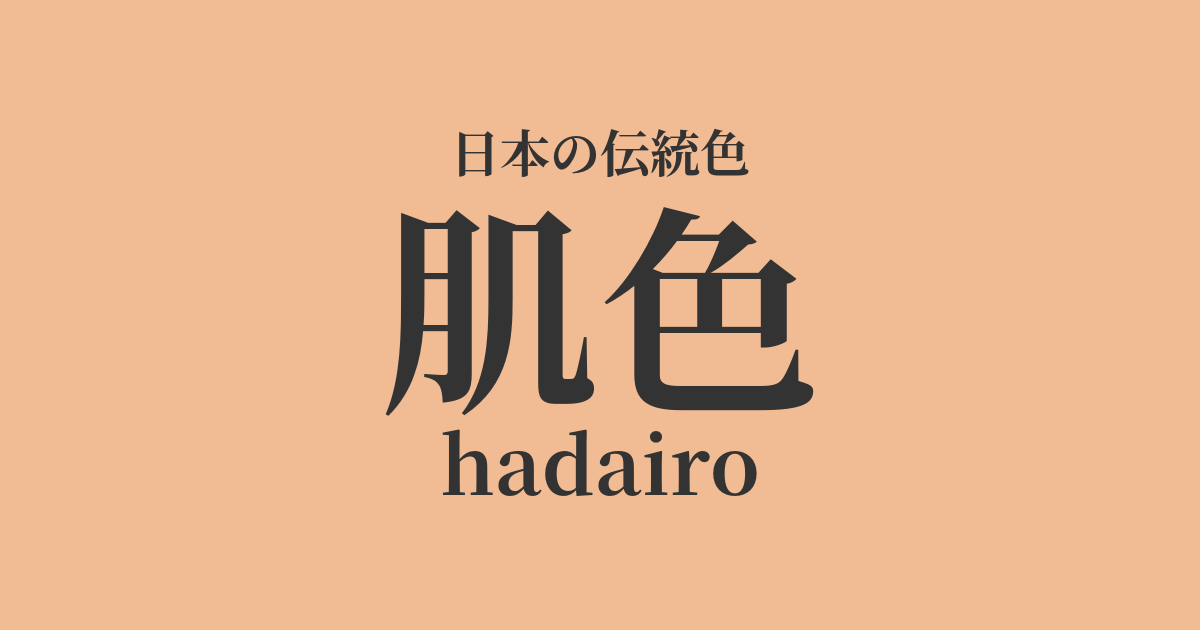
| Japanese color name | skin tone |
|---|---|
| reading | hadairo |
| HEX | #F1BB93 |
| RGB | 241, 187, 147 |
What is skin color? Origin and etymology
The direct origin of the term "skin color" (肌色) is literally the color of human skin. In particular, it has traditionally been used to refer to the skin color of Japanese people. This warm, orangey-brown color is perceived as a friendly and vibrant hue. In the past, there was a similar color called "shishiiro" (宍色), which meant the color of animal meat, but the term "skin color" (肌色) became established relatively recently, after the Edo period.
Historical background of skin color
The color name "skin color" is believed to have become commonly used during the Edo period. In particular, as Ukiyo-e, a type of woodblock print with multiple colors, developed, it was used as an important color to represent the skin of women depicted in portraits of beautiful women. This is thought to have led to the widespread recognition among people as a specific shade representing "skin color."
During the Meiji era, art supplies such as crayons were introduced from the West, and the term "skin color" (肌色) was adopted as a translation for "flesh tint" (肉色). This led to its establishment as one of the basic colors for art supplies used by schoolchildren. However, because this name is based on a specific skin tone, alternative names such as "light orange" (うす橙ダイ) are increasingly being used in recent years to reflect greater diversity.
Related literature, waka poetry, and seasonal words
In classical literature and Japanese poetry, there are very few examples of using the direct color name "skin color" to describe skin. At that time, it was common to use expressions that praised the whiteness and smoothness of skin as ideals, such as "white" or "jewel-like skin." This is thought to reflect the aesthetic sensibilities that existed before "skin color" became established as a color name.
In modern literature, there are instances where skin color is mentioned within realistic character descriptions. For example, skin tone can be effectively used to express a character's health or lifestyle. However, even in these cases, descriptions are often given using adjectives such as "healthy-looking" or "pale" rather than using a specific color name like "skin color."
Color scheme preview
This is to check the readability of the text when this color is used as the background.
Suggestions for skin tone color schemes
Uguischa (#715C1F)
A combination of earth tones. The warmth of skin tones harmonizes with the deep, calming green of olive green, creating a natural and reassuring color scheme. Suitable for Japanese-style and natural designs.
Cherry blossom pink (#FEEAFA)
Both skin tone and cherry blossom pink are warm colors with high brightness, making them highly compatible. The delicate and gentle atmosphere of cherry blossom pink enhances the warmth of skin tone, creating a soft and feminine impression. It suits spring-like designs and cosmetic color schemes.
Blue and white (#EBF4F8)
By combining a warm, skin-tone color with a very pale bluish-white, the colors complement each other. This creates a sense of cleanliness and elegance, resulting in a refined and refreshing impression. It's easy to use in interior design and web design.
Practical Scenes
In traditional Japanese clothing, this color is sometimes used for the undergarments (hadajuban and nagajuban). It is also used as an accent in the patterns of obi sashes and kimonos, softening the overall color scheme. It blends well with other colors, creating a sense of unity in the outfit.
In interior design, using it in wallpaper, curtains, and furniture fabrics brings warmth and tranquility to the entire room. It pairs particularly well with wood tones, making it ideal for creating a natural and comfortable space.
In web and graphic design, using this color as a background or content area color creates a friendly and reassuring impression. It is particularly effective for websites on themes such as health, beauty, and childcare, where a soft impression on the user is desired.