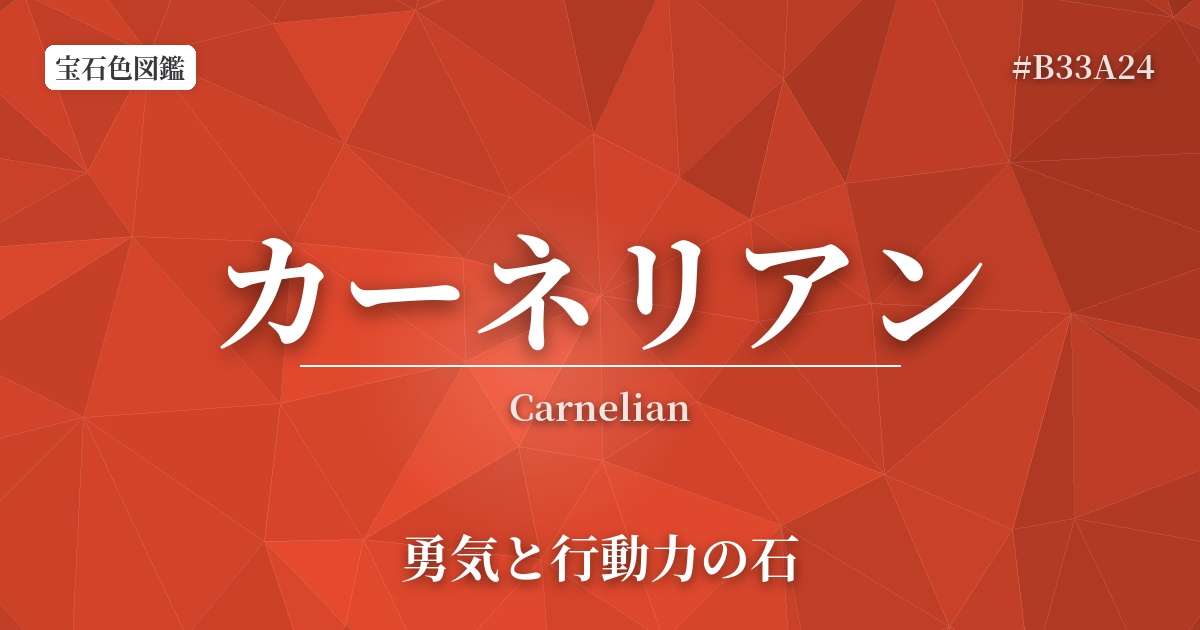
| English name | Carnelian |
|---|---|
| Katakana | Carnelian |
| HEX | #B33A24 |
| RGB | 179, 58, 36 |
| Mineralogy | Oxide minerals |
What is Carnelian? Origin and Mineralogy
There are several theories about the origin of the name carnelian, but the most likely is that it comes from the Latin words "caro," meaning "flesh," or "carneus," meaning "flesh-filled." As the name suggests, it has a vibrant, fleshy color. Another theory is that it was named because its color resembles the fruit of the Cornell cherry tree, a type of cherry blossom.
Mineralogically, carnelian is a type of chalcedony, composed of fine crystals of quartz. It is classified as an oxide mineral, and its characteristic reddish-orange color comes from iron oxides (iron hydroxide) contained within. It is known that when this iron content is heated, it changes to a more vivid red color.
With a Mohs hardness of 6.5 to 7, it has sufficient hardness for everyday jewelry.
The main producing regions are India, Brazil, Uruguay, and Madagascar. Indian carnelian, in particular, has long been known for its high quality and has been used in jewelry and crafts. One of the charms of this gemstone is that there are subtle differences in color and clarity depending on the origin.
Carnelian history and culture
Carnelian has a long history, with numerous discoveries found in Mesopotamian civilization and ancient Egyptian ruins. In ancient Egypt, it was used as an amulet to protect the journey to the afterlife, and carnelian ornaments have been found in the tomb of King Tutankhamun. Due to its blood-red color, it was considered a symbol of rebirth and life.
Carnelian was a very popular gemstone in ancient Greece and Rome. Romans, in particular, took advantage of its property of not easily sticking to hot wax and used it as a signet ring with intaglio (recessed carving) to seal letters. It is also said that warriors wore it as a talisman to bring courage and victory when going into battle.
In medieval Europe and the Islamic world, carnelian was highly valued as an ornament and amulet. A famous anecdote tells of Napoleon Bonaparte, the French emperor, who always wore an octagonal carnelian seal he acquired during his Egyptian campaign. It is a gemstone that has continued to fascinate people across time and cultures.
Carnelian and Color Psychology
Carnelian's fiery red-orange color evokes positive emotions such as vitality, passion, and energy. It's a color that warms the heart and inspires a positive outlook; it possesses an active energy. It can also be said to stimulate creativity and encourage taking on new challenges.
Known as the "stone of courage and action," carnelian is believed to remove the wearer's doubts and anxieties, powerfully guiding them toward achieving their goals. It is said to dispel lethargy and weariness, and boost motivation, making it a reassuring ally when you want to take a new step or when you need the courage to face difficulties.
Color scheme preview
This is to check the readability of the text when this color is used as the background.
Carnelian color scheme proposal
Navajo White (#FFDEAD)
The combination of warm carnelian and creamy Navajo white creates a bright, gentle, and comfortable atmosphere. This natural and relaxed combination blends easily into any setting.
Teal (#008080)
The warm tones of carnelian and the cool tones of teal, which are close to their complementary colors, complement each other, creating an energetic and sophisticated impression. It also evokes an exotic and modern atmosphere, making it an effective accent in design.
Charcoal (#36454F)
The deep charcoal gray powerfully complements the vibrant red of the carnelian. This creates a sense of gravitas and luxury, resulting in a modern and urban color scheme. It's a sophisticated combination that evokes both calmness and passion.
Practical Scenes
In jewelry design, carnelian is popular as the centerpiece for necklaces, bracelets, and rings due to its vibrant color. It pairs particularly well with gold, creating a glamorous and warm impression. In addition to cabochon cuts, designs featuring carvings such as ancient cameos and intaglios are also appealing.
In interior design, incorporating carnelian into cushion covers, rugs, and artwork adds a warm and energetic touch to the space. Combining it with natural elements like wooden furniture and houseplants creates a cozy, bohemian style.
In website and graphic design, this color is effective for call-to-action buttons and headlines to grab attention. When used by brands that want to convey passion and vitality, such as those in fitness, creative, or food-related fields, it can leave users with a positive and energetic impression.