
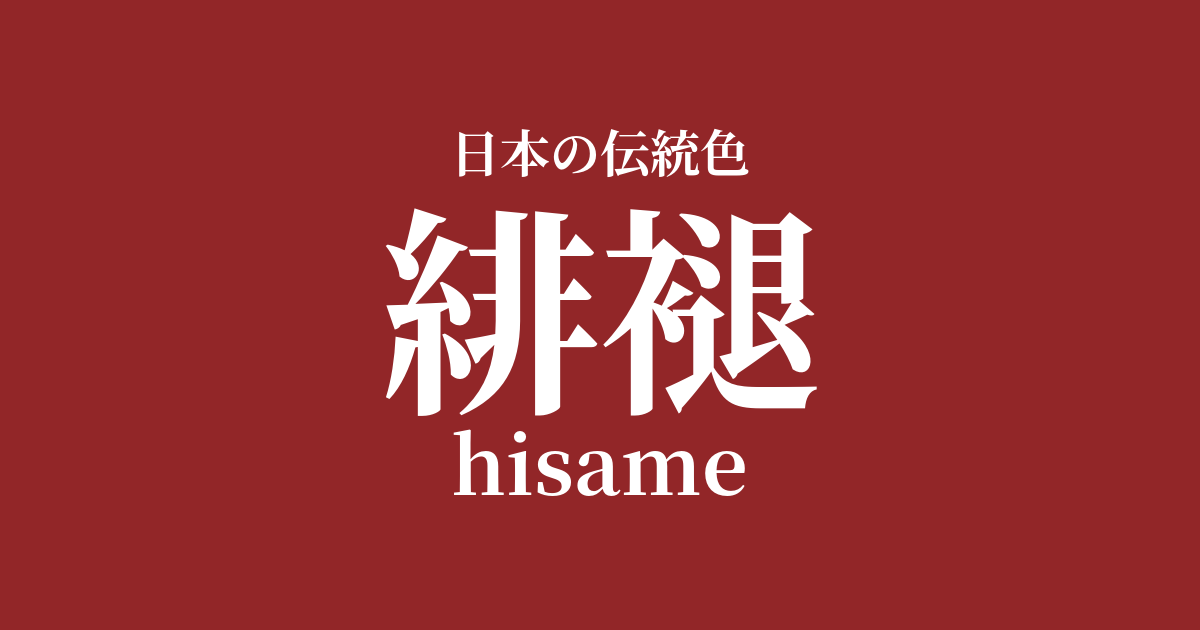
| Japanese color name | Scarlet |
|---|---|
| reading | hisame |
| HEX | #922628 |
| RGB | 146, 38, 40 |
What is "hisa" (crimson fade)? Origin and etymology.
Hisame, as the name suggests, refers to a faded shade of crimson. Crimson is a vibrant red dyed with madder or safflower, but over time, exposure to sunlight causes it to lose its vibrancy and change into a dull, subdued red. It is said that the ancient Japanese people cherished the beauty of this color that arises from this natural aging process, giving it its own distinct color name.
This color name reflects a Japanese sensibility that finds beauty not merely in deterioration, but in transience.
The etymology of the word "hisa" (緋薄) means that a color fades or loses its vibrancy. Hisa is a color that, while retaining its former splendor, gives off a somewhat melancholic and understated impression. It is thought that this color name embodies the unique Japanese aesthetic sense and philosophy regarding the passage of time, such as the rise and fall of empires and the impermanence of all things. Hisa is a color that is different from a vivid red, possessing depth and a sense of narrative.
Historical background of fading
Crimson is a color with a long history, appearing in literary works from the Heian period. Particularly famous is the "Suetsumuhana" chapter of "The Tale of Genji," where the character Princess Suetsumuhana is depicted wearing a "hisame no hitohe" (a single layer of crimson kimono). This depiction effectively uses the color to symbolize her fallen circumstances and her old-fashioned personality, which is out of touch with the times.
At the time, vibrant crimson was an expensive color used by people of high social standing. It is thought that faded crimson was perceived as a melancholic yet dignified color that evoked the former glory. In the Edo period, with the development of townspeople culture, dyeing and weaving techniques diversified, and it is said that muted reds like faded crimson became popular among commoners as a stylish color.
Related literature, waka poetry, and seasonal words
The most famous use of the word "hisa" (scarlet) in literature can be found in Murasaki Shikibu's "The Tale of Genji." In the scene where Hikaru Genji reunites with the princess of Hitachi-no-miya, commonly known as "Suetsumuhana," the color of the clothing she was wearing is described as "a very old-fashioned, faded single-layered garment." This refers to an outdated, old-fashioned, faded scarlet single-layered garment, strongly impressing upon the reader the princess's unfortunate life and unsophisticated appearance.
In this context, "hisa" (crimson) is not merely a color information of faded red. It plays a symbolic role in hinting at the social status and inner world of the characters. This color, which evokes a glamorous past while also indicating a lonely present, functions as a literary device that adds depth to the story. Although it is not designated as a seasonal word, its hue evokes images of late autumn foliage.
Color scheme preview
This is to check the readability of the text when this color is used as the background.
Scarlet color scheme proposal
Indigo tea (#554738)
The combination of the reddish hue of Hihachi and the dark, grayish-yellowish-brown of Aibicha creates a dignified and refined impression. The subdued tones of each color complement each other, resulting in a calm and profound traditional Japanese color scheme reminiscent of Edo-period kimonos and lacquerware.
Color produced (#FBFBF4)
By using an off-white background with a very slight yellowish tint, the deep red of the faded leather stands out, creating an elegant contrast. It achieves a balance of cleanliness and warmth, creating a sophisticated Japanese modern atmosphere. It is suitable for designs that make good use of negative space.
Moss color (#69821B)
The reddish fading and the greenish moss green are close to complementary colors, and they have the effect of making each other appear more vibrant. This color scheme, reminiscent of autumn leaves and moss in nature, gives a calm impression in which vitality and tranquility coexist. The harmony as earth tones is also beautiful.
Practical Scenes
In the world of traditional Japanese clothing, scarlet is used to bring out a calm, mature charm. It is particularly suitable for expressing the seasonal feel of autumn and winter, and by adding accents with accessories such as obi sashes and obi ties, it can create a sophisticated elegance within its understated beauty. It is also a color that is frequently seen in antique kimonos.
In interior design, incorporating it into fabrics such as wallpaper, cushions, and curtains brings warmth and depth to a space. It pairs exceptionally well with natural materials such as wood, bamboo, and Japanese paper, and functions as an accent color that adds a touch of Japanese aesthetics to modern spaces.
In the fields of website and graphic design, it is suitable for content themed around history, tradition, and luxury. When used as a main color, it creates a dignified impression, while when used as an accent color, it attracts attention while maintaining an elegant atmosphere. For readability, it is generally combined with white or off-white.