
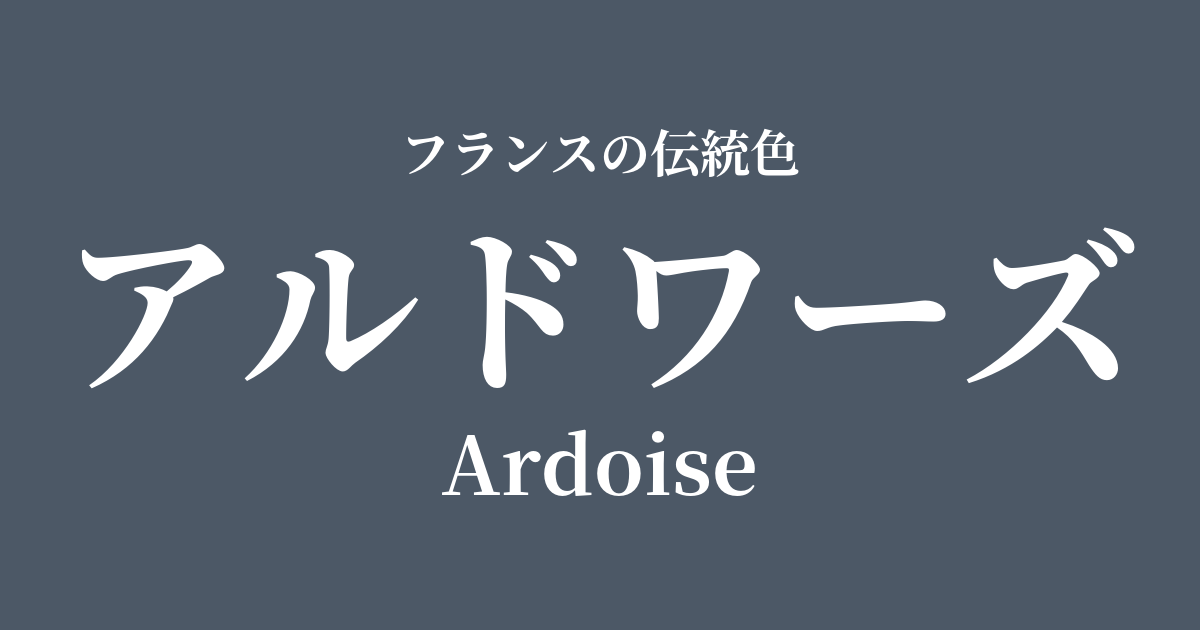
| French | Ardoise |
|---|---|
| Katakana | Ardoise |
| HEX | #4c5866 |
| RGB | 76, 88, 102 |
What is Ardoise? Origin and etymology
"Ardoise" is a French word meaning "slate" or "shale." As the name suggests, this color is derived from the deep, slightly bluish, beautiful dark gray hue of shale, which has been used as a building material, especially for roofing, since ancient times.
The unique texture and color variations of natural stone possess a complex nuance that cannot be fully expressed with artificial pigments. This color, created by nature, is inextricably linked to the French landscape, especially the urban scenery of Paris, and has quietly blended into people's lives. Its hue is not merely gray, but a vibrant color that changes its expression depending on the color of the sky and the angle of the light.
Historical background of Ardoise
The fact that the color Ardoise became an iconic color of France is largely due to the major transformation of Paris in the mid-19th century. This urban plan, spearheaded by Baron Georges-Eugène-Haussmann at the behest of Emperor Napoleon III, shaped the beautiful Parisian cityscape we see today.
The roofs of apartments built during this period in the "Haussmann style" were uniformly made of ardoise (slate), which was highly durable and fire-resistant. As a result, the landscape of rows of bluish-gray roofs became known worldwide as "the roofs of Paris," and ardoise became a color that symbolized the modern city of Paris.
Of course, its history is even older, and it can be seen on the roofs of ancient castles scattered throughout the Loire Valley, suggesting that it is a color deeply intertwined with the traditions of French architecture.
Ardoise in the world of art and fashion
The color Ardoise has inspired many artists. In particular, it frequently appears in the works of Impressionist painters who depicted everyday scenes of modern Paris. In Gustave Caillebotte's "Parisian Street, Rainy Day" and Camille Pissarro's aerial view of a boulevard, Ardoise effectively expresses the sophisticated atmosphere of the city as the color of rain-soaked cobblestones and rooftops.
In the world of fashion, ardoise is a very important color. Not as heavy as black, and possessing more depth and sophistication than typical gray, this color has been repeatedly used by leading French fashion houses such as Chanel and Dior for suits, coats, and dresses. Its understated hue brings out the best in the texture of high-quality materials such as wool and cashmere, creating a chic and elegant style that is loved across generations.
Color scheme preview
This is to check the readability of the text when this color is used as the background.
Ardoise's color scheme proposal
Rose Pompadour (#ED87A3)
By combining the intellectual and mannish Ardoise with the graceful and vibrant Rose Pompadour, a sophisticated yet softly feminine touch is added, creating a modern and elegant impression.
Jaune de Naples (#F7D98E)
The combination of the calm Ardoise and the bright, warm Jaune de Naples creates a beautiful contrast. This color scheme achieves a balance between classic elegance and a cheerful, modern feel.
Blanc d'Argent (#E8E4E3)
The combination of Ardoise and the silvery-white Blanc d'Argent is urban and minimalist. It maximizes the cool impression of Ardoise, creating an intelligent space with a clean and open feel.
Practical Scenes
Ardoise is a versatile color that can be used in a variety of situations.
In interior design, incorporating this color into a wall, sofa, or rug brings a sense of calm and gravitas to the space. It's ideal for quiet spaces like studies and living rooms. It also functions as an excellent background color that complements other colors, making paintings and objects stand out.
In fashion, using it with classic items like suits, jackets, and coats creates an intelligent and sophisticated impression. It's suitable for business settings, but can also be dressed down with accessories. Because it pairs well with any color, owning one will greatly expand your wardrobe options.
In web and graphic design, it is effective as a key color for corporate websites that want to convey reliability and stability, or for brands that want to create a sense of luxury.