
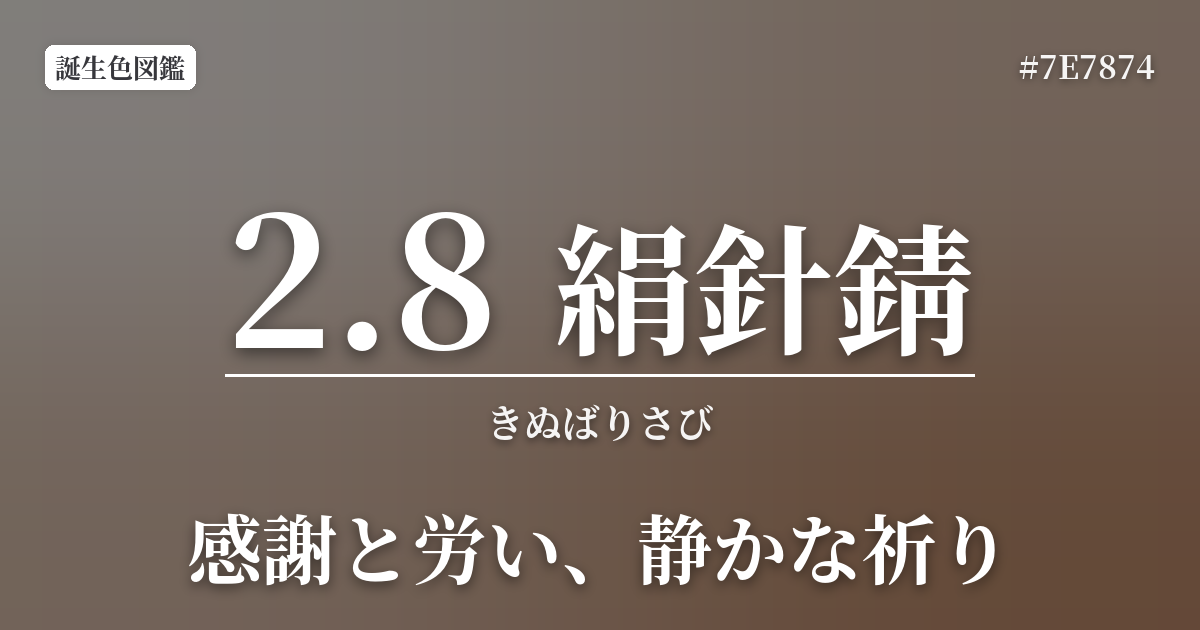
| birthday | February 8 |
|---|---|
| Color name | Silk needle rust |
| HEX | #7E7874 |
| RGB | 126, 120, 116 |
| Color meanings | Gratitude and appreciation, quiet prayer |
- What is the birth color "Silk Needle Rust" for February 8th?
- The color's meaning is "gratitude and appreciation, quiet prayer" and its corresponding personality.
- Connection to the seasons — Needle memorial service and end of the year
- Color scheme preview
- Color scheme proposal for silk needle rust
- FAQ
- Related traditional colors
What is the birth color "Silk Needle Rust" for February 8th?
The birth color for February 8th is "Kinubari Sabi" (silk needle rust). It's a quiet and tasteful gray, inspired by the dull, lustrous color of rust on well-used silk needles. This birth color was uniquely selected and created by this website, drawing inspiration from the "Hari Kuyo" (needle memorial service) ceremony held on February 8th.
It's not flashy, but it exudes a sincerity and warmth that only tools that have sewn countless pieces of fabric over a long period of time can possess. Despite being a cold, metallic color, it has a profound charm that somehow evokes the warmth of human hands or the soft light filtering into a quiet winter room.
The color's meaning is "gratitude and appreciation, quiet prayer" and its corresponding personality.
People who prefer this color tend to have a deep sense of gratitude towards things and others, and value appreciation. They are calm and thoughtful, and may not often assert themselves outwardly, but they harbor a quiet passion and unwavering conviction within.
They value well-used tools and carefully crafted handmade items more than flashy things. They possess a keen observational eye for discerning the essence of things and find inner fulfillment by cherishing their daily lives. Their calm demeanor brings a great sense of security to those around them.
Connection to the seasons — Needle memorial service and end of the year
February 8th is known as "Hari Kuyo" (Needle Memorial Day), a day to honor needles that have broken or rusted and become unusable. On this day, people stick needles into soft foods such as tofu and konjac to thank the needles for their service and pray for improvement in their sewing skills. This day also marks the end of the year's farming work and events.
The color "silk needle rust" perfectly embodies the spirit of this needle memorial service. It represents gratitude for the small tools that have supported people's lives and a quiet prayer for those that have fulfilled their purpose. It also seems to symbolize the state of mind of "finishing a task"—a quiet reflection upon reaching the end of a job or season.
Color scheme preview
This is to check the readability of the text when this color is used as the background.
Color scheme proposal for silk needle rust
Misty Rose (#FFE4E1)
The quiet gray of "Silk Needle Rust" is complemented by a soft, gentle pink, adding warmth and tenderness. It's a calm and comforting color scheme that evokes the warmth of well-used tools and the hands of the person who uses them.
Indigo (#243A64)
Combining the serene "silk needle rust" with a deep "indigo" creates a dignified elegance and calmness. This combination evokes the image of traditional Japanese work clothes and workshops, giving an honest and intellectual impression.
Moss color (#69821B)
The combination of "silk needle rust," reminiscent of aged metal, and the moist "moss green" evokes images of tranquil gardens and natural landscapes. It is a tasteful and calming color scheme that conveys the passage of time and the breath of life.