
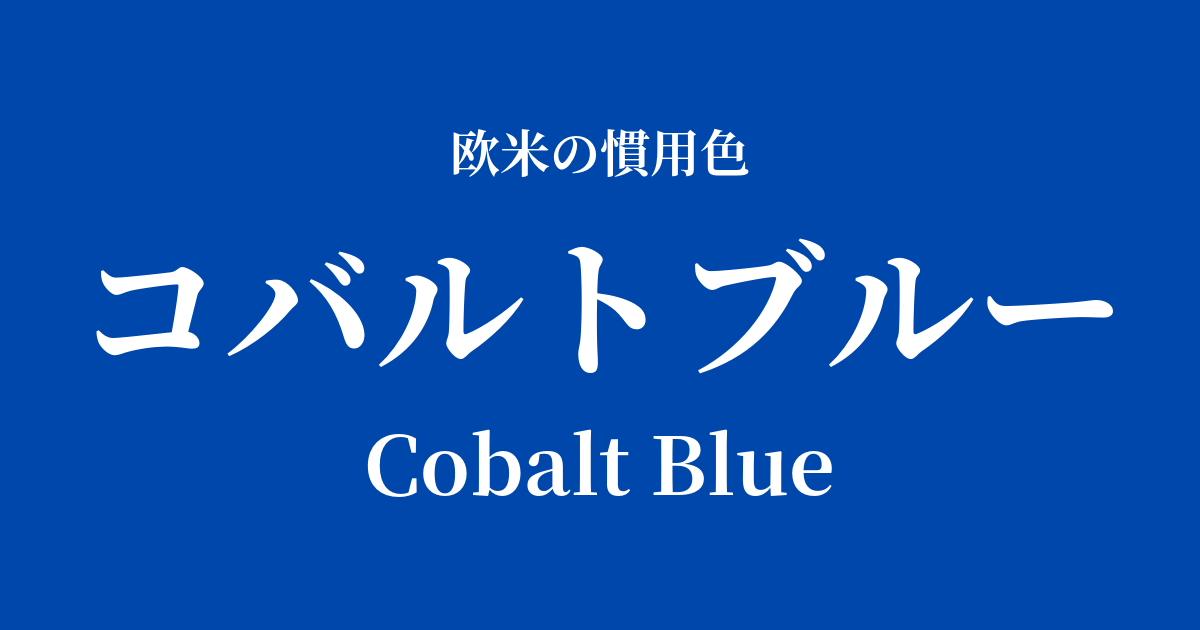
| Original English name | Cobalt Blue |
|---|---|
| Japanese notation | Cobalt blue |
| HEX | #0047AB |
| RGB | 0, 71, 171 |
What is cobalt blue? Origin and etymology
The term "cobalt blue" originates from "Kobold," a spirit from German mining legends. At the time, cobalt ore was often mistaken for silver ore. However, when it was smelted, it released toxic arsenic gas, which miners believed to be "the curse of the Kobold," and thus began to refer to it by that name.
The use of cobalt as a blue coloring agent is ancient, with traces of its use found in ancient Egyptian glass and Chinese porcelain. In particular, a pigment made from powdered cobalt glass called "smalt" was widely used in medieval Europe.
However, the pure cobalt blue pigment we know today only came into existence in the early 19th century. In 1802, the French chemist Louis-Jacques Thénard successfully developed a more stable and vibrant blue pigment. Because of this achievement, cobalt blue is also known by the alternative name "Thénard blue."
This new blue was welcomed by many artists as an alternative to natural ultramarine (a pigment made from lapis lazuli), which had previously been expensive and difficult to obtain. Scientific advancements had brought new color possibilities to the world of art.
The historical background and culture of cobalt blue
The history of cobalt blue is more than just the invention of a pigment; it's also a story of cultural exchange between East and West and innovation in artistic expression.
Since ancient times, cobalt compounds have produced beautiful blues in various parts of the world, as seen in Persian tiles and Chinese blue-and-white porcelain. In particular, white porcelain decorated with blue paint made in China during the Yuan and Ming dynasties traveled along the Silk Road to Europe, where it was highly prized among royalty and nobility, even being called "blue gold." This yearning for the mystical blue brought from the East can be said to have fostered the development of blue pigments in Europe.
When Thénard developed a stable pigment for cobalt blue in the 19th century, it quickly captivated European painters. This vibrant and powerful blue was particularly ideal for Impressionist painters who sought to depict the changing light outdoors. Claude Monet and Pierre-Auguste Renoir frequently used this color to express the shimmer of the sky and water.
Among them, Vincent van Gogh's "Starry Night," with its swirling night sky, is particularly famous as a work that symbolizes the expressive power of cobalt blue. He used this color to brilliantly depict inner passion and the mystery of the universe.
Cobalt blue in design and art
Cobalt blue, with its striking beauty, has been loved not only in the world of painting but also in various other fields.
In the art world, numerous masters, including Van Gogh and Monet mentioned earlier, as well as J.M.W. Turner who used it to depict stormy seas, have explored its expressive possibilities. Even in contemporary art, its powerful presence continues to inspire many artists.
In the field of crafts, especially ceramics, cobalt blue is an indispensable color. In contrast to the pale blue of Wedgwood's Jasperware, it is used to express a deeper, more vibrant blue. Furthermore, ceramics around the world, such as Delftware from the Netherlands and Arita ware from Japan, have competed to showcase the beauty of this blue.
In the world of fashion, cobalt blue conveys an intelligent and sophisticated impression. Its vibrant yet deep color makes it versatile, used in everything from statement pieces like dresses and coats to accessories like bags and scarves. It also possesses a noble aura, similar to royal blue.
In industrial product design, this color is often chosen when creating a modern and stylish image, such as for car body colors, smartphone casings, and high-end writing instruments.
The deeper the blue becomes, the more strongly it calls man towards the infinite.
Color scheme preview
This is to check the readability of the text when this color is used as the background.
Cobalt blue color scheme proposal
Snow White (#FFFAFA)
This is the most classic combination, maximizing the vibrancy of cobalt blue. It exudes cleanliness and intelligence, creating a modern and sophisticated impression. Ideal for web design and minimalist interiors.
Golden Yellow (#FFDF00)
This artistic and energetic color scheme is reminiscent of Van Gogh's paintings. The near-complementary color relationship makes each color appear more vibrant, creating a dramatic and lively impression. It's highly recommended for designs that want to catch people's attention.
Silver (#C0C0C0)
When combined with metallic silver, the intellectual feel of cobalt blue is further enhanced. It gives a cool, futuristic, urban, and stylish impression, making it suitable for industrial products and men's fashion.
Practical Scenes
Cobalt blue, with its strong presence, can be used effectively in a variety of situations.
In interior design, it's recommended to use cobalt blue as an accent rather than using it throughout the entire space. For example, using cobalt blue wallpaper on just one wall in the living room, or incorporating it through sofas, cushions, or art panels, will give the entire room a more refined and sophisticated feel. It pairs exceptionally well with white, gray, and natural wood tones.
In fashion, cobalt blue is a versatile color that can be the main focus or an accent color in an outfit. A cobalt blue dress or knitwear can instantly create both a glamorous and sophisticated look. Using it instead of navy in a business suit or jacket allows you to express individuality while maintaining a sense of reliability. Even adding just a touch of cobalt blue in a bag, shoes, or accessories can instantly elevate the overall impression.
In web and graphic design, it's a popular key color for corporate websites that want to convey trustworthiness and innovation. It's particularly favored in the technology and finance sectors. Furthermore, its high visibility makes it effective when used in link text and call-to-action (CTA) buttons, as it attracts user attention and encourages clicks.