
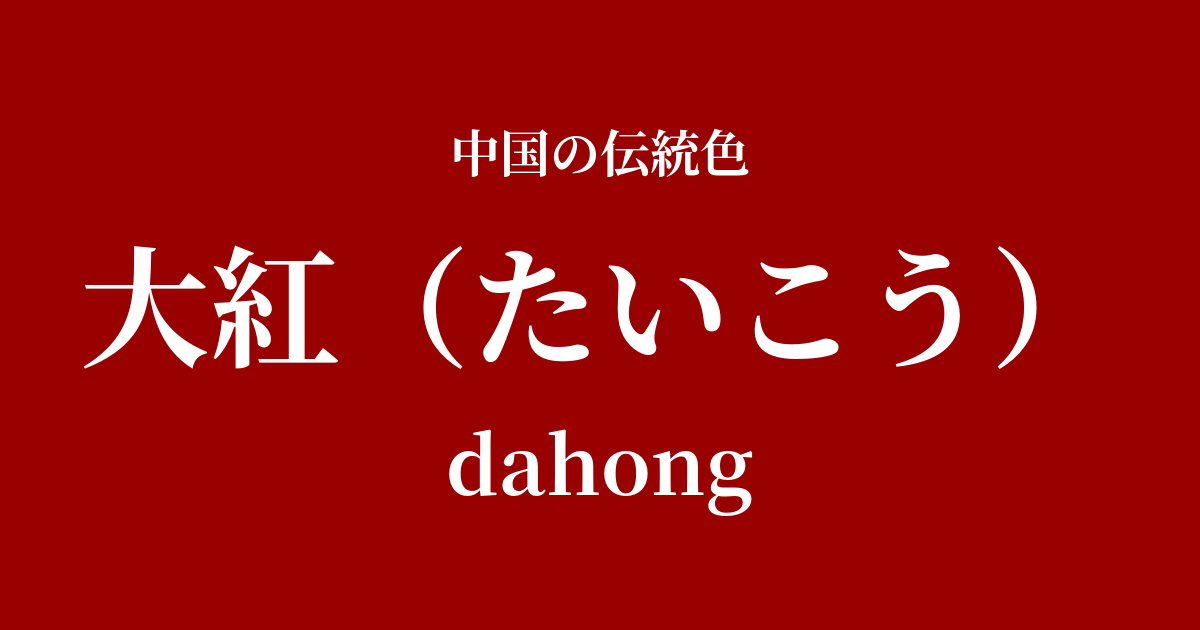
| Color name | Big red |
|---|---|
| reading | Taiko |
| pinyin | dahong |
| HEX | #990000 |
| RGB | 153, 0, 0 |
What is Da Hong? Origin and Etymology
Da Hong is the most symbolic and powerful red among traditional Chinese colors. The character "Da" (大) means "orthodox" or "first," and Da Hong refers to the purest and most vibrant red among many other shades of red.
The color is said to originate from cinnabar, a pigment that has been considered precious since ancient times. Cinnabar is a mineral composed of mercury sulfide, and its vivid red color was believed to possess the power of immortality and protection against evil, so it was used to color the emperor's seals and palaces. This color is also the origin of the color known as "China Red" in the West.
Madder and safflower have been used as dyes since ancient times. The red extracted from these plants has adorned people's clothing and lives, and has been cherished as a color that expresses the dynamism and passion of life. Dahong is a profound color that encompasses the history of both these blessings of nature and mineral pigments that were symbols of authority.
The historical background of Da Hong
The culture of revering the color red dates back to the Zhou Dynasty. In the Five Elements philosophy, red is the color of the Vermilion Bird, the mythical beast that guards the south, and symbolizes the element of fire. This philosophy had a great influence on later generations, and red became established as a color that signifies vitality, passion, and good fortune.
During the Han Dynasty, red became widely accepted as an auspicious color in people's lives. In the imperial court in particular, it was used extensively on the pillars and walls of the palace and on clothing used in ceremonies, as a color that symbolized the authority and dignity of the emperor. Its value remained unchanged in subsequent dynasties, and red always held a special status.
In particular, during the Ming Dynasty, red was considered extremely important as the color of the national surname, as the first emperor, Zhu Yuanzhang, had the surname "Zhu." The walls and gates of the Forbidden City in Beijing, a World Heritage Site, are painted in a magnificent red, a remnant of this era. Red was also believed to be a protective color that shielded buildings from evil spirits, and thus played an important role in architecture.
Even today, the color red (Da Hong) is a symbol of China. It is the color of the national flag, and during the Spring Festival (Lunar New Year), the biggest holiday in China, the streets are dyed red with lanterns, decorations, and "Hongbao" (red envelopes) used to give New Year's money. It is a color that has been loved across generations, embodying people's joy, hope, and wishes for the future.
The Great Red in Chinese Art and Crafts
In Chinese art, the beauty of Da Hong (great red) has been expressed in various forms. In the world of ceramics, deep, vibrant red glazes such as the "Ji Hong Yu" of the Ming Dynasty and the "Lang Yao Hong" of the Qing Dynasty were highly prized as the pinnacle of technique. These porcelains were made for the emperor and the imperial court, and are considered extremely valuable due to the difficulty of their production.
In clothing culture, Da Hong (day red) also holds special significance. It is used in traditional wedding attire because it symbolizes the wish to celebrate the bride's happiness and ward off evil spirits. Furthermore, in traditional performing arts such as Peking Opera, Da Hong makeup is used to represent characters who possess loyalty and bravery, symbolizing the character's personality.
Da Hong is indispensable in architectural decoration and folk art. The magnificent red seen on the doors and pillars of temples and palaces gives a space both solemnity and splendor. Many crafts deeply rooted in people's lives, such as paper cutting (jianzhi) and Chinese knotting (panchang) displayed during the Spring Festival, are also made with Da Hong, brightening the atmosphere of celebratory occasions.
Hidee Hanakoku Katsubishi
Color scheme preview
This is to check the readability of the text when this color is used as the background.
A color scheme proposal for Da Huang
Yellow (#FFD700)
Red and yellow are the most traditional and noble color combination in China. They symbolize the authority and wealth of the emperor, and give off a magnificent and festive atmosphere. They are suitable for formal designs.
Moon White (#E0F0F0)
By combining a powerful red with a pure and serene moon-white, the intense impression is softened. This creates a modern, sophisticated, calm, and elegant space.
Matsuka (#B5CAA0)
The vibrant red is complemented by the gentle pine blossoms that evoke the breath of nature, creating an elegant impression full of vitality. The colors enhance each other, bringing a sense of tranquility amidst the splendor.
Practical Scenes
In interior design, dark red is a color that adds a dramatic accent to a space. Simply using dark red on one wall, or incorporating it into small items such as cushions, rugs, or artwork, can bring energy and vibrancy to the entire room. In particular, combining it with achromatic colors such as white, black, and gray, or with dark wood-grain furniture, creates a modern and sophisticated impression.
In the world of fashion, dark red is a color that expresses confidence and presence. Dark red dresses and coats become statement pieces that attract attention on special occasions. In everyday life, simply incorporating it into a scarf, bag, shoes, or lip color will tighten up the entire outfit and give it a vibrant impression.
In web and graphic design, bright red (Da Hong) has a strong effect in attracting user attention. Using it in call-to-action (CTAs), important headings, and logos can leave a strong impact. However, because the color is so assertive, overuse can create a feeling of being overwhelmed. It's important to use it effectively as an accent color while considering the overall balance.