
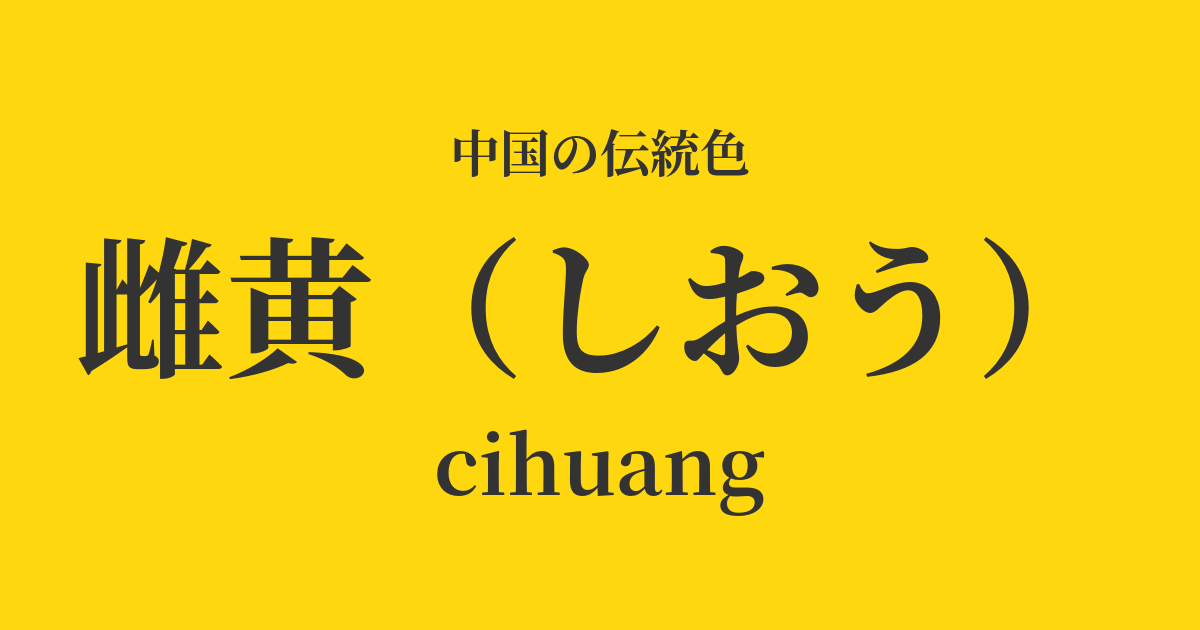
| Color name | female yellow |
|---|---|
| reading | Shiou |
| pinyin | cihuang |
| HEX | #FFD70F |
| RGB | 255, 215, 15 |
What is orpiment? Origin and etymology
Orpiment is a vibrant, powerful golden color. Its name comes from the naturally occurring mineral called "orpiment." In English, it is called orpiment, and chemically it is an arsenic compound called diarsenic trisulfide (As2S3).
This mineral is often found together with a reddish-orange mineral called "realgar." It is said that the name "realgar" (女黄) comes from the ancient Chinese concept of yin and yang, where the lighter color was seen as "female" and the darker color as "male." As the name suggests, it is characterized by a color that possesses both softness and elegance.
While oryzae possesses a beautiful color, it is also highly toxic due to its arsenic content. This duality has given oryzae a mysterious and somewhat dangerous allure. In addition to being used as a pigment, it was also used in the past as a medicine and insect repellent, but its handling required extreme caution.
Historical background of orpiment
The use of orpiment is ancient, and it was already known as a pigment during the Han Dynasty. Its golden luster made it a highly valued color, symbolizing noble beings such as emperors and gods.
In Taoism in particular, orpiment, along with realpiment, was considered an ingredient in the "golden elixir," a miraculous elixir of immortality. However, it is actually a highly toxic arsenic compound, and it is said that this led to tragedies in which many people who dreamed of becoming immortals instead lost their lives.
Furthermore, orpiment was also used as an "eraser" to correct writing. Some ancient papers were colored yellow, and by applying orpiment powder to areas where writing mistakes had been made, the writing could be made invisible.
This custom gave rise to the idiom "shinkō shikou," which refers to the attitude of carelessly correcting statements or making arbitrary criticisms without any basis, just as one would easily rewrite words with yellow ink. It is an interesting example of how a color itself became a lesson about the weight of words.
Oryct in Chinese Art and Crafts
The vibrant yellow of orpiment played a crucial role in Chinese art, particularly Buddhist art. In the murals of the Dunhuang Mogao Caves, orpiment was lavishly used as a substitute for gold to depict the halos and robes of Buddha statues, as well as the sacred spaces within them. In the dimly lit caves, the glow of the orpiment must have appeared to people like a divine aura.
In ink painting and brushwork, it was used to add vibrancy and accent to works, such as depicting autumn foliage or the clothing of noble figures. However, because it contains sulfur, it easily reacts chemically with other pigments and discolors, making it a difficult pigment for painters to work with.
In clothing culture, oryzae was primarily used as a pigment to draw patterns on fabrics rather than as a dye. Mineral pigments do not easily penetrate fibers, making them unsuitable for dyeing entire pieces of cloth. However, it is believed that oryzae patterns drawn on silk fabrics and other materials made the garments appear even more luxurious due to their brilliance.
褚も薛 sama hesu 覓, paper female yellow arbitrary portion.
Color scheme preview
This is to check the readability of the text when this color is used as the background.
A proposed color scheme for orpiment.
Yuhuang (#FF9900)
This combination features orpiment, the mineral that complements orpiment. Both are vibrant and powerful colors, yet they create a gradient of yellow and orange, giving an energetic and flamboyant impression.
Stone green (#16856D)
The color scheme, which also uses mineral pigments like "stone green," evokes a sense of the vitality of nature. This classic and dignified combination, also seen in the murals of Dunhuang, gives a vibrant yet calm impression.
Mayuzumi (#465DAA)
By pairing it with the calm, deep blue-black "Mayuzumi," the vibrancy of the yellow-green color stands out. It gives a modern and sophisticated impression, and it's an intelligent combination where each color enhances the other.
Practical Scenes
In interior design, orpiment is an ideal accent color for brightening a space. Incorporating it into cushion covers, artwork, or small pieces of furniture brings vibrancy and a sense of luxury to the entire room. Pairing it with gold metal or dark wood furniture creates an even more sophisticated atmosphere.
In fashion, it's recommended to incorporate it through accessories such as scarves, bags, and jewelry. In particular, pairing it with basic colors like black, navy, and white will highlight the vibrancy of the yellow, adding a glamorous and unique accent to your outfit.
In web and graphic design, it's effective when used for buttons and headlines that you want to attract attention. Due to its historical background, it's also suitable as a key color for brands that want to express tradition, authority, and uniqueness. However, because it can evoke associations with toxicity, its use in food and health-related fields should be carefully considered.