
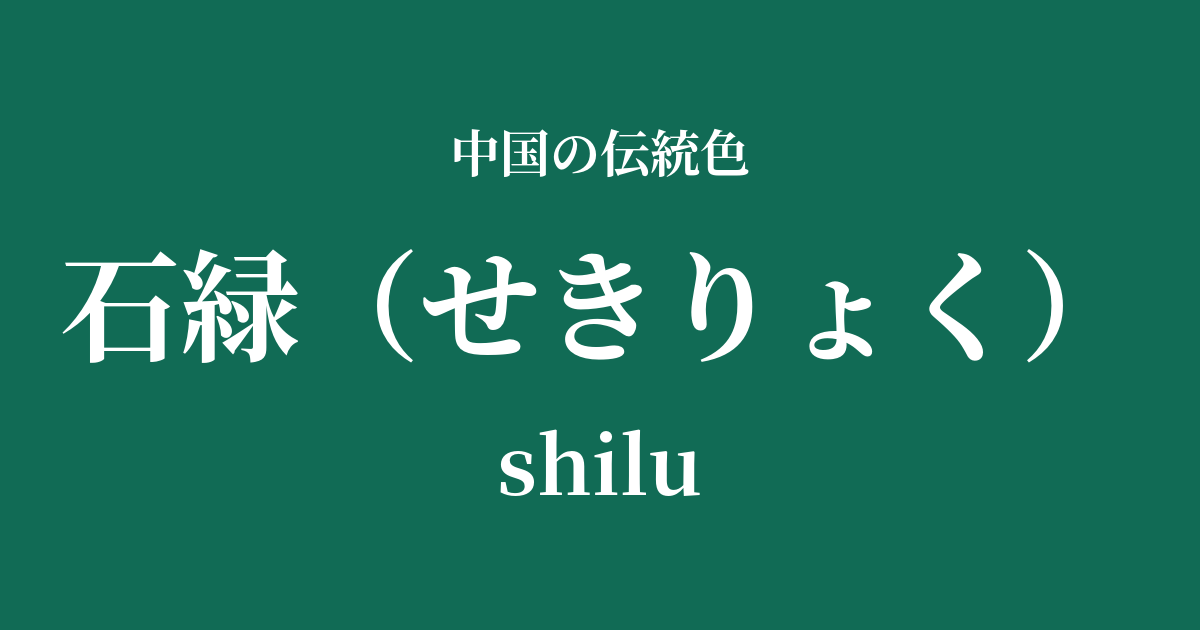
| Color name | Stone Green |
|---|---|
| reading | Sekiryoku |
| pinyin | Shilu |
| HEX | #116B55 |
| RGB | 17, 107, 85 |
What is "stone green"? Origin and etymology
Sekiryoku, as its name suggests, means "stone green," and is a beautiful green pigment made by crushing malachite, a natural mineral.
Because it is made from malachite, which has been treated as a gemstone since ancient times, stone green has been considered an extremely valuable pigment. Although the manufacturing method is simple, involving grinding the mineral into a powder, the intensity of the color changes depending on the fineness of the particles. The coarsest particles and the darkest color are called "head green," followed by "second green" and "third green," with the color becoming lighter as the particles become finer. By skillfully using these differences in particle size, a rich expression and depth were created in paintings.
Historical background of Shilu
Shi Lu's history is long and deeply intertwined with the development of Chinese painting, particularly landscape painting. His presence is most prominent in the "blue-green landscape" style established during the Sui and Tang dynasties.
In this style, azurite, another mineral pigment, and slate green played a leading role, depicting natural landscapes in a decorative and magnificent way. When it evolved into "golden landscapes," which incorporated gold paint, the colors became even more opulent and resplendent, becoming a favorite among court painters. The vivid colors of slate green, which have not faded with time, can still be seen in the murals of the Mogao Caves in Dunhuang.
Stone green in Chinese art and crafts
The art form most closely associated with Shi Lu is undoubtedly "blue-green landscape painting." The "Thousand Miles of Mountains and Rivers" scroll, attributed to the Northern Song dynasty genius Wang Ximeng, is a well-known masterpiece. The vast scroll, depicting a chain of mountains using Shi Lu and Shi Qing, is breathtakingly beautiful.
Although sekiru is a pigment and therefore has a different use than dyes for fabrics, its noble hue was used in the designs of Hanfu (traditional Chinese clothing) worn by emperors and nobles, and in the patterns depicted on silk fabrics. While green glazes also exist for ceramics, the vibrancy of sekiru in paintings sets it apart from other crafts, giving it a distinctive presence.
I knelt in front of the green stone green cup, and the user was drunk and did not return.
Color scheme preview
This is to check the readability of the text when this color is used as the background.
Stone Green Color Scheme Proposal
Stone blue (#305088)
This color scheme has traditionally been used in blue-green landscape paintings. The colors vividly complement each other, creating a majestic, dignified, and classical impression.
Pilestone (#A0522D)
This combination evokes lush green mountains and red earth, creating a natural and calming atmosphere. It evokes warmth and stability, and the harmonious earth tones create a comfortable space.
Moon White (#D9E4E8)
This color scheme features a deep, stone-green hue complemented by the pure white of moon-white. It evokes a sense of tranquility and elegance, creating a sophisticated and modern impression.
Practical Scenes
In interior design, incorporating stone greenery into accent walls, cushions, and artwork brings depth and tranquility to a space. It pairs particularly well with solid wood furniture and metal materials such as brass, making it ideal for quiet spaces like studies and bedrooms.
In fashion, this deep green creates an intelligent and elegant atmosphere. Simply incorporating it into a coat, dress, or accessories like a scarf or bag will elevate your entire look, giving it a refined impression. It's a particularly striking color for autumn and winter outfits.
In web design and graphic design, it's suitable for brands that want to convey a sense of luxury and trustworthiness. Using it as a background color or key color creates a calm and sophisticated atmosphere that attracts attention. Combining it with light white or pale beige results in a beautiful design while maintaining readability.