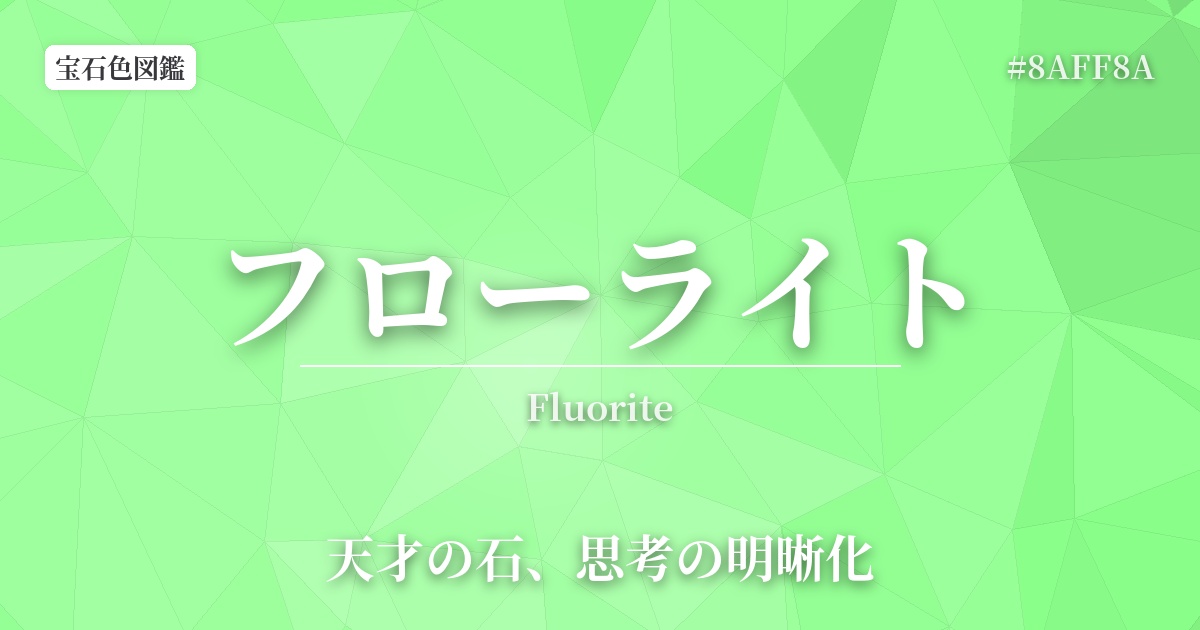
| English name | Fluorite |
|---|---|
| Katakana | Fluorite |
| HEX | #8AFF8A |
| RGB | 138, 255, 138 |
| Mineralogy | Halide minerals |
What is fluorite? Origin and mineralogy
The name fluorite comes from the Latin word "fluere," meaning "to flow." This is because fluorite has properties that make it a "flux," lowering the melting point of other minerals and making them easier to melt.
As a mineral, it is a halide mineral whose main component is calcium fluoride (CaF2). It is found in various locations around the world, with the UK, China, Mexico, and the US being particularly well-known as major sources.
The most striking feature of fluorite is its astonishing variety of colors. It exhibits a wide range of hues, including green, purple, blue, yellow, pink, and colorless, making it hard to believe it's a single mineral. This color variation is created by trace amounts of impurity ions within the crystal and lattice defects in the crystal structure.
Furthermore, many fluorites glow beautifully when exposed to ultraviolet light (black light). This phenomenon is called "fluorescence," and the fact that this word itself is derived from "fluorite" speaks to the uniqueness of this stone. However, not all fluorites fluoresce.
As a gemstone, it has a very soft Mohs hardness of 4 and also possesses a property called "cleavage," which makes it prone to breaking in certain directions. Therefore, care must be taken to avoid impact and friction when wearing it as jewelry.
The history and culture of fluorite
Fluorite has a long history of use, and records show that in ancient Roman times, its beautiful colors led to its use in sculptures, cups, vases, and other decorative items. In particular, fluorite from Derbyshire, England, with its beautiful purple and yellow stripes, was known as "Blue John" and was extremely popular among the aristocracy from the 18th to the 19th centuries.
There is a theory that fluorite was used in ancient Egypt for carvings and beads depicting the scarab beetle, which was considered sacred. Its soft nature may have made it relatively easy to process even with ancient tools, which may have contributed to its long-standing popularity as a decorative item.
Fluorite has made a significant contribution to industrial development, not only as a material for jewelry, but also as a flux used to remove impurities in the processes of ironmaking and aluminum refining. Its "melting-friendly" properties have literally played an important role in various aspects of history.
Fluorite and Color Psychology
This color, #8AFF8A, is a fresh and bright green reminiscent of young spring leaves. In color psychology, green symbolizes harmony, growth, healing, and tranquility, and is said to have the effect of balancing mind and body. It will refresh the viewer's mind and inspire a sense of hope for new beginnings.
Fluorite, affectionately known as the "stone of genius," is believed to possess the power to guide intellect and consciousness to higher dimensions. It is said to alleviate mental confusion and stress, and to help discern the true nature of things by releasing rigid thought patterns and suppressed emotions.
Because it is believed to activate brain function and enhance concentration and memory, it is popular as a good luck charm when studying for exams or qualifications, or when working on creative projects. It is loved by many people as something that encourages free thinking and inspiration, and provides clues to solving problems.
Color scheme preview
This is to check the readability of the text when this color is used as the background.
Fluorite color scheme proposals
Lavender (#E6E6FA)
This dreamy and gentle color scheme is reminiscent of the way the purple and green of fluorite blend together. It's a calming and healing combination that brings tranquility to any space or design where relaxation is desired.
Slate Gray (#708090)
Combining bright green with sophisticated slate gray creates a refined and modern impression. This color scheme emphasizes fluorite's "clarification of thought" aspect, making it ideal for studies and offices where you want to enhance concentration.
Buttercup (#F3AD34)
The combination of the fresh green of young leaves and the bright yellow of buttercups creates a vibrant impression reminiscent of spring sunshine. This positive and cheerful atmosphere stimulates creativity and brightens the mood.
Practical Scenes
In jewelry design, considering the softness of fluorite, it is recommended to use it in items that are less susceptible to impact, such as pendant tops, earrings, and brooches. Taking advantage of its rich colors, gradient designs combining different colored fluorites are also very appealing.
In interior design, incorporating this vibrant green as an accent in cushions, art, or accessories brings a fresh and calming feel to the space. It also pairs perfectly with houseplants, contributing to the creation of a natural and comfortable atmosphere.
In website and graphic design, it pairs well with themes related to wellness, education, and the environment. While it can be a bit too strong as a main color, using it as an accent color for buttons and headings attracts attention and creates a vibrant impression.