
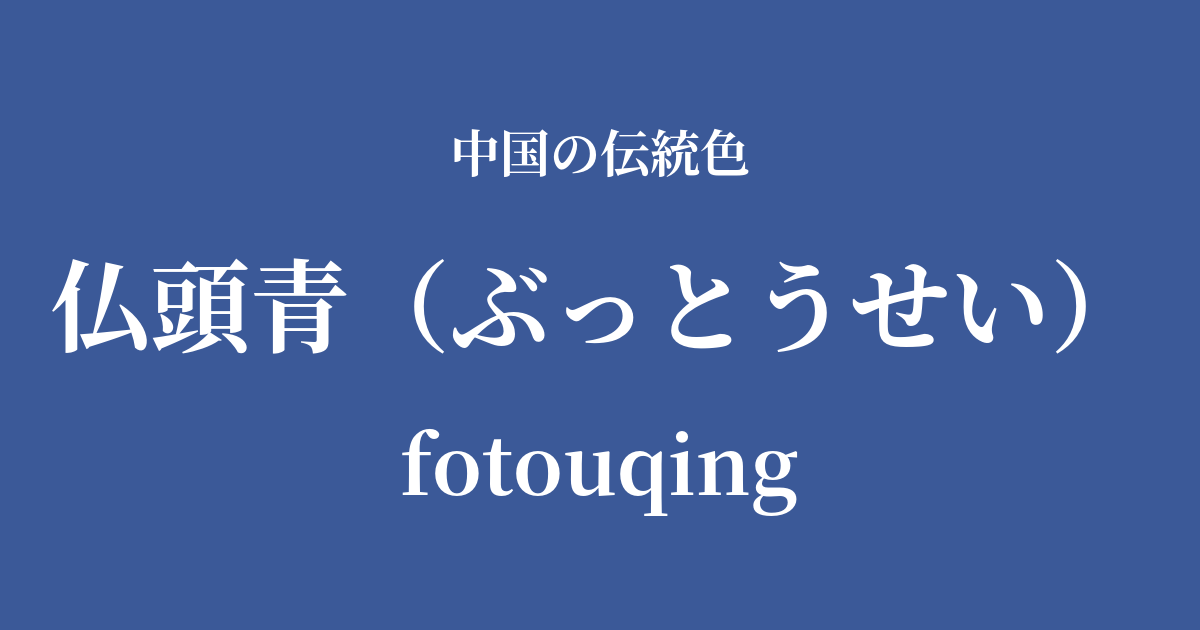
| Color name | Buddha Head Blue |
|---|---|
| reading | Buttousei |
| pinyin | fotouqing |
| HEX | #3B5998 |
| RGB | 59, 89, 152 |
What is Buddha's Head Green? Origin and Etymology
Buttosei, as its name suggests, means "the blue of Buddha's head," and is a deep, majestic shade of blue.
The direct origin of this color lies in the hair of Buddhist statues, particularly the distinctive right-handed spiral hair known as "rahotsu." One of the "32 marks and 80 auspicious features" of Buddha's superhuman physical characteristics is "konjōsō," which refers to dark blue hair. Buddha's head blue was used to represent this sacred hair color.
Therefore, this color has been cherished not merely as a beautiful blue, but as a color imbued with profound spirituality, symbolizing the Buddha's vast wisdom, compassion, and cosmic truth.
It is said that pigments such as lapis lazuli and azurite, which have long been considered precious, were used. Lapis lazuli, in particular, was an expensive mineral brought from the West via the Silk Road, and its vivid, deep blue was considered suitable for expressing the sanctity of Buddha. This rarity was also one of the reasons why Buddha's head blue was treated as a special color.
Historical background of Buddha's head green
The history of Buddha Head Chrysanthemum is deeply intertwined with the era when Buddhism was introduced to China and its art flourished.
After Buddhism was introduced to China during the Later Han Dynasty, particularly from the Northern and Southern Dynasties to the Tang Dynasty, the construction of cave temples flourished throughout China. This "Buddha head blue" can be seen in the murals and Buddha statues that still exist in places like the Mogao Caves in Dunhuang and the Longmen Grottoes. In the dark caves, this deep blue must have shone particularly divinely, attracting the faith of the people.
These works were created using expensive mineral pigments without reservation. A product of an era when Buddhist art flourished, receiving the fervent devotion of the imperial family and nobility, Buddha's Head Blue conveys to the present day the richness of Buddhist culture, which was a spiritual pillar for the people of that time.
Buddhist head bells in Chinese art and crafts
Buddha's head blue is an indispensable color in Chinese Buddhist art. In temple murals and Buddhist paintings on silk, it was standard practice to color the hair of Buddhas and Bodhisattvas with this color. In addition to the Buddha statues themselves, it was also used to represent halos, patterns on clothing, and the sky in the background, giving the entire image a serene and majestic atmosphere.
In the world of ceramics, the cobalt blue used in blue-and-white porcelain is well-known, but Buddha's head blue is a different, deeper, and more subdued shade. This color was sometimes used as a glaze for ceramics with special purposes, such as Buddhist implements and ritual vessels.
In the context of clothing culture, this deep blue is believed to have been chosen as the color of the robes worn by Buddhist monks, or as the color of the garments used in important Buddhist ceremonies. It was a color that stood apart from secular colors and was meant to represent spiritual authority and purity.
Tonokaku Butsutou Seisaku Tile
Color scheme preview
This is to check the readability of the text when this color is used as the background.
Buddha Head Blue Color Scheme Proposal
Mug gold (#B89432)
This traditional and dignified color scheme is reminiscent of the majestic decorations of Buddhist statues and temples. The sacredness of the Buddha blue and the brilliance of the gold accentuate each other, creating a luxurious yet calm and refined impression.
Tsukihaku (#EAF4FC)
This combination is pure and serene, like moonlight floating in a quiet night sky. The soft light of moon white softens the deep blue of Buddha's head blue, creating a meditative tranquility. It is an ideal color scheme for spaces where you want to calm your mind.
Pilestone (#99462A)
The warm reddish-brown of the ochre stone, reminiscent of the earth, harmonizes with the tranquility of the Buddha's Head Blue, creating a stable and calm impression. The combination with natural elements achieves both grounded solidity and profound spirituality.
Practical Scenes
In interior design, this color is ideal for spaces where tranquility and concentration are required, such as studies, bedrooms, and meditation rooms. Using this color as an accent wall adds depth and tranquility to the space. Combining it with wooden furniture and gold-colored lighting fixtures creates a sophisticated and refined atmosphere.
In fashion, this color symbolizes intelligence and trustworthiness, making it ideal for business and formal occasions. Incorporating it into suits, dresses, and coats creates a dignified and composed look. It's also effective as an accent color in accessories such as scarves, ties, and bags.
In web and graphic design, this color is suitable for financial institutions, law firms, or content with a spiritual theme where trustworthiness and expertise are crucial. Adding this color as an accent to a design based on white or light gray can create a modern and reliable impression.