
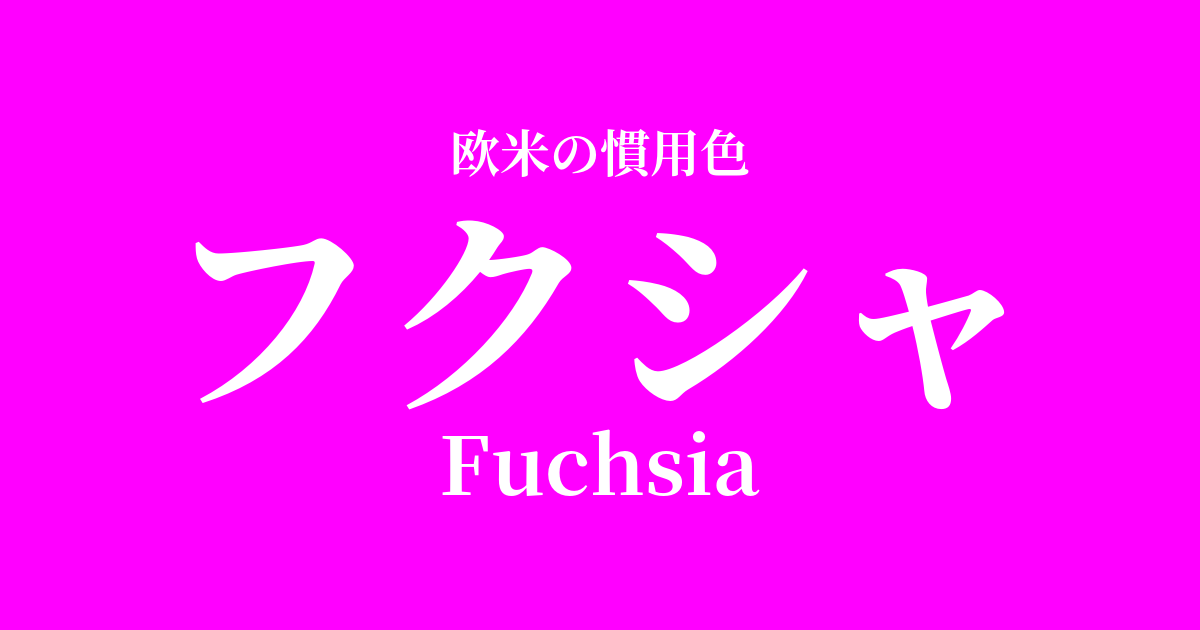
| Original English name | Fuchsia |
|---|---|
| Japanese notation | Fuchsia |
| HEX | #FF00FF |
| RGB | 255, 0, 255 |
What is fuchsia? Origin and etymology
Fuchsia is a vibrant purplish-red color derived from the bright flower color of the fuchsia plant, a member of the Onagraceae family. Pronounced "fuchsia" in English, its striking hue has endeared it to many.
This plant was named in honor of Leonhart Fuchs, a German botanist who was active in the 16th century. The plant, named in his honor, later became the origin of a beautiful color name.
The color name "fuchsia" originates from the synthetic dye "fuchsine," which was patented in France in 1859. This dye was named after the fuchsia flower because its color resembled that of the flower.
Fuchsia is also widely known by the name "magenta." This is an alternative name given to the dye to commemorate the victory of the French-Sardinian coalition at the Battle of Magenta, which took place in the same year, 1859, during the Italian Wars of Unification. Therefore, especially in the digital world, fuchsia and magenta are generally treated as the same color (#FF00FF).
Fuchsia's historical background and culture
In the mid-19th century, advances in chemistry led to the development of numerous synthetic dyes, making vibrant colors that had previously been difficult to achieve with natural dyes readily available. Fuchsia (magenta) was one such dye, and it had a significant impact on the Victorian fashion world.
Its striking colors became a symbol of wealth and cutting-edge technology in a society where subdued color palettes were prevalent at the time. It was particularly boldly incorporated into women's dresses, ribbons, and hats, becoming a fashionable and trendy color that swept the nation.
In the 20th century, fuchsia once again attracted attention in new art movements. In the 1960s, psychedelic and pop art artists favored this surreal and vivid color, conveying powerful messages that broke down preconceived notions by expressing everyday images in bold colors.
In modern times, fuchsia holds an important position as one of the basic colors for web design. It is a color created by mixing red and blue at their maximum concentrations in the RGB color system, and is also an essential element as magenta in the CMYK color system used in printing. From digital to print, it enriches our visual world.
Fuchsia in design and art
In the world of fashion, fuchsia has always been used as a color to express boldness and confidence. In particular, designer Elsa Schiaparelli called this color "shocking pink" and frequently used it as her signature color. Her work brought the elegance and provocative allure of fuchsia to the world's attention.
Even today, it's incorporated as an accent in dresses, coats, and bags, adding glamour and playfulness to outfits. It also remains a popular staple in lipsticks and nail polishes.
In the fields of art and design, fuchsia is effectively used to attract people's attention due to its strong visual impact. In graphic design and advertising, it gives a modern and energetic impression and is a key color that is easily remembered by viewers.
In interior design, incorporating fuchsia into small items such as cushions, rugs, and artwork brings vibrancy and a sophisticated accent to a space. Adding just one fuchsia piece to a simple space based on white or gray can dramatically change the atmosphere of the entire room.
Be a flamingo in a flock of pigeons.
Color scheme preview
This is to check the readability of the text when this color is used as the background.
Fuchsia color scheme proposal
Charcoal Gray (#36454F)
The vibrant fuchsia color is enhanced by the calming charcoal gray. It creates a sophisticated, urban atmosphere, giving a modern and chic impression.
Lime Green (#32CD32)
Two colors that are close to complementary colors enhance each other's saturation. This creates an energetic, vibrant, tropical, and playful impression.
Turquoise (1TP5 T40E0D0)
Fuchsia and turquoise both contain blue pigment, creating a sense of unity. They have an exotic and creative feel, giving a unique impression.
Practical Scenes
If you want to incorporate fuchsia into your fashion, it's best to start with accessories. Adding just one item, such as a bag, shoes, or scarf, can instantly elevate your entire outfit and add a touch of glamour. It pairs particularly well with basic colors like monochrome and navy.
For a bolder look, try making a dress or skirt the focal point of your outfit. In that case, keeping the other items in simple colors will further highlight the beauty of the fuchsia fabric.
In interior design, fuchsia is an ideal accent color that brings personality and energy to a space. Using it in living room cushions or art panels, or in bedroom bed throws, adds warmth and vibrancy to the room.
When using it over a large area, such as wallpaper, incorporating it as an accent wall on just one wall can create a sophisticated space without feeling overwhelming. It looks particularly good in rooms with a white, beige, or gray color scheme.
In web and graphic design, the fuchsia symbol has the power to strongly attract the user's attention. It is particularly effective when used selectively on elements you want to draw attention to, such as purchase buttons or important headlines.
Depending on the brand image, you can use it boldly as the main color to express youthfulness, creativity, and fun. However, using it too much can strain the eyes, so it's important to balance it with a white or light gray background.