
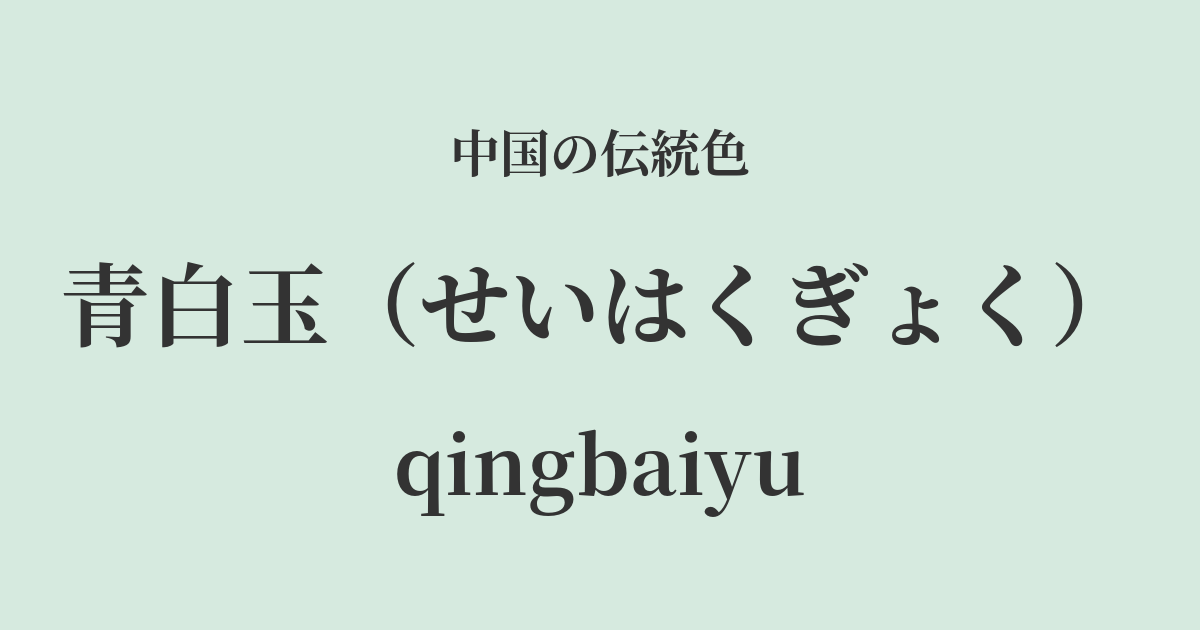
| Color name | Blue and white jade |
|---|---|
| reading | Seihakugyoku |
| pinyin | qingbaiyu |
| HEX | #D6EADF |
| RGB | 214, 234, 223 |
What is Aohakutama? Origin and Etymology
As the name suggests, "seihakugyoku" (青白玉) derives its name from the beautiful color of "gyoku" (玉), which has been revered as a treasure in China since ancient times.
The jade referred to here is mainly nephrite (soft jade) produced in the Hotan region of the Xinjiang Uyghur Autonomous Region. Among these, the milky white variety with a slight bluish or greenish tint is called "qingbai yu" (blue and white jade) and was highly prized as having a quality second only to the pure white, top-grade "yunfen bai yu" (sheep fat white jade).
In ancient China, the Chinese character for "blue" (青) encompassed a wide range of hues, including not only modern blue but also green, gray, and black. Therefore, the pale, greenish-white color of blue-white jade was accurately described as the color of "pale jade." Its lustrous sheen and deep, pure hue gave rise to this elegant color name.
Historical background of blue and white jade
The culture of jade in China dates back to the Neolithic period before the Common Era, and it has always been considered to hold special value throughout successive dynasties.
Especially during the Han dynasty, influenced by Confucian thought, jade came to be a symbol of a virtuous person possessing the five virtues of "benevolence, righteousness, wisdom, courage, and purity," and its value surpassed that of gold and silver. The gentle and elegant hues of bluish-white jade embodied the character that a virtuous person should strive for, and it was deeply cherished by emperors, nobles, and literati.
During the Song Dynasty, a period of great flourishing arts and culture, a unique aesthetic emerged that rejected extravagant ornamentation and valued simple and refined beauty. The quiet and introspective beauty of celadon perfectly matched the spirit of this era, leading to the creation of numerous outstanding jade artifacts.
During the Ming and Qing dynasties, jade carving techniques reached their peak, and blue and white jade was transformed into extremely intricate and complex carvings of figurines, stationery, and jewelry, continuing to shine as collectibles in the imperial court and among wealthy merchants.
Blue and white jade in Chinese art and crafts
The color of blue and white jade has inspired various fields of Chinese art.
First, the blue and white jade itself became the main material for fine arts and crafts. Its uses were diverse, ranging from ceremonial vessels used in religious rituals to brush washers and water droppers adorning the studies of scholars, and even jade pendants and belt hooks worn by the wearer. The smooth texture of the jade and its soft, luminous hue were transformed into magnificent works of art by skilled craftsmen.
In the world of ceramics, "qingbai porcelain" (青白磁), fired during the Song Dynasty, is particularly famous. This porcelain was produced in kilns such as Jingdezhen and is also known as "yingqing" (影青). As the name suggests, it aims to reproduce the clear beauty of celadon in porcelain, and is characterized by its translucent, thin surface and a slightly bluish, transparent glaze.
In fashion culture, pale, elegant greenish-white, like a bluish-white jade, was a favored color for the clothing of the aristocracy and the literary class. It was believed that expressing this color in lustrous silk fabrics created a noble and refined atmosphere, enhancing the wearer's dignity.
Gennen Junzi, Wen Qi Ruyu.
Color scheme preview
This is to check the readability of the text when this color is used as the background.
Blue and white ball color scheme proposal
Peony Mouse (#E8D3D1)
The serene green of the pale blue jade and the soft, warm pink of the peony gray complement each other, creating an elegant and refined impression. It's a calm and dignified color scheme reminiscent of a spring garden.
Tsukihaku (#EAF4FC)
The pure impression of the pale blue jade is further enhanced by the clear, moonlight-like white. This is an extremely delicate and transparent combination, perfect for creating a quiet and dignified atmosphere.
Pilestone (#A44200)
By combining pale, cool bluish-white jade with warm, earthy ochre, a contrast is created, giving a sophisticated yet stable impression. The color scheme evokes the beauty of nature.
Practical Scenes
With its elegant and subdued color, blue and white jade can be used in a variety of modern settings.
In interior design, incorporating this color into wallpaper, curtains, sofas, and other fabrics brings brightness and a calm atmosphere to a space. It harmonizes beautifully with natural wood and tones such as white and gray, creating a sophisticated space in both Japanese and Western-style rooms. Decorating with ceramics or glass items in this color as an accent is also a lovely idea.
In fashion, using this color in items such as dresses, blouses, and scarves brightens the complexion and gives an intelligent and elegant impression. It pairs particularly well with natural materials such as silk, linen, and high-quality cotton, as the texture of the material further enhances the beauty of the color.
In web and graphic design, using it as a background color creates a clean and trustworthy image. It is suitable for minimalist designs, brand websites that want to convey a sense of luxury, and wellness-related content, providing viewers with a sense of security and comfort.