
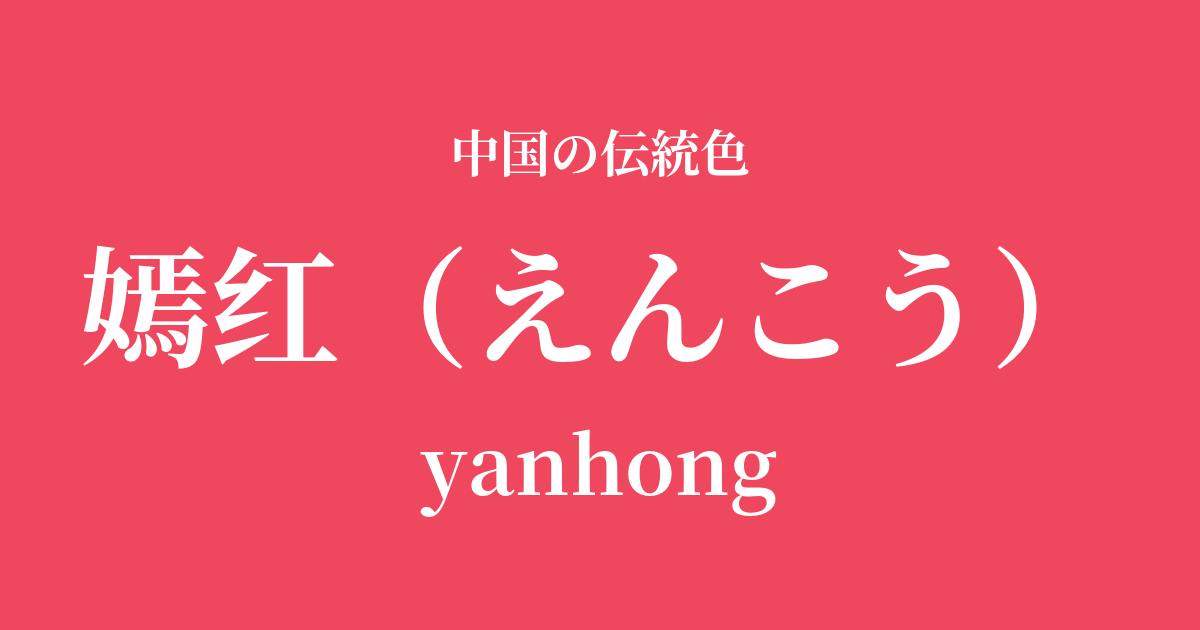
| Color name | red |
|---|---|
| reading | Enkou |
| pinyin | yanhong |
| HEX | #EF475D |
| RGB | 239, 71, 93 |
What is Yan Hong? Origin and etymology
"Yan Hong" is a vibrant red color full of life, reminiscent of a woman's beautiful smile or the luscious color of her lips.
The kanji character "嫣" that makes up this color name, as seen in the phrase "嫣然一笑" (yīnrán yīshǎo), means a woman's beautiful, radiant smile or a dazzling beauty. "红" refers to the color red, so "嫣红" is not simply red, but a color name that embodies a narrative of feminine charm and splendor.
Its origins are thought to be traceable back to the poetry and prose of the Song Dynasty. In particular, during this era when expressions praising the beauty of women became abundant, the aesthetic image of the character "嫣" (yan) became associated with the color red, giving rise to the elegant color name "嫣红" (yanhong).
The historical background of Yan Hong
Vibrant red colors like Yanhong were particularly favored within the sophisticated aristocratic culture from the Tang to the Song dynasties.
Women in the Tang Dynasty favored a type of makeup called "diān li," which involved applying red lipstick, and used various shades of red to enhance their beauty. Bright, vibrant reds like yan hong were thought to symbolize youthfulness and vitality, and were particularly popular among young women.
During the subsequent Song dynasty, aesthetic sensibilities became even more refined, and the word "yan" (嫣) was frequently used in poetry and painting to express the beauty of women. Against this cultural backdrop, "yanhong" (嫣红) transcended being merely a color name and became established as a concept symbolizing ideal feminine beauty. This color was incorporated into the luxurious clothing and exquisite ornaments worn by court ladies, conveying the splendor of that era to this day.
Yan Hong in Chinese Art and Crafts
The beauty of the reddish-brown color can be found in various Chinese works of art and crafts.
In the realm of clothing culture, the vibrant colors of Hanfu, particularly the silk garments worn by women during the Tang and Song dynasties, were utilized. The highly sophisticated dyeing techniques used to create the vibrant red fabrics adorned garments such as jukun (skirts) and jizi (skirts), enhancing the elegance and beauty of the wearer.
In the field of painting, this color can be seen in portraits of beautiful women painted using the Gongbi technique. Artists used yanhong (a type of red pigment) to give the figures a sense of life and attempted to express even the inner emotions and youthfulness of the women by using it as an accent color in the women's luscious lips and clothing.
In the world of ceramics, red glazes reminiscent of Yan Hong were also highly prized. In particular, Jun ware, known for its "kiln transformation" that produces unexpected color changes, sometimes features a deep yet vivid red like Yan Hong amidst its complex colors, making it highly coveted by collectors.
In the snow, what is the gift of Kimibetsu?
Color scheme preview
This is to check the readability of the text when this color is used as the background.
A suggestion for a red color scheme
Moon White (#D1D9E5)
This color scheme features a vibrant red accentuated by a soft, serene moon-white. The contrast between the passionate red and the intellectual bluish-white creates a modern and sophisticated impression.
Sea red (#F2A0A1)
Combining begonia red, which has a similar hue to reddish-brown, creates a harmonious and vibrant gradation. It's recommended for creating a feminine, elegant, and romantic atmosphere.
Matsuka (#B0CE98)
While red and green are close to complementary colors, the calm tones of pine blossom gently complement the vibrancy of red. It gives a lively, natural, and vibrant impression.
Practical Scenes
With its vibrant color and striking presence, the reddish-brown hue makes an effective accent in a variety of settings.
In fashion, incorporating it into items like dresses, blouses, and scarves instantly creates a show-stopping, eye-catching outfit. In particular, pairing it with neutral colors like black, white, and gray further enhances the vibrant beauty of the color. Using it as a lip color is also a classic way to brighten the complexion.
In interior design, it's recommended to use accent colors in small items such as cushion covers, artwork, and vases. This brings energy and warmth to the entire space, creating a modern yet comfortable atmosphere. When using it on large areas like walls, slightly reducing the saturation or choosing textured materials will add depth and tranquility to the space.
In web and graphic design, it's effective to use it for buttons, important headings, and logos that you want to attract the user's attention. Because it's highly visible and has the power to encourage action, it can lead to improved conversion rates. Keeping the background simple allows for a clean and impactful design.