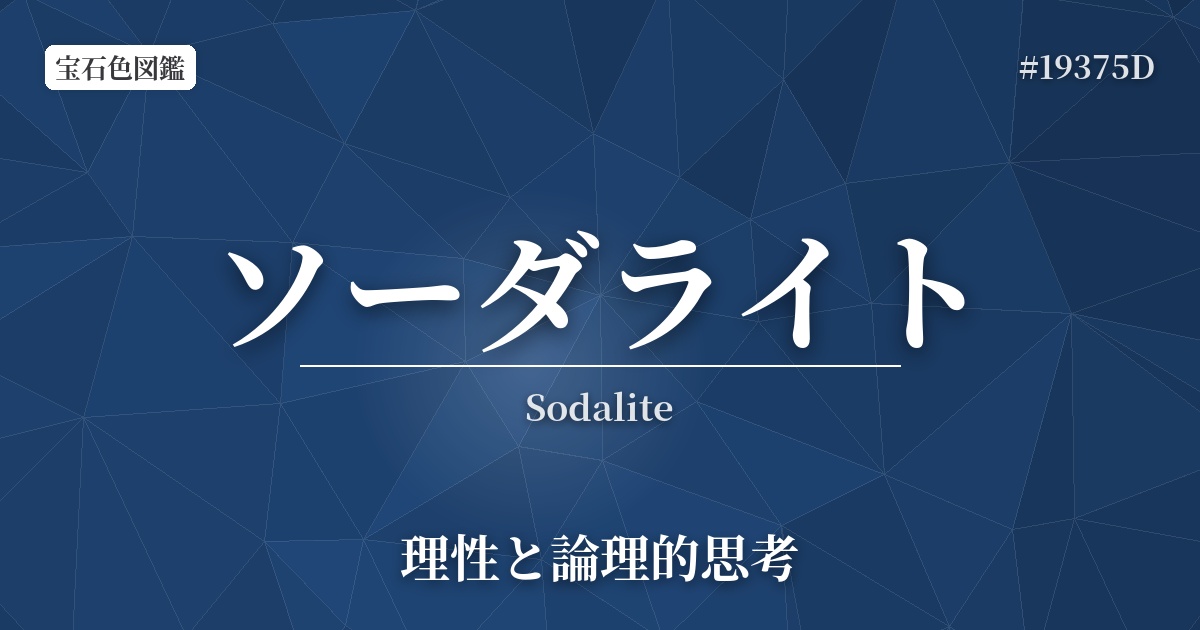
| English name | Sodalite |
|---|---|
| Katakana | Sodalite |
| HEX | #19375D |
| RGB | 25, 55, 93 |
| Mineralogy | Silicate minerals |
What is sodalite? Origin and mineralogy
The name sodalite is a combination of the Greek words "soda," meaning sodium, and "lithos," meaning stone. As the name suggests, it was named because it contains a large amount of sodium (soda) as its main component.
As a mineral, it is a type of silicate mineral and belongs to the "feldspar" group, the same group as lapis lazuli and lazurite. Its Mohs hardness is 5.5 to 6, making it relatively soft among gemstones.
Sodalite is primarily produced in various parts of the world, including Canada, Brazil, Namibia, Russia, Greenland, and the United States. In particular, sodalite from Bancroft, Ontario, Canada, is highly regarded for its beauty.
Because it is one of the main minerals that make up lapis lazuli, sodalite is often confused with it. However, sodalite is a single mineral, and is often characterized by white, streaky calcite inclusions. There is also a rare variety called "hackmanite" that changes color in response to ultraviolet light.
The history and culture of sodalite
Sodalite only recently appeared on the world stage. It was first discovered in 1811 by European scientists in the Irsak complex in Greenland. However, at that time, it was not yet widely known as a material for jewelry.
The discovery of a large deposit of sodalite in Ontario, Canada, in 1891 was the catalyst for its widespread recognition. Furthermore, Queen Mary of the British royal family (wife of George V) was so taken with the stone during a visit to Canada that she used 130 tons of sodalite in the interior of her London residence, Marlborough House, which brought it instant fame. Because of this episode, sodalite is sometimes affectionately known as "Princess Blue."
Sodalite and color psychology
The deep, calming navy blue of sodalite symbolizes intelligence, composure, and trust. This color, reminiscent of the night sky or the deep sea, is said to have a calming effect, soothing heightened emotions and promoting inner peace. It can enhance concentration and help you discern the true nature of things.
As a power stone, sodalite is considered the "stone of reason and logical thinking." It is said to help organize confused thoughts and emotions, and guide you toward achieving realistic goals. It has also been cherished as a charm that facilitates self-expression and communication, and helps build trusting relationships with others.
Color scheme preview
This is to check the readability of the text when this color is used as the background.
Sodalite color scheme proposals
Slate Gray (#708090)
This combination gives an intelligent and sophisticated impression. The deep blue of sodalite and slate gray harmonize to create a modern, urban atmosphere. It's perfect for business settings and formal designs.
Sandy Brown (#F4A460)
The combination of deep blue and warm brown creates a sense of both trustworthiness and approachability. Earth tones, when combined, create a natural and calming atmosphere and fashion.
Antique White (#FAEBD7)
The contrast between deep navy blue and soft off-white creates a classic and elegant impression. This timeless and elegant color scheme exudes cleanliness while also conveying warmth.
Practical Scenes
As jewelry, its subdued color makes it popular with both men and women. It is used in a wide range of items, including tie clips and cufflinks for men, and pendants and bracelets for women. It pairs particularly well with silver and platinum, which enhance the stone's deep blue color.
In the field of interior design, as evidenced by historical anecdotes, it is sometimes used as a decorative stone. Incorporating it into tabletops, wall accents, or small items such as doorknobs brings a sense of luxury and tranquility to a space. It is ideal as an accent color in places where you want to spend time quietly, such as a study or bedroom.
In web and graphic design, it is effective when you want to convey trustworthiness and expertise. Using it as a corporate color for a company or as a key color for an academic website can convey an intelligent and sincere image.