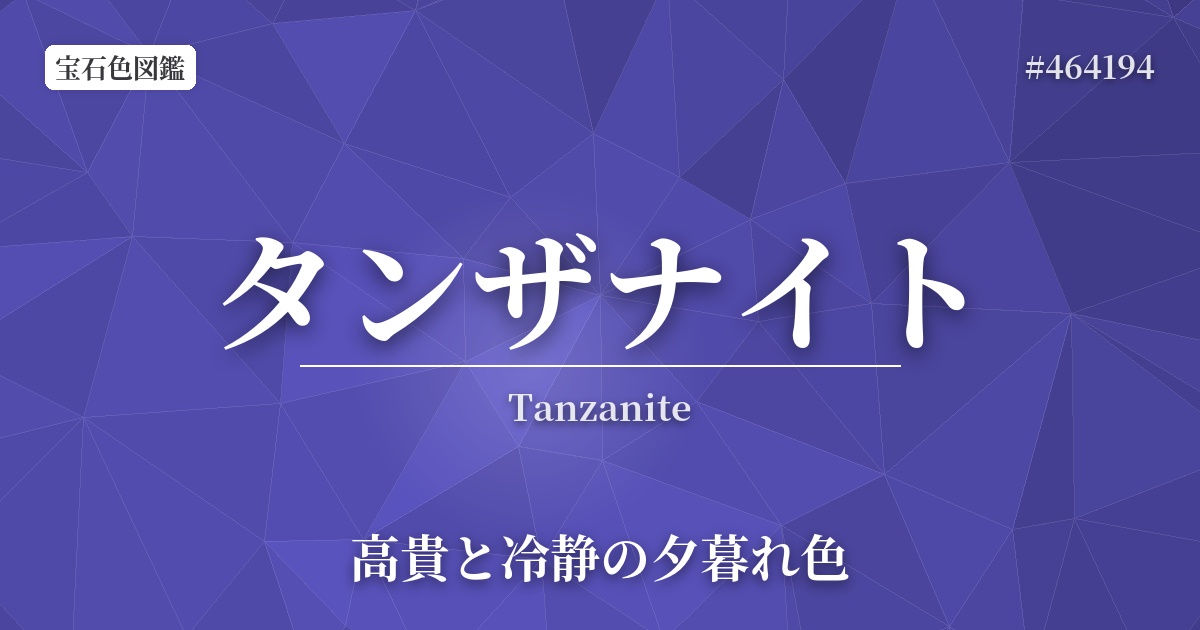
| English name | Tanzanite |
|---|---|
| Katakana | Tanzanite |
| HEX | #464194 |
| RGB | 70, 65, 148 |
| Mineralogy | Silicate minerals |
What is Tanzanite? Origin and Mineralogy
As its name suggests, tanzanite is a gemstone discovered in Tanzania, Africa. It is said to have been accidentally found in 1967 by a Maasai shepherd near the Merelani mine. The world-renowned jewelry brand Tiffany & Co. named this beautiful gemstone "tanzanite" in honor of its place of origin and introduced it to the world.
Even today, tanzanite is an extremely rare gemstone, as it is only mined on a commercial scale at the Merelani mine in Tanzania. This limited availability further enhances the value of tanzanite.
Mineralogically, it is a type of mineral called "zoisite," and only those that exhibit blue to purple hues are specifically called "tanzanite." This beautiful color comes from the vanadium contained in the mineral.
The most captivating characteristic of tanzanite is its "pleochroism," which means its color changes depending on the viewing angle and type of light. From the front, it displays a noble blue; from a different angle, it reveals an intelligent purple, and sometimes even a reddish hue, emitting a mystical glow as if the shifting colors of the twilight sky were captured within a single stone.
The history and culture of tanzanite
The history of tanzanite is relatively recent compared to many other gemstones, beginning with its discovery in 1967. While it's not associated with ancient civilizations or royal jewelry, it instead made a spectacular debut as a "20th-century gemstone."
After its discovery, Tiffany & Co. recognized its extraordinary beauty and launched a major promotion, causing tanzanite to quickly captivate people all over the world. Tiffany described the stone's unique bluish-purple color as "the night of Tanzania," establishing its romantic image.
Despite being a relatively new gemstone, its popularity and beauty led to its inclusion as the December birthstone by the American gem industry in 2002. This was a major revision since the birthstones were established in 1912, demonstrating the significant importance of tanzanite in modern times.
Tanzanite and Color Psychology
The deep blue-violet color of tanzanite is a blend of "blue," which symbolizes calmness and intelligence, and "violet," which symbolizes nobility and sensitivity. For this reason, it is said to have the effect of calming the viewer's mind and enhancing calm judgment and intuition. It will gently guide your mind when you are facing complex problems or seeking creative inspiration.
As the keywords "the twilight color of nobility and serenity" suggest, tanzanite is believed to bring calmness and dignity to its wearer. Because it soothes mental turmoil and stimulates intellectual curiosity, it has long been treated as a highly spiritual stone. It is also popular as a talisman that illuminates the path forward and guides one toward the right choices during life's turning points.
Color scheme preview
This is to check the readability of the text when this color is used as the background.
Tanzanite color scheme proposals
Silver (#C0C0C0)
The cool, sophisticated shine of silver further enhances the calm and intellectual aura of tanzanite. This sharp combination creates a refined, modern, and urban impression.
Misty Rose (#FFE4E1)
The mystical blue-violet of tanzanite is complemented by the soft pink of misty rose, adding gentleness and warmth. This color combination is perfect for creating an elegant and romantic atmosphere.
Ivory (#FFFFF0)
The warm white of ivory gently envelops the noble hue of tanzanite. This combination exudes elegance, composure, and a classic, timeless charm.
Practical Scenes
In jewelry design, tanzanite is cut to maximize its pleochroism. It is particularly popular as a necklace or earring to elevate formal attire. However, because it is fragile, if you choose a ring that will be worn daily, it is best to select a design that protects the stone.
In interior design, incorporating tanzanite as an accent color brings depth and a sense of luxury to a space. Using this color in cushions, artwork, or rugs can add an intellectual atmosphere to places where you seek tranquility, such as a study or bedroom.
Tanzanite is also effective in the fields of fashion and web design. In fashion, incorporating it into accessories such as dresses and scarves creates a mysterious and elegant impression. On websites, using it as a key color for services that you want to convey trustworthiness and expertise can give users a sophisticated impression.