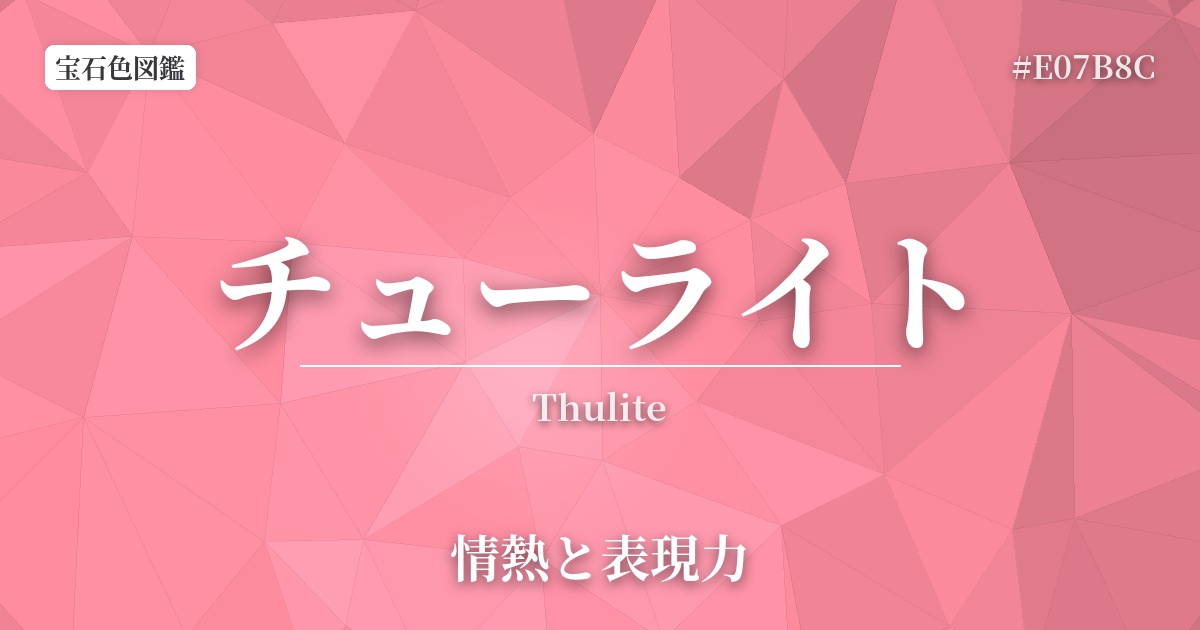
| English name | Thulite |
|---|---|
| Katakana | Thulite |
| HEX | #E07B8C |
| RGB | 224, 123, 140 |
| Mineralogy | Silicate minerals |
What is thulite? Origin and mineralogy
Thulite is a gemstone that, mineralogically, belongs to the group called "zoisite," and its beautiful pink to reddish-purple hues are created by the presence of manganese. Because of this characteristic, it is also called "pink zoisite." In fact, tanzanite, a well-known gemstone, is also a member of the same zoisite family, and they are like relatives, exhibiting different colors due to differences in their chemical composition.
The name Thulite originates from Norway, where the stone was first discovered in 1820. It was named after Thule, the legendary land of the farthest reaches of the world, which appears in ancient Greek and Roman texts. This name pays homage to the Scandinavian Peninsula where it was discovered.
While its primary source is Norway, where it was discovered, it has also been reported to be found in various other locations around the world, including Australia, South Africa, and North Carolina in the United States. However, gem-quality specimens are rare.
With a Mohs hardness of 6 to 6.5, it falls into the somewhat delicate category for jewelry. Furthermore, it possesses a property called "cleavage," meaning it tends to break easily in certain directions, so care should be taken to avoid strong impacts.
The history and culture of Thulite
Thulite has a relatively recent history, having been discovered in the 19th century, and therefore is not found in the ornaments of ancient civilizations. However, in Norway, the country where it was discovered, it is treated as something special and is cherished by the people as the national stone.
Due to its captivating colors, it has been used in jewelry and ornaments since its discovery. In particular, it is often cut into cabochons to highlight the stone's color and pattern, and has been popular as a material for pendants, brooches, and sculptures. Even today, its unique colors continue to fascinate many designers and collectors.
Thulite and Color Psychology
Thulite's vibrant raspberry pink is said to symbolize vitality, passion, and overflowing love. Just looking at it brightens the heart and seems to give off positive energy.
As the gemstone's keywords, "passion and expressiveness," suggest, it has long been believed to help its owner express themselves and bring out their hidden charm and talent. It is also said to be a talisman that facilitates communication and brings warmth and joy to relationships. It is a gentle presence that supports those who wish to express their thoughts and feelings honestly.
Color scheme preview
This is to check the readability of the text when this color is used as the background.
Thulite color scheme proposal
Dove Gray (#6D6F6E)
The vibrant pink of the thulite is elegantly complemented by the calming gray, creating a sophisticated and mature impression. This color scheme is recommended when you want to create a modern and stylish atmosphere.
Pistachio (#93C572)
The natural contrast reminiscent of flowers and leaves creates a vibrant and fresh impression. The pistachio green gently envelops the affectionate nature of thulite.
Navy Blue (#000080)
The vibrant pink of the thulite stands out against the deep navy blue, creating a dramatic and luxurious impression. It's an impressive color combination that exudes confidence and elegance.
Practical Scenes
In the world of jewelry, thulite is commonly used to create cabochon-cut rings, pendants, and earrings, taking advantage of its unique color. Due to its opaque nature, many designs showcase the beauty of the color itself and the white patterns visible within. It is also sometimes processed into beads and used in bracelets.
Its beautiful pink color is also used as an accent in interior design. When used in small sculptures, decorative items, or inlays on tabletops, it can add warmth and elegance to a space.
In web and graphic design, this color is effective as a theme color to express love, gentleness, and self-esteem in products and wellness-related services aimed at women. In particular, when combined with neutral gray or beige, it can create a sophisticated atmosphere that is not overly sweet.