
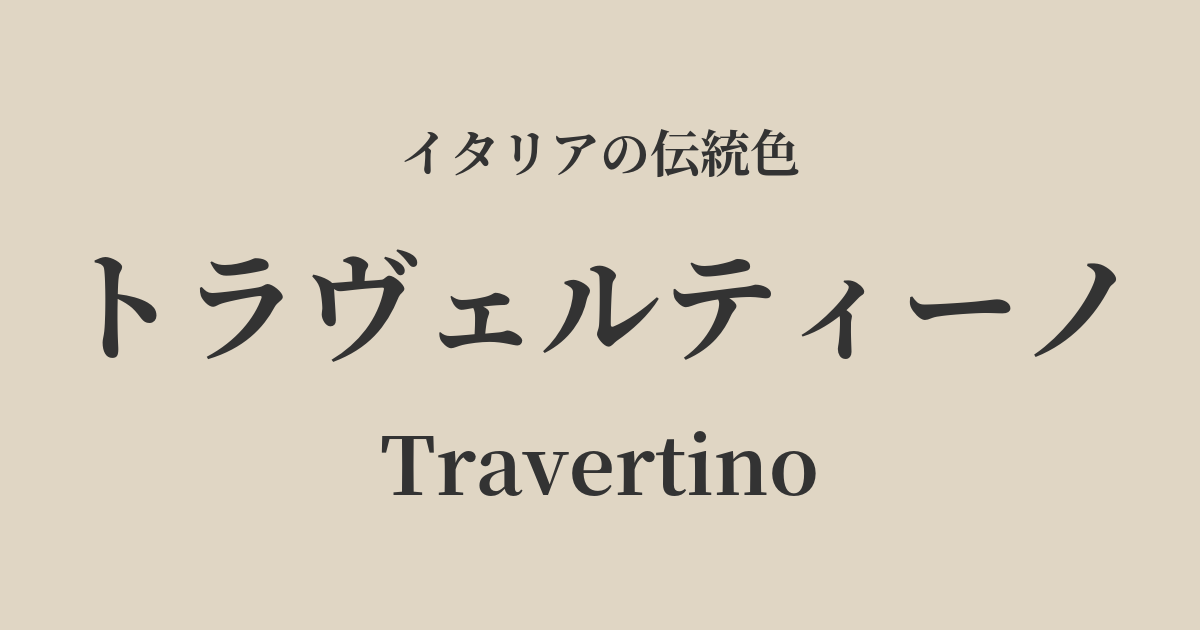
| Italian original name | Travertino |
|---|---|
| Japanese notation | Travertino |
| HEX | #E0D6C4 |
| RGB | 224, 214, 196 |
What is a Travertino? Origin and Etymology
Travertino is an Italian word meaning "travertine," a type of limestone. As the name suggests, this color represents the warm, soft beige hue of this stone, which is quarried in Tivoli, near Rome.
The name has ancient origins, tracing back to the Latin "lapis tiburtinus," meaning "stone of Tibur (present-day Tivoli)." Over time, the word evolved and it came to be called "travertino." This porous stone, sometimes exhibiting striped patterns, possesses a unique texture created by nature, and its colors evoke both tranquility and a sense of historical weight.
Historical background of Travertino
The history of travertine is deeply intertwined with the history of ancient Rome itself. From the time of the Roman Republic onward, this stone was widely used as the primary material for public buildings such as temples, aqueducts, and amphitheaters.
The most iconic example of this is the Colosseum in Rome. Much of the outer wall of the massive amphitheater is made of travertine, and its pale beige color still brings a sense of grandeur and harmony to the Roman cityscape, even after two millennia.
Travertine stone remained a favorite among architects throughout the Renaissance and Baroque periods. For example, it was used extensively in the magnificent colonnade of St. Peter's Square designed by Bernini, and it has remained a fundamental color that underpins the beauty of Italian architecture across generations.
Travertine in Italian Culture and Art
The colors of Travertino stone are, first and foremost, closely related to architectural art. The natural hues and textures of the stone itself give the building's facade a delicate interplay of light and shadow, creating an impression that is both substantial and light.
It was also used as a material for sculpture. Baroque sculptors, in particular, took advantage of travertine's ease of processing and warm texture to create numerous statues and fountains that adorned churches and squares.
In the world of painting, this color scheme is thought to have been reproduced as the color of walls and ground when depicting ancient buildings and ruins in frescoes and other art forms. Even today, its elegant and timeless hue is favored in interior design and fashion to express a sophisticated and natural style.
Color scheme preview
This is to check the readability of the text when this color is used as the background.
Travertino's color scheme proposal
Terra di Siena (#E2725B)
This combination of earth tones, both originating from the earth, creates a warm, calming, natural, and comfortable harmony, resulting in a peaceful and relaxing space.
ヴェルデ・マリーナ (#3D9970)
The contrast between the beige stone and the deep green evokes the gardens of ancient Roman villas. It gives an intelligent, classical, yet vibrant and sophisticated impression.
ポンペイ・ロッソ (#D21F3C)
The neutral Travertino beautifully complements the vibrant Pompeii Rosso. Enjoy a dramatic and elegant color scheme reminiscent of ancient Roman frescoes.
Practical Scenes
In interior design, Travertino is an extremely popular color. When used on walls, floors, or countertops, it creates a bright and calming atmosphere throughout the space. It pairs exceptionally well with natural materials such as wood, metal, and linen, and harmonizes with a wide range of styles, from minimalist to classic.
In the world of fashion, incorporating this color into trench coats, knitwear, and linen shirts gives an elegant and sophisticated impression. It's a versatile neutral color that goes well with any other color, while its historical background adds depth to your outfit.
In web and graphic design, using this color as a background can gently enhance content and create a calm, eye-friendly screen. It is suitable for luxury brands, lifestyle websites, and architecture-related sites.