
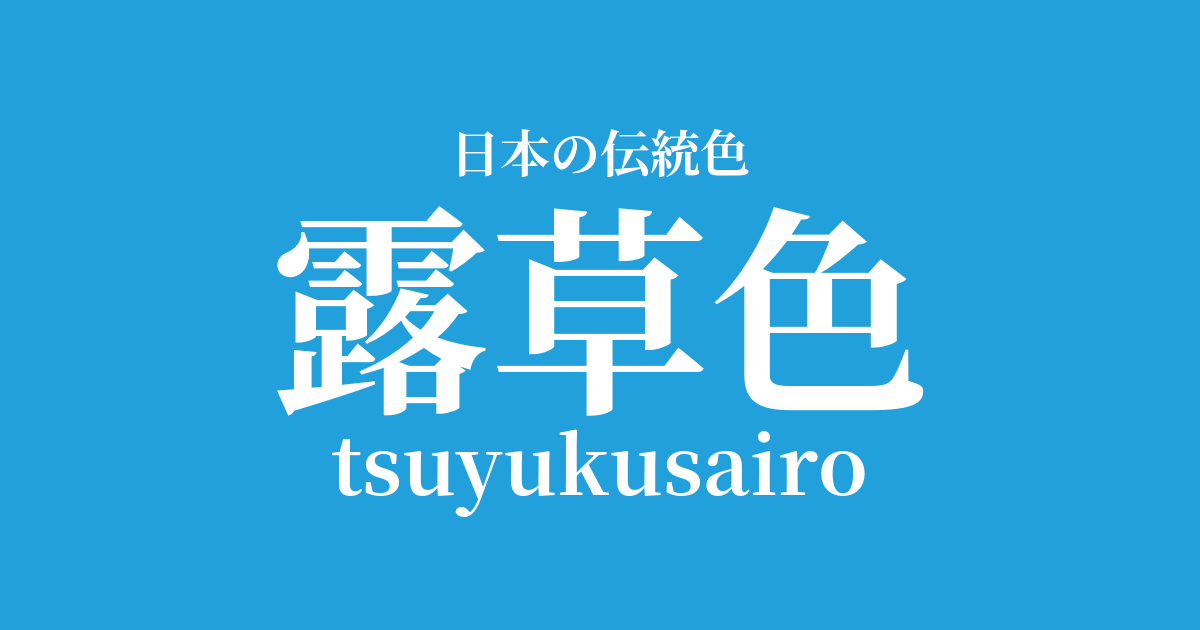
| Japanese color name | dew grass color |
|---|---|
| reading | tsuyukusairo |
| HEX | #21A0DB |
| RGB | 33, 160, 219 |
What is "dewdrop color"? Origin and etymology.
Tsuyukusa-iro (dayflower blue) is a bright, vivid blue color derived from the juice extracted from the petals of the dayflower. The dayflower is an annual plant belonging to the Commelinaceae family that grows wild along roadsides and in grasslands throughout Japan, blooming with distinctive blue flowers from summer to autumn. In the past, people picked these flowers and rubbed them onto cloth or paper to dye fabrics, hence the name of the color. It is also known by many other names, such as "Tsukikusa" (moon grass), "Aobana" (blue flower), and "Boushibana" (hat flower).
The dayflower blue dye is very prone to fading, as its color easily washes out when wet and is also sensitive to sunlight. For this reason, it was considered a symbol of something that is difficult to fix as a dye and is easily changed. On the other hand, this property was utilized, as it could be easily washed away with water, making it a valuable pigment for drawing underpaintings for Yuzen dyeing. In particular, the "Aobana-shi" paper from Kusatsu in Omi Province (present-day Shiga Prefecture) was known as the highest quality and was an indispensable element in traditional dyeing techniques.
The historical background of the dayflower color
The color of dayflower blue is one of the oldest colors, and its name appears as "tsukikusa" (moon grass) in the Manyoshu, a collection of poems compiled during the Nara period. It was a familiar plant to the people of that time, and it can be inferred from waka poems that the blue color of its flowers was used to dye clothing. However, as mentioned earlier, the color does not set easily, so it is possible that it was used for temporary dyeing or as a form of entertainment.
During the Edo period, as Yuzen dyeing techniques developed, dayflower blue established itself as a pigment for underpainting. Its water-washable properties made it extremely useful in the process of creating complex patterns. It is also said to have been used by commoners for dyeing yukata and other garments, and it is believed to have served as a substitute for the expensive and durable indigo dye. Its ephemeral beauty was also linked to the aesthetic sensibilities of Edo.
Related literature, waka poetry, and seasonal words
Due to its fleeting nature, the color of the dayflower has been depicted in literature as a symbol of transience and impermanence. The Manyoshu anthology contains the poem, "I will dye my clothes with dayflower, even though they will fade after being wet with morning dew," which compares the easily fading color of the dayflower to the fickleness of human hearts and the transience of love. In haiku, "dayflower" and "dayflower" are considered seasonal words for autumn, and their appearance, wet with morning dew, is often depicted as an element that deepens the autumnal atmosphere.
I will dye my clothes with moonflower, though they will fade after being wet with morning dew.
Color scheme preview
This is to check the readability of the text when this color is used as the background.
A suggested color scheme in dayflower green.
Depressed gold color (#FAB529)
The vibrant blue of the dayflower and the bright yellow of the turmeric are close to complementary colors, making each other stand out. This color scheme gives a lively and energetic impression, and can create a classic yet modern atmosphere.
White green (#D6E9CA)
This color scheme evokes the natural landscape of dayflowers coexisting with the green of their leaves. The soft, gentle green of the white-green tones down the vividness of the dayflower's color, creating a refreshing and cool impression. It is suitable for creating a natural and comfortable space.
Silver mouse (#AFB1B4)
By combining it with a bright, achromatic silver-gray, the vibrancy of the dayflower blue is highlighted. It gives a sophisticated, urban impression and creates a cool, calm atmosphere. This color scheme is suitable for modern designs.
Practical Scenes
In the world of traditional Japanese clothing, the dayflower color is especially often used for yukata, summer kimonos, and accessories such as obiage (sash ties). Its cool hue gives a refreshing feel to summer attire and leaves a pleasant impression on the viewer. It is a classic combination with white and is widely used in everything from classical patterns to modern designs.
In interior design, it is most effective when used as an accent color. Incorporating dayflower blue into cushion covers, curtains, or art panels brings brightness and freshness to the entire space. It pairs particularly well with natural spaces based on white, beige, and wood tones.
In web and graphic design, its high saturation and brightness make it suitable for buttons, links, and headings that you want to attract attention. It is also suitable as a brand color for corporate websites that want to convey trustworthiness and cleanliness, as well as for soft drinks and IT-related services.