
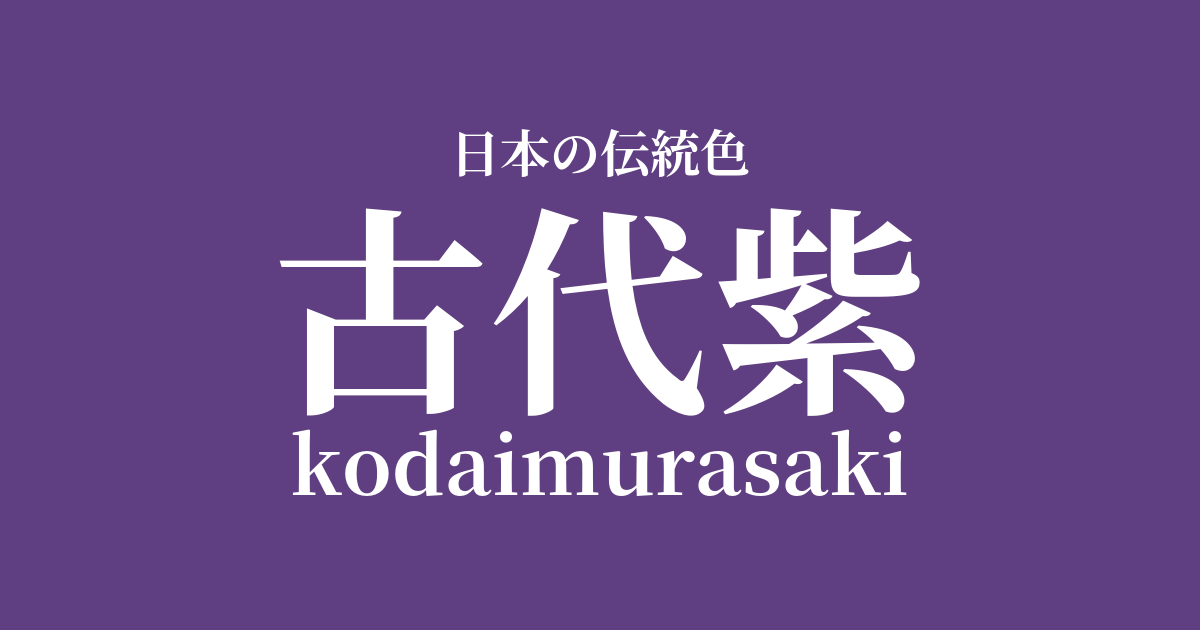
| Japanese color name | ancient purple |
|---|---|
| reading | kodaimurasaki |
| HEX | 1TP5 T5F3F81 |
| RGB | 95, 63, 129 |
What is ancient purple? Origin and etymology
Ancient purple is a color dyed using "shikon," the root of the purple gromwell plant (Murasakisou), a member of the Boraginaceae family. Shikon has long been known as a valuable dye, and its cultivation and dyeing required advanced techniques and effort. As a result, purple was extremely expensive, and only people of a certain social status could wear it. The name "ancient purple" is thought to have been given in later times to refer to the deep, subdued purple hue obtained by this ancient dyeing method.
Its color is characterized by a dark purple with a slight reddish tint.
Historical background of ancient purple
Purple was adopted as the color representing the highest rank, "Daitoku," in the "Twelve Levels of Court Rank" (603 AD) established by Prince Shotoku during the reign of Empress Suiko. As a result, purple became a forbidden color that could only be used by emperors, members of the imperial family, and the highest-ranking nobles, establishing its status as a symbol of nobility and authority. Its value remained unchanged even into the Heian period, and detailed regulations concerning the cultivation of gromwell and dyeing can be found in the "Engishiki" (a compilation of laws and regulations from the Heian period).
As the samurai rose to power, a preference for brighter shades of purple emerged, but the understated elegance of ancient purple was passed down as a cornerstone of Japanese aesthetics.
Related literature, waka poetry, and seasonal words
Purple has appeared in many literary works since ancient times, and has been particularly used as a color to symbolize love and nobility. The Manyoshu contains numerous poems about purple gromwell, and among them, Princess Nukata's famous poem expresses feelings of love by comparing it to a field where purple gromwell is cultivated. Also, in the "Young Murasaki" chapter of The Tale of Genji, from which the protagonist Hikaru Genji's name is derived, the fateful encounter with Lady Murasaki is depicted, and purple plays an important role throughout the entire story.
While "ancient purple" is not a direct seasonal word, "purple grass" and "purple field" are sometimes used as seasonal words for summer.
On the way to Murasakino, the way to Shimeno, the field guardian does not see you waving your sleeve.
Color scheme preview
This is to check the readability of the text when this color is used as the background.
Ancient purple color scheme proposal
White training (#E3E3E3)
This color scheme, where the nobility of ancient purple is enhanced by the pure and innocent white, is a combination seen in ancient ceremonies and attire, such as the Twelve Levels of Court Rank, and gives a solemn and dignified impression. It is suitable for expressing sanctity and dignity.
Blue gold (#FABE29)
Turmeric yellow is a vibrant yellow dyed with gardenia or turmeric, and its combination with ancient purple, considered a noble color, is an elegant color scheme also seen in the "layered color combinations" of Heian period aristocratic attire. The two colors complement each other, creating an impression that is both vibrant and refined.
Light green (#A9D159)
Moegi-iro (light green) is a vibrant green reminiscent of the fresh leaves of spring. When combined with ancient purple derived from the gromwell plant, it expresses the beauty of nature and the changing seasons. A touch of youthfulness is added to the calmness, creating a refined Japanese atmosphere.
Practical Scenes
Ancient purple, with its noble and subdued hue, is often used for special occasions. In kimonos and obi sashes, it is favored for formal wear and high-class tea ceremonies, enhancing the wearer's dignity. In interior design, incorporating it into accent walls, cushions, and accessories can add depth and a sense of luxury to a space. It harmonizes well not only with Japanese-style rooms but also with modern spaces, creating a quiet and contemplative atmosphere.
In web and graphic design, it is effective when you want to express a brand's reliability, tradition, and sense of luxury. Using it as the main color can sometimes create an overly heavy impression, so using it as an accent color or part of the background color can give a more refined impression. It is particularly well-suited to websites featuring traditional crafts, luxury inns, and historical sites.