
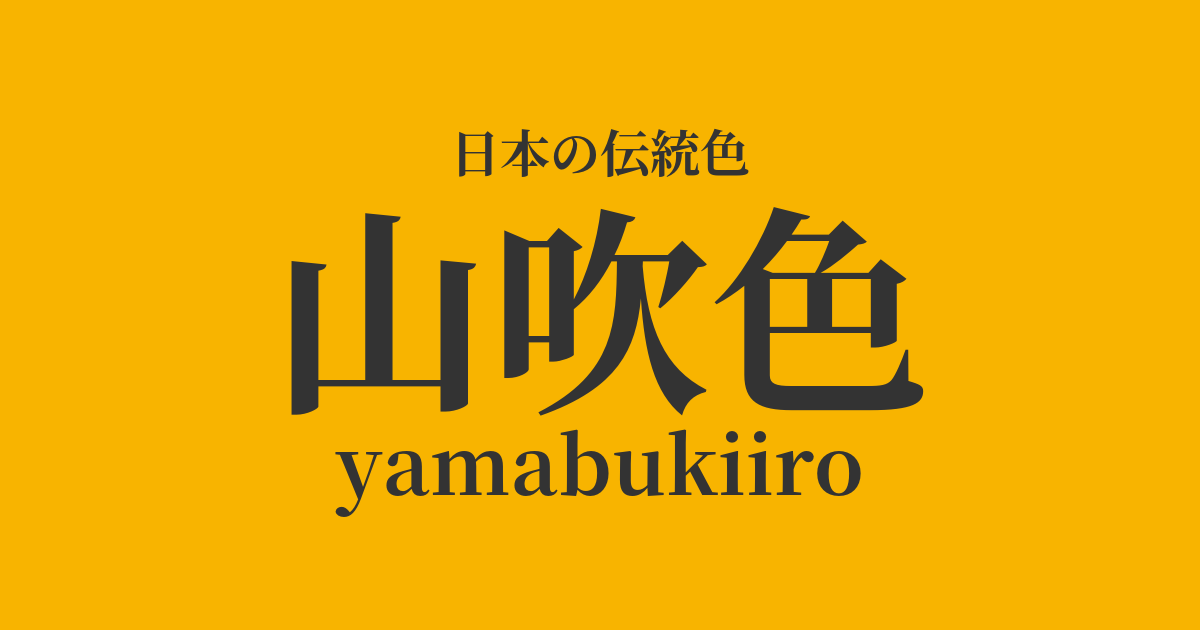
| Japanese color name | Yellow |
|---|---|
| reading | yamabukiiro |
| HEX | #F8B400 |
| RGB | 248, 180, 0 |
What is Yamabuki-iro (Japanese kerria yellow)? Origin and etymology.
Yamabuki-iro refers to a bright, reddish-yellow color, like the flower of the yamabuki, a deciduous shrub belonging to the rose family. Its name is said to originate from the expression "yamaburi," which describes the way its supple branches sway in the wind. The prevailing theory is that this "yamaburi" later transformed into "yamabuki." It has long been native to the mountains and fields of Japan and has been cherished as a flower that heralds the arrival of spring.
Furthermore, the vibrant yellow of the Japanese kerria flower is reminiscent of gold and gold coins, and has long been considered a symbol of wealth. For this reason, it is sometimes also called "golden yellow." As an auspicious color, it was used in celebratory clothing and furnishings, and has become established as a color that brings splendor and prosperity to people's lives.
The historical background of the golden yellow color
Yamabuki (golden yellow) was already a widely known color in aristocratic society during the Heian period. Its name appears in classical literature such as "The Tale of Genji," conveying to us the richness of the color sense of the people of that time. Furthermore, "yamabuki" is also found in "kasane no irome," a system of color combinations for clothing, and it is recorded that it was used for spring attire, with the outer layer being a withered leaf color and the inner layer a yellow.
With the advent of the Edo period, advancements in cotton dyeing techniques made yamabuki (golden yellow) a popular color among common people. The previously expensive dye became more affordable, and various everyday items such as kimonos, hand towels, and curtains were adorned with this vibrant color. Its bright and cheerful hue can be said to have symbolized the vibrancy of Edo's townspeople's culture.
Related literature, waka poetry, and seasonal words
The Japanese kerria flower and its color have long been the subject of many Japanese poems. The Manyoshu anthology contains the poem, "As the mountain drizzle begins, I wonder if the spring rain will not fall heavily so that I may stay here," depicting a traveler captivated by the beauty of the kerria. Its vibrant colors have always inspired the creativity of poets.
One particularly famous anecdote concerns Ota Dokan, a samurai from the Muromachi period. When Dokan was caught in the rain on his way back from a falconry trip, he went to a farmhouse to borrow a straw raincoat, but the daughter silently offered him a branch of yellow rose. Dokan was angry because he didn't understand the meaning, but he later realized that it was a reference to a poem by Prince Kaneakira in the Goshūi Wakashū anthology, "Though the yellow rose blooms in seven or eight layers, it is sad that there is not a single fruit," conveying his poverty by saying "not even a raincoat."
In the world of haiku, "yamabuki" (Japanese kerria) is used as a seasonal word for spring. Matsuo Basho's haiku, "Yamabuki flutters softly, the sound of the waterfall," contrasts the quiet sound of the waterfall with the falling petals of the yamabuki, depicting a beautiful scene woven from movement and stillness. In this way, the color yamabuki has played an important role in expressing Japanese aesthetics and a sense of the seasons through literary works.
Though the flowers bloom in seven or eight layers, it is sad that there is not a single fruit in the Japanese kerria.
Color scheme preview
This is to check the readability of the text when this color is used as the background.
Suggested color scheme in golden yellow
Dark blue (#001A43)
The vibrant golden yellow is contrasted by a deep, rich indigo, making each color stand out. This creates a classic and dignified impression, and is a traditional color combination often seen in kimono pairings.
Tokiwa color (#007B43)
A natural color scheme reminiscent of Japanese kerria flowers and evergreen leaves. It expresses a vibrant spring scene and gives a lively impression. Suitable for Japanese-style designs and interiors.
Color produced (#FBFBF4)
The soft, creamy white gently complements the vibrant golden yellow, creating an elegant and bright impression. This color scheme balances cleanliness and warmth, making it suitable for natural and modern spaces and designs.
Practical Scenes
In the world of traditional Japanese clothing, the golden yellow color is widely used in everything from furisode (long-sleeved kimono) and houmongi (formal visiting kimono) to accessories such as obi (sash) and obiage (sash tie). It is especially favored for spring attire and celebratory occasions, and has the power to create a bright and vibrant atmosphere. Its striking color can be the main focus or an accent in an outfit.
In interior design, incorporating it as an accent in cushion covers, curtains, or art panels brings warmth and vibrancy to a space. It pairs very well with natural materials such as wood and tatami mats, contributing to the creation of a modern Japanese-style space. Painting just one wall in this golden yellow color is also an effective technique.
In web design and graphic design, golden yellow is used as a color that attracts attention. Because it gives a bright and positive impression, it is suitable as an accent color for call-to-action buttons and headings. Its high visibility makes it effective when used in areas where you want to draw the user's attention.