
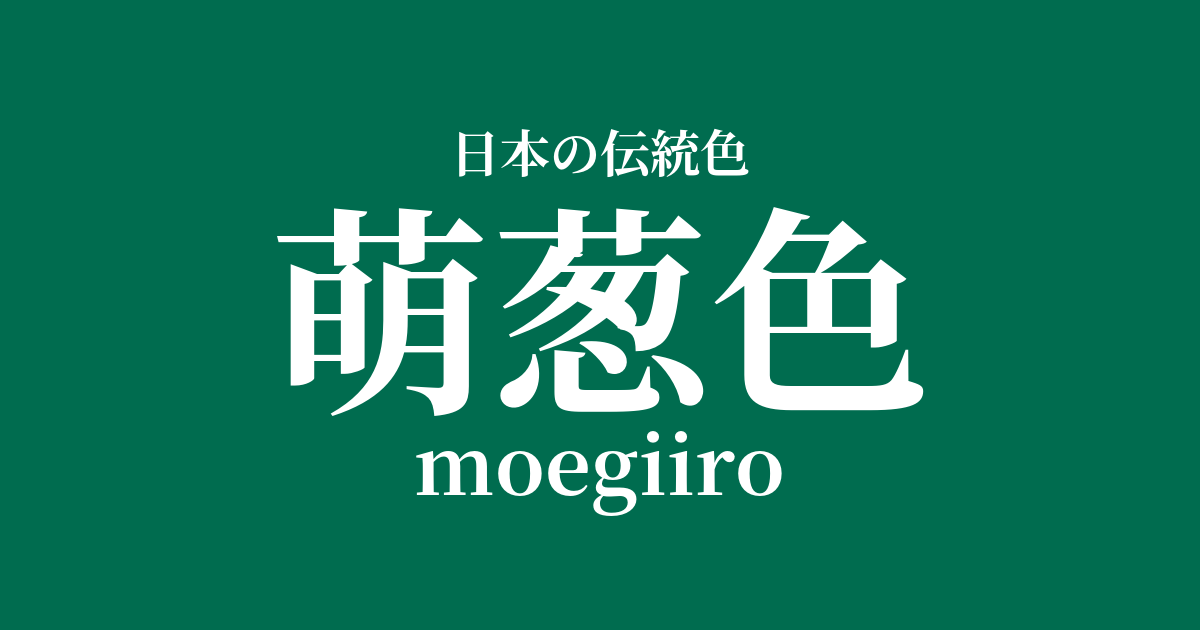
| Japanese color name | green onion color |
|---|---|
| reading | moegiiro |
| HEX | #006C4F |
| RGB | 0, 108, 79 |
What is "Moegi-iro" (a type of greenish-brown color)? Origin and etymology.
Moegi-iro refers to a vibrant, bluish-green color, like the young shoots of green onions that sprout in early spring. The name combines the word "moederu" (to sprout), which evokes the breath of life, with the plant "negi" (green onion), symbolizing youthful vitality. It is often confused with "moegi" (yellowish-green), but while moegi is a yellowish-green, moegi-iro is said to be a deeper, more bluish shade.
In the past, this beautiful green color was said to have been achieved by combining indigo with yellow dyes such as Japanese knotweed.
The historical background of the light green color
The color "moegi" (萌黄) originated in the Heian period and was widely accepted in aristocratic society as a color symbolizing youth. It appears as "moegi" in the Engishiki (a set of regulations compiled in the Heian period), indicating that it was also stipulated as a color for official clothing at the time. Its fresh, vibrant hue was particularly favored by young people who had just come of age, as well as boys and girls.
From the late Heian period to the Kamakura period, this color was particularly popular among the samurai class. It is known to have been frequently used in the hitatare (a type of formal robe) and odoshige (lacing) of armor, as a color representing the vitality and bravery of young warriors. Many war chronicles, such as "The Tale of the Heike," depict young warriors clad in light green armor, conveying the aesthetic sensibilities of the samurai of that time.
Related literature, waka poetry, and seasonal words
Light green is a color that plays a symbolic role in classical Japanese literature, particularly in war tales. The most famous example is the depiction of the young warrior Taira no Atsumori in "The Tale of the Heike." Atsumori, who was killed by Kumagai Naozane at the Battle of Ichinotani, is described as wearing "armor of light green scent." This light green color highlighted his youth and tragic fate, leaving a deep impression on readers of later generations.
Furthermore, in Heian literature such as "The Tale of Genji," the color "moegi" (light green) is often used to represent youthful characters. Although "moegi" is rarely used directly as a seasonal word, its color is deeply associated with other spring seasonal words such as "wakakusa" (young grass) and "shinryoku" (fresh greenery), and in the world of waka poetry, it is often thought of as a background color when composing poems about the vitality and hope of spring.
Color scheme preview
This is to check the readability of the text when this color is used as the background.
A color scheme proposal in light green.
Coral color (#F88379)
The vibrant green of the light green and the warm color of the coral complement each other beautifully. This color scheme evokes spring flowers and gives a lively and vibrant impression. It is also suitable for designing Japanese clothing and accessories.
Blue gold (#FABE00)
Combining a vibrant green like sprout green with a bright turmeric color creates a youthful and lively impression. This traditional color scheme, also seen in the attire of Heian period aristocrats, achieves a balance between elegance and brightness.
White training (#FEFEFE)
When combined with pure white, the vibrancy of the light green color stands out even more, giving an impression of cleanliness and elegance. The contrast is clear yet harmonious, making it a color scheme that can be easily applied to modern designs.
Practical Scenes
In the world of traditional Japanese clothing, light green is used to express youthfulness in furisode (long-sleeved kimono), houmongi (formal visiting kimono), and accessories such as obiage (kimono sashes). It is especially favored for spring attire, adding a touch of color to celebratory occasions. Due to its historical background, it also pairs very well with classical patterns.
In interior design, using it as an accent color brings vitality and tranquility to a space. Incorporating it into cushion covers or parts of wallpaper can create a Japanese modern atmosphere. It also harmonizes well with the natural tones of wood.
In web and graphic design, its vibrant green color attracts attention and is often used for buttons and important headlines. It has a strong affinity with content themed around nature, the environment, tradition, and growth, and can convey both trustworthiness and vitality at the same time.