
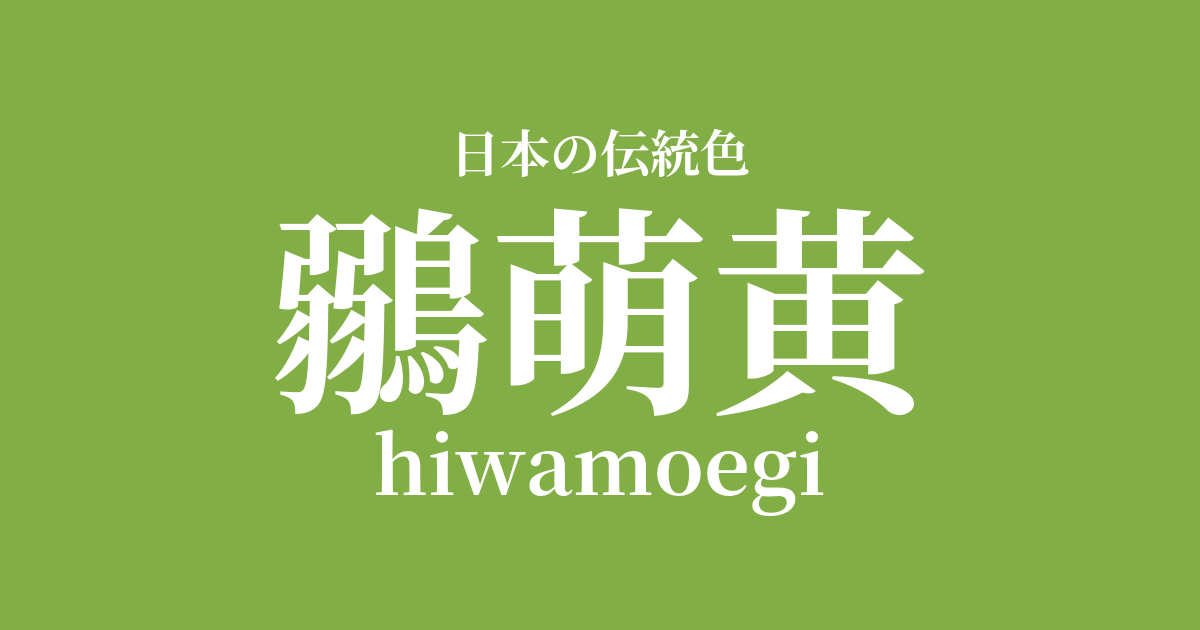
| Japanese color name | 鶸萌えぎ |
|---|---|
| reading | hiwamoegi |
| HEX | #82AE46 |
| RGB | 130, 174, 70 |
What is "Hiwamoegi"? Origin and etymology
Hiwa-moegi is a vibrant yellowish-green color derived from the feather color of the male siskin, a small bird belonging to the finch family. Among the various shades of "moegi" (light green), which refer to the color of young leaves sprouting in spring, this particular shade is especially yellowish and bright, and is distinguished by the name "hiwa." It is said that in traditional dyeing, this beautiful color was mainly achieved by dyeing a fabric yellow with Japanese knotweed (kariyasu) and then layering a light indigo dye on top.
This color name is one that reveals the Japanese sensibility in accurately capturing and naming the beautiful colors of the natural world.
Historical background of the Japanese name "Hiwamegi"
The color name "hiwamegi" (yellowish-green) has existed since the Heian period and is said to have been particularly favored by young people. It appears in the classical literary work "The Tale of Genji," where it is depicted as a color symbolizing youthfulness and vitality. From the Kamakura period onward, it was also used in the attire of samurai, and "The Tale of the Heike" describes young warriors of the Minamoto clan wearing armor in this yellowish-green color. This suggests that it also played a role in standing out on the battlefield as a color representing youth and vigor.
During the Edo period, it became popular as a kimono color among commoners and was widely cherished as a color that brightened up spring.
Related literature, waka poetry, and seasonal words
The yellow-green color, known as "moegi-nioi," appears frequently in classical literature due to its youthful appearance. In the "Wakana" chapter of "The Tale of Genji," there is a scene where Yugiri, the son of Hikaru Genji, wears a yellow-green outfit, effectively symbolizing his youth and future potential. Furthermore, in "The Tale of the Heike," it is recorded that many young warriors, such as Taira no Atsumori and the Sato brothers, Tsugunobu and Tadanobu, retainers of Minamoto no Yoshitsune, wore armor in the "moegi-nioi" color, strongly highlighting its role as a symbolic color for young warriors.
These descriptions reveal that the image of vitality and hope associated with this color has been deeply rooted in people's hearts since ancient times.
The light green robes of the swan's feathers become even more vibrant as spring arrives.
Color scheme preview
This is to check the readability of the text when this color is used as the background.
A proposed color scheme for yellow-green.
Cherry blossom pink (#FEEAFA)
This vibrant color scheme evokes the fresh leaves and cherry blossoms of spring, exuding a sense of vitality. The vividness of the yellow-green is complemented by the gentle hues of cherry blossom pink, creating a calm yet elegant impression. It is suitable for traditional Japanese clothing and spring event designs.
Kutsuha color (#917347)
This combination expresses the changing colors of nature, from fresh green leaves to withered leaves. The vibrant yellow-green is balanced by the calm brown of faded leaves, creating a deep and stable color scheme. It can be applied to interior design and autumn fashion.
Lapis Lazuli (#1F4788)
These colors are close to complementary colors, and they have the effect of making each other stand out strongly. The brightness of the yellow-green and the deep blue of the lapis lazuli create a strong contrast, resulting in a lively and impressive design. This is effective when you want to attract attention, such as on websites or in advertisements.
Practical Scenes
In the world of traditional Japanese clothing, yellow-green is used in furisode, houmongi, and komon kimonos to express youthfulness and the feeling of spring. It is especially often incorporated into the kimonos of young women and in accessories such as obiage and obijime. Combining it with other flower colors can create an even more vibrant look.
In interior design, using it as an accent color gives the entire room a bright and refreshing impression. Incorporating it into cushion covers, curtains, and art panels brings vitality and a refreshing effect to the space. It also goes well with the natural color of wood and blends well with Scandinavian and Japanese modern styles.
In web and graphic design, it is effective as a background color for buttons and banners that you want to attract attention because it gives a bright and positive impression. It has high compatibility with content themed around nature, health, and ecology. When used as a main color, combining it with white or light gray can improve readability while maintaining a clean look.