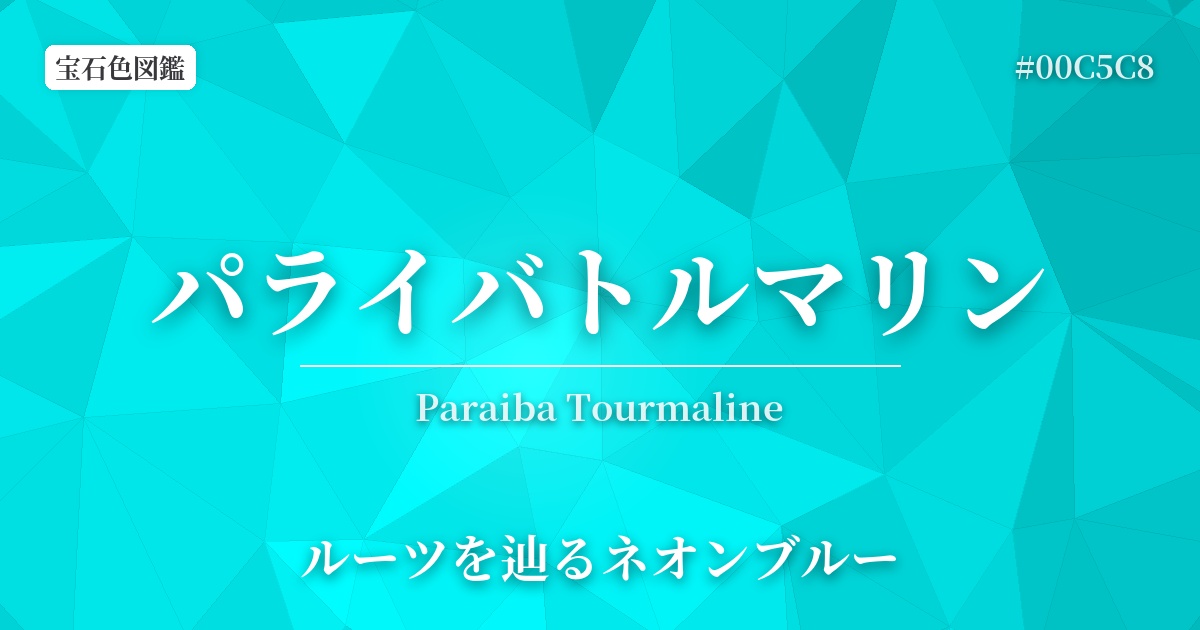
| English name | Paraiba Tourmaline |
|---|---|
| Katakana | Paraiba Tourmaline |
| HEX | #00C5C8 |
| RGB | 0, 197, 200 |
| Mineralogy | Silicate minerals |
What is Paraiba tourmaline? Origin and mineralogy
The name Paraiba tourmaline originates from the Brazilian state of Paraíba, where it was first discovered in the 1980s. As a mineral, it is classified as "elbaite," a type of tourmaline (electric stone) that exhibits a wide range of colors. Among these, only those that contain trace amounts of copper (Cu) and manganese (Mn) and exhibit a uniquely vivid neon blue to green color are called Paraiba tourmaline.
This unique color is accompanied by a strong brilliance that seems to emit light from within, and is sometimes described as "electric blue." Initially, the term referred only to tourmaline from Brazil, but later, similar copper-containing tourmaline was found in Mozambique and Nigeria in Africa, and now, regardless of the origin, blue tourmaline with a distinctive neon color derived from copper is identified as Paraiba tourmaline.
Its production volume is extremely small, and it is said that the mines in Paraíba, Brazil, where it was first discovered, have already closed down. Due to its rarity, it has even come to be called the "phantom gem." Large, gem-quality rough stones are rarely found, and most are small, but even a single tiny stone exudes an overwhelming presence.
The history and culture of Paraiba tourmaline
The history of Paraiba tourmaline is relatively recent compared to many other gemstones. In the late 1980s, in the Brazilian state of Paraíba, a miner named Hayter Dimas Barbosa continued his persistent search for many years, driven by the belief that "something special must be found." And finally, he discovered a tourmaline with a vivid neon blue color that no one had ever seen before.
First introduced at the Tucson Gem Show in the United States in 1989, its stunning beauty instantly captivated buyers and collectors worldwide. Within a short period of its discovery, its price skyrocketed, and it came to be recognized as a gemstone comparable to, or even surpassing, the four historically significant gemstones (diamond, ruby, sapphire, and emerald). Despite being a relatively new gemstone, its dramatic discovery story and unique color have secured it a brilliant place in the history of gemstones.
Paraiba Tourmaline and Color Psychology
The striking neon blue of Paraiba tourmaline is said to have a powerful impact on the viewer, stimulating inspiration and creativity. Its color, reminiscent of a tropical sea, is believed to liberate the mind and encourage free self-expression. It can help break free from preconceived notions and outdated values, fostering new perspectives and ideas.
The keyword for this gemstone, "Neon Blue Tracing Your Roots," symbolizes confronting your origins and true nature. It is like a light that illuminates your journey to listen to your inner voice and discover your own truth and talents. It is believed that wearing it as a talisman during life's turning points or when starting new challenges will give you positive energy and courage to embrace change.
Color scheme preview
This is to check the readability of the text when this color is used as the background.
Paraiba Tourmaline Color Scheme Proposal
Champagne (#F7E7CE)
The delicate, elegant hue of champagne beautifully complements the vibrant neon blue of the Paraiba tourmaline. This color combination achieves both sophisticated luxury and a relaxed atmosphere.
Slate Gray (#708090)
By combining it with a calm slate gray, the modern appeal of Paraiba tourmaline is highlighted. The resulting color scheme gives an urban, stylish, and intellectual impression.
Coral (#FF7F50)
The cool tones of neon blue and the warm tones of coral create a beautiful contrast. This combination gives off a vibrant, energetic, playful, and tropical impression.
Practical Scenes
In jewelry design, Paraiba tourmaline is treated as something special due to its rarity and beauty. Rings and pendants surrounded by diamonds bring out its neon color to the fullest, giving the wearer glamour and elegance. Even small stones emit a powerful sparkle, making them effective as accents in earrings and bracelets.
In interior and product design, using this color as an accent brings a modern and luxurious atmosphere to the entire space. For example, incorporating this color into cushions, art panels, or glass products will draw the eye and add depth and vibrancy to the space.
In the world of web design and graphic design, its high visibility makes it ideal for logos, buttons, and headlines that you want to attract attention. It also works well with brand images that want to express innovation and uniqueness, leaving a strong impression on users.